

15 Middle Eastern Foods You Have To Try At Least Once
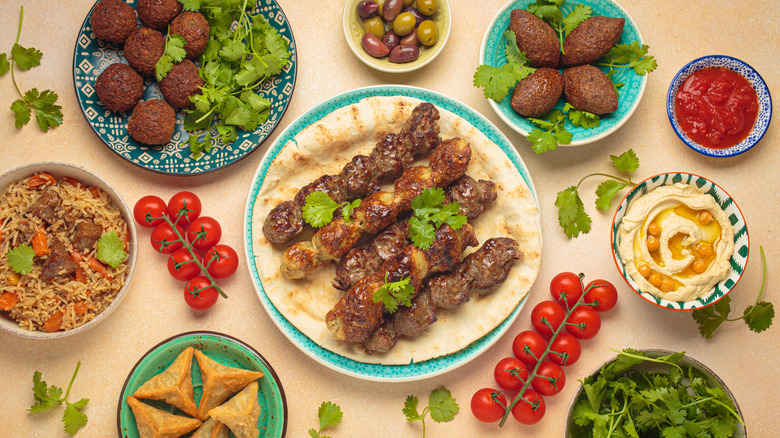
The Middle East is one of those terms that is used frequently in daily life, yet is rarely well-defined. Is Türkiye included? Georgia? Afghanistan? Especially when it comes to food, there's much overlap and repetition, certainly on or near the borders of what purportedly defines this region. As such, for this piece, we're using a relatively wide interpretation, including Türkiye to the north, Iran to the east, the Arabian Peninsula to the south, and North Africa to the west. That said, many of the most iconic Middle Eastern dishes either originated or were popularized in what's traditionally known as the Levant, corresponding roughly to modern-day Israel, Lebanon, Syria, and Jordan.
Perhaps the most important concept in Middle Eastern cuisine is the mezze (or meze) platter. Derived from the Persian word "maza" (meaning to taste), mezze is a collection of dishes that serve as meal starters or shared plates. Now recognizable items like hummus, falafel, and tabbouleh are key to a proper mezze and are the perfect way to kick off our exploration of Middle Eastern foods everyone must try.
Hummus
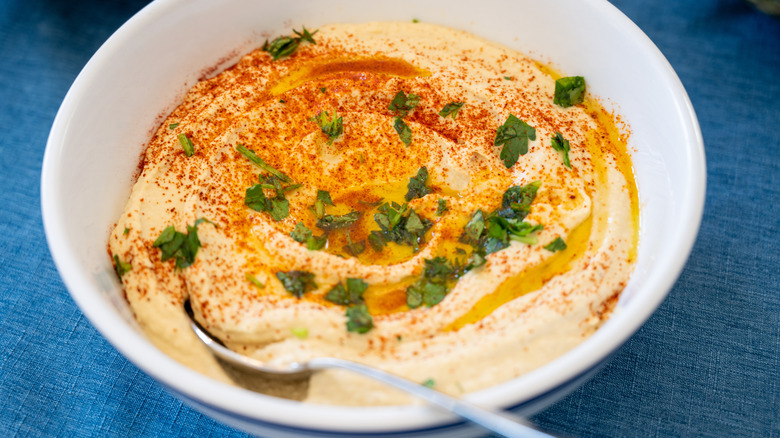
Once a niche foodstuff in the U.S., hummus has become ubiquitous. It's the best entry point into this list of must-try Middle Eastern foods, especially for someone who hasn't tried it already. Often considered the centerpiece of the mezze platter, no Middle Eastern feast would be complete without hummus.
True hummus uses a base of chickpeas (or garbanzo beans), and the term itself is derived from the Arabic word for chickpea. In the traditional recipe, garbanzos are blended with tahini — a paste of pure sesame seeds — along with garlic, lemon juice, and usually olive oil. That being said, creative-minded chefs have more recently taken to using other beans, calling their dish something like white bean hummus, or adding diverse flavorings such as chocolate or fall-inspired pumpkin hummus.
In traditional Middle Eastern cuisine, the dish is eaten on its own with a fork or spoon, can be scooped with a pita, or used as a sandwich spread. In the U.S., however, it has transformed into more of a dip, to be gathered up with pita pieces, of course, but also with vegetables, chips, and more.
Falafel
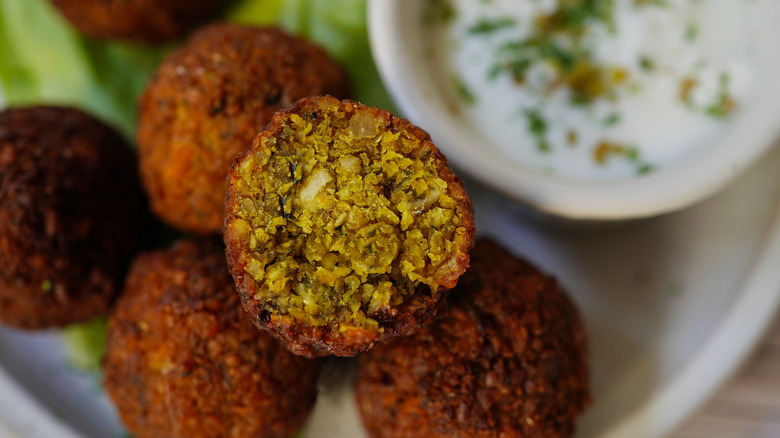
Falafel is another chickpea-based dish. In this case, the legumes are mixed with flour, garlic, onions, herbs, and spices, then formed into balls and deep fried. Proper falafel is crispy on the outside but soft within, rich and savory without overwhelming the palate. The fritters are typically served on sandwiches, wrapped in fluffy flatbread alongside tahini or yogurt-based sauces and vegetables, but can also be included in a mezze or similar platter.
Falafel probably started as a fava bean-based dish in Egypt, where it was known as ta'amiya. Legend even claims that Napoleon's troops were familiar with ta'amiya, but when they were unable to find fava beans, they substituted chickpeas. (This is probably apocryphal.) Today in Egypt, fava beans are still used, often blended with chickpeas, while in Israel, it is more common to find 100% chickpea-based falafel. In the U.S., chickpeas are also the bean of choice.
Tabbouleh
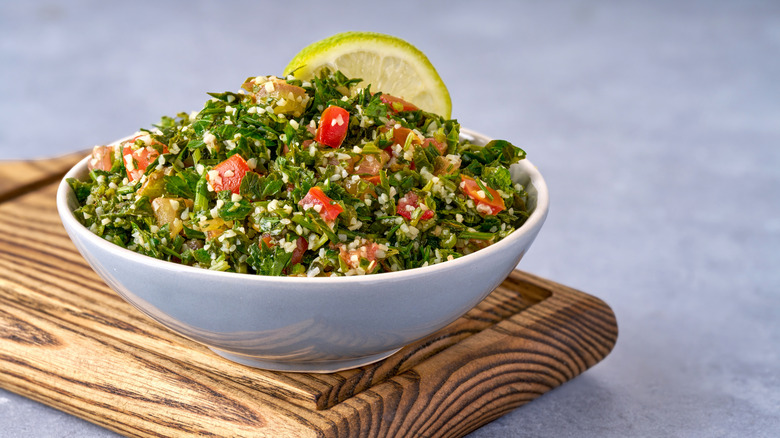
An herb salad made primarily from flat-leaf parsley with a bit of bulgur added for texture, tabbouleh is arguably the most famous and beloved Middle Eastern salad. It's incredibly bright in flavor — aggressively so, in fact — considering all that raw parsley, tomato, and onion, and the tangy lemon dressing. As such, it is particularly well-suited as a topping for richly flavored sandwiches, such as shawarma or falafel, or as part of a mezze platter featuring the same. That said, it is often eaten on its own, traditionally scooped with romaine lettuce, but today also eaten with a fork.
Tabbouleh has a long history, with some food historians believing a dish like it was eaten as far back as 5,000 years ago in the mountains around the Bekaa Valley. As such, there are quite a few varied tabbouleh recipes across the Levant region, as well as many spellings, including tabouli, taboulah, and tabooley. (The name derives from the Arabic word tabil, meaning seasoning or spice.)
Baba ganoush
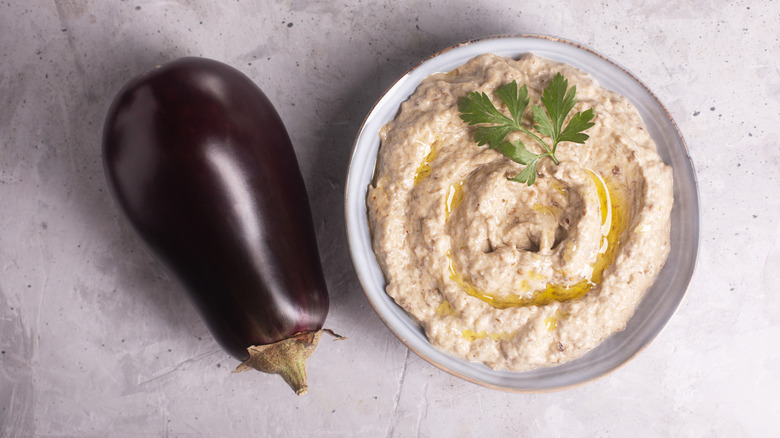
Another dip-like dish that stars in the mezze, baba ganoush is made primarily of eggplant, specifically one that has been roasted over open coals to give it a pronounced smokiness. The vegetable can also be roasted in the oven, but that may not produce as much charred flavor, so some modern recipes even call for a dash of liquid smoke to make up for the loss. The eggplant is roasted until it's falling apart, then mixed, like hummus, with tahini and lemon juice to form a silky smooth paste, which is typically served chilled or at room temperature. Well-made baba ganoush is not only smoky, but also lemony and creamy, perfect for layering on pita triangles or scooping up with vegetables or chips.
As for the name, legend suggests the moniker translates to "pampered daddy" and that the dish was a favorite of sultans going back centuries. The dip is also known as moutabel in other parts of the Middle East, but the ingredients largely remain the same. Finally, though baba ganoush is not nearly as popular as hummus in the U.S., tubs of it can often be found in the same supermarket aisle. (That said, roasting fresh eggplants over coals yourself will always bring the best flavor.)
Shawarma
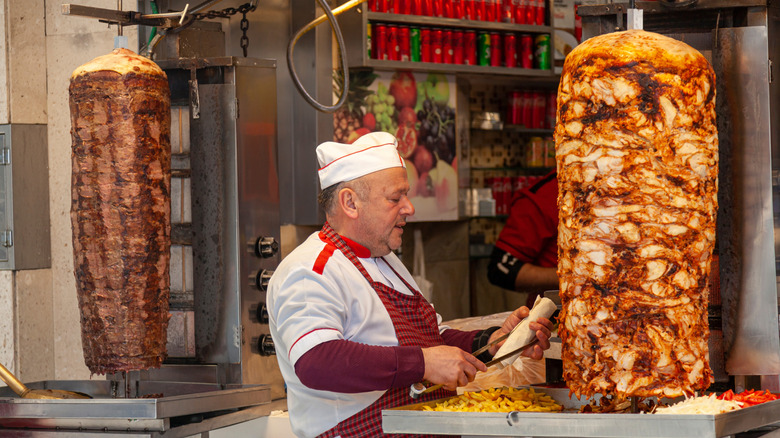
Shawarma is arguably the most iconic Middle Eastern food, at least from a visual standpoint. It's that vertical skewer — surely you've seen it — that holds a conical piece of indistinguishable meat and is often found hanging conspicuously in the window of street food eateries. This is not, of course, an individual cut of meat, but is instead a conglomeration of different layers that have been mixed with garlic, onion, and a variety of spices. When one has a hankering, the shawarma man (or woman) will slice thin pieces on demand from the outside of this large kebab, then layer them on flatbread or a platter with a variety of sauces, vegetables, and pickled options.
Shawarma is often said to have originated in Türkiye, where a butcher in the city of Bursa came up with the idea to remove the bones from meat and cook it slowly on an upright spit. This way, the meat basted itself in its own juices, and he could slice it as needed. In Türkiye, this dish is known as döner kebab, meaning "rotating kebab," while in Syria, Jordan, and Lebanon, it became known as shawarma, an Arabic word meaning "to turn." It is also similar to the Greek gyro, a word which has the same meaning. The most traditional shawarma uses lamb, though it can also be beef, chicken, or perhaps a mix of multiple meats, and the spices vary by maker.
Lahmacun
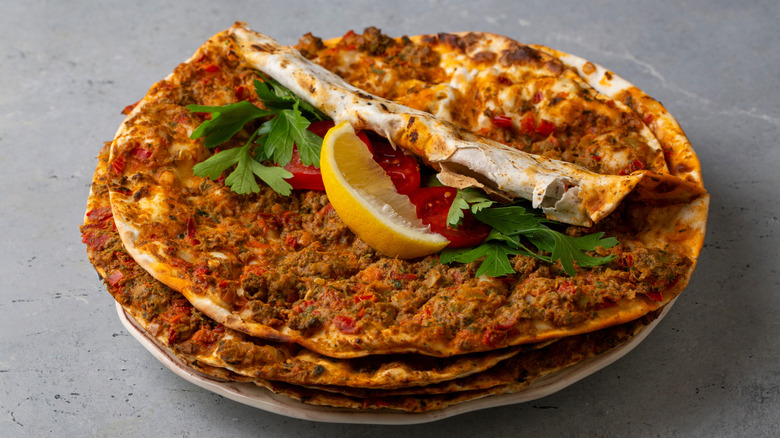
Often called Armenian pizza, lahmacun is a round, thin flatbread that's topped with a spiced — sometimes spicy — meat mixture. The bread itself is extremely thin, with a crispy, crackly texture, but not so much so that it can't be folded and eaten like other flatbreads or pizzas. The topping is typically made from lamb, beef, or a combination of the two, mixed with tomatoes, sweet or spicy peppers, and onions. The dish is often finished with a squeeze of lemon. Lahmacun — pronounced "lah-ma-joon" and sometimes spelled lahmajun — is not aggressively topped; one pound of meat, for example, can supply around 12 servings. The flatbread itself is as thin as the toppings, but the dish is still rich, hearty, and satisfying. Though cheese is not a part of the traditional recipe, some modern makers do include it, perhaps as a nod to lahmacun's Italian cousin.
Though it is today considered an Armenian dish, similar and possibly related flatbreads do appear across the Middle East. There's no consensus on lahmacun's origins, and in fact, it has striking similarities to flatbreads from Türkiye, Syria, and other places. In the U.S., however, one typically needs to find a local Armenian bakery or restaurant to source modern lahmacun.
Kibbeh
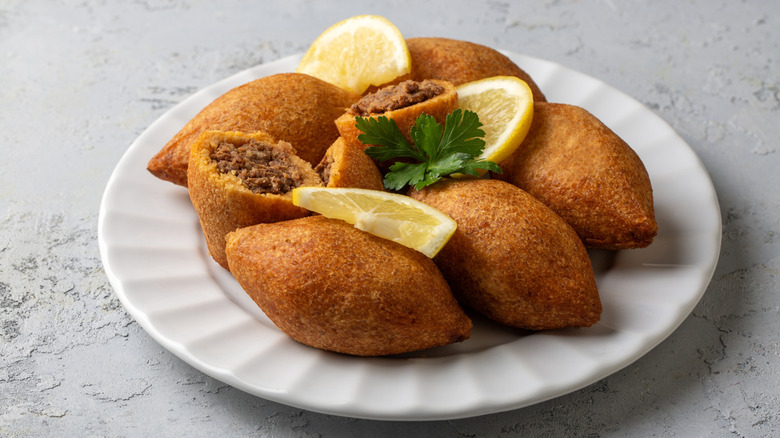
At its most basic, kibbeh is a ground meat patty that's mixed with bulgur, sometimes onions and spices, then shaped into a torpedo and fried. But kibbeh is also so much more than that, and, in fact, better described as a category of food than a specific recipe. For one, in addition to frying, it can be baked, grilled, boiled, and even eaten raw. Though traditionally made with goat or lamb, it can also feature beef, chicken, or be vegetarian or vegan. A canvas for culinary invention, modern kibbeh can include a wide variety of herbs, spices, and many other flavorings.
The preparation is particularly popular in both Lebanon and Syria, and is often said to be the national dish of both. Many believe foods similar to kibbeh have been made in the Levant region for centuries, and documentation traces as far back as the Assyrian Empire. This Middle Eastern food is without a doubt one of the most significant dishes — if not the most important — today in Levantine cuisine.
Shakshuka
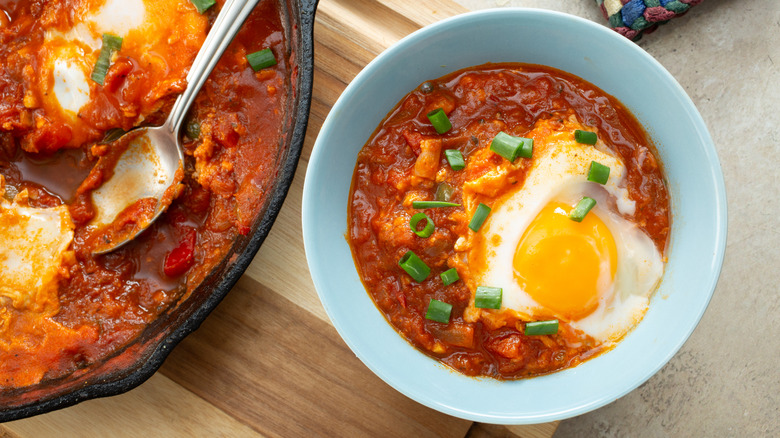
Like many profiled here, shakshuka is more of a framework than a specific recipe, featuring a wide variety of interpretations. In its most basic form, the dish is made from eggs poached in a tomato and pepper sauce — sweet, spicy, or both — with onions, garlic, and other herbs and spices. The most traditional version is red shakshuka (with tomatoes and red peppers), though there's also yellow and orange shakshuka, featuring the peppers of these colors. There's also a green rendition, with spinach and herbs, and even humshuka, made with hummus. Regardless of the specific variant, the dish is traditionally served at breakfast, offering a savory, spicy, and complex bite.
The word shakshuka comes from the Berber language, meaning "mixture," and the dish originated in Northern Africa, in either modern-day Tunisia or Libya. In the 1990s, it exploded in Israel after the success of a restaurant called Doctor Shakshuka, opened and run by a Libyan immigrant. In the U.S., however, it is often mistakenly referred to as an Israeli dish. Regardless of origin, it is always exciting to find it on a local restaurant menu, or you can make shakshuka at home, too.
Kebab
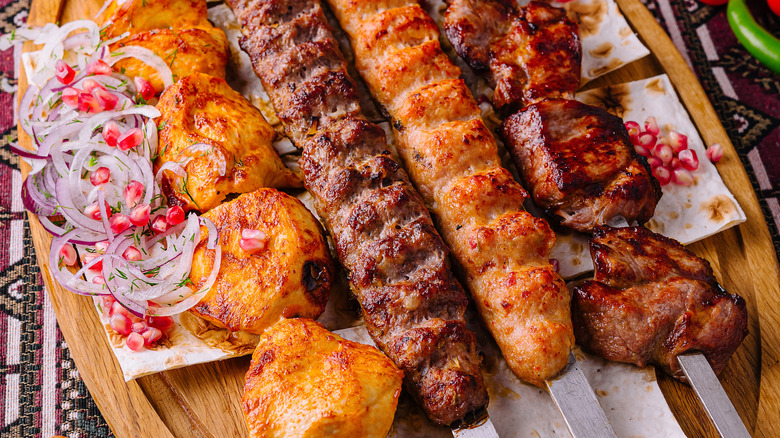
The kebab is yet another idea that's more of a loose structure than one particular dish. Perhaps the most famous variant is the shish kebab — derived from an Armenian term with roots in Turkish — but the name itself simply means "skewered meat." This is, of course, what most kebabs are: small pieces of marinated meat that are skewered and then cooked, most commonly on a grill. In the Middle East, the meat of choice would traditionally be lamb or goat. In modern times, however, it could just as easily be beef, chicken, or any other type of meat, sometimes with vegetables speared onto the same skewer. Common veggies include onions, zucchini, eggplant, tomato, and peppers, but almost anything can be used as long as the skewer can hold it. Regardless of meat or vegetable choice, you can also upgrade grilled kebabs with tangy amba sauce.
Another notable kebab type is kofta (or kafta). Ground meat is mixed with spices, formed into meatball-like vessels of various shapes and sizes, then slid onto a skewer and cooked just like any other kebab. In Türkiye and some parts of Europe, shawarma is frequently called döner kebab, but it's not really the same thing as the kebab outlined here.
Baklava
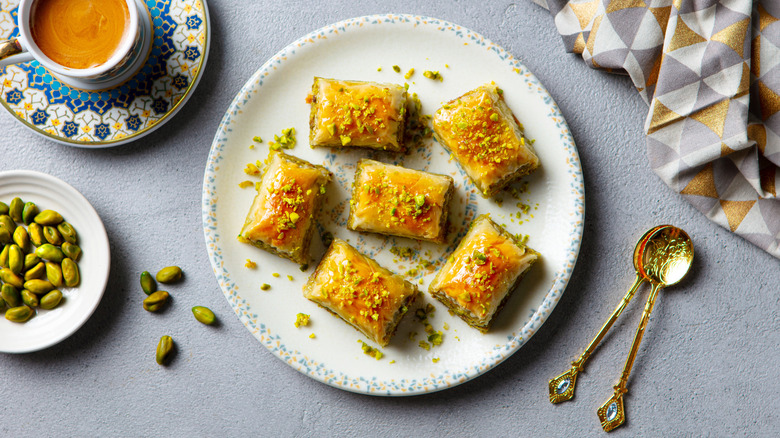
Likely familiar in the U.S. through its association with Greek cuisine and restaurants, baklava is an elaborately constructed pastry that can feature as many as 40 sheets of phyllo dough. Between this dough, a mixture of butter, nuts, and spices is layered, and finally, the whole thing is drenched in honey or syrup to make it extraordinarily sweet. Though certainly delicious, baklava's borderline overwhelming richness can certainly limit the amount one can consume in a single session, though hardcore sugar lovers may disagree.
A dish similar to baklava can be traced all the way back to the eighth century B.C. in ancient Mesopotamia, an area encompassing many present-day Middle Eastern countries. Versions that come closer to modern-day baklava, however, didn't arrive until around the 16th century during the Ottoman Empire as a dessert for the royals and the wealthy. Today, it is widely enjoyed across the Middle East, as well as in Greece and the Balkans, and is also relatively easy to find in the U.S.
Manakish
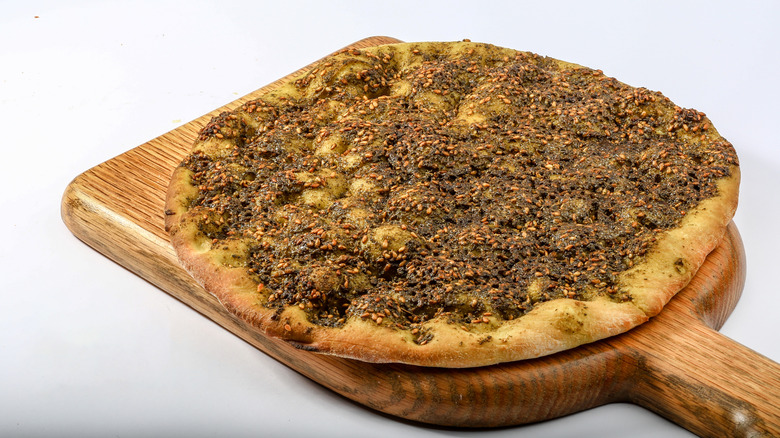
Another loaded flatbread — sometimes called Lebanese pizza — manakish has a softer and fluffier base than lahmacun. The traditional topping for this flatbread is olive oil and a za'atar spice mix, featuring oregano, thyme, sumac, sesame seeds, and salt. In modern times, though, it can also be slathered with a variety of additional toppings, including cheese, kishik (a fermented dairy product), meat, or vegetables.
Though it is somewhat unclear when manakish emerged in its modern form, similar dishes and ingredients have been enjoyed in the Levant since the Phoenician period to as far back as 4,500 B.C. The name derives from the Arabic verb "naqasha" (meaning to engrave), which refers to the way manakish makers push their fingertips into the dough before adding toppings. In 2023, UNESCO added Lebanon's manakish — or Al-Man'ouché — to its Intangible Cultural Heritage of Humanity list, helping propel it to further acclaim.
Halva
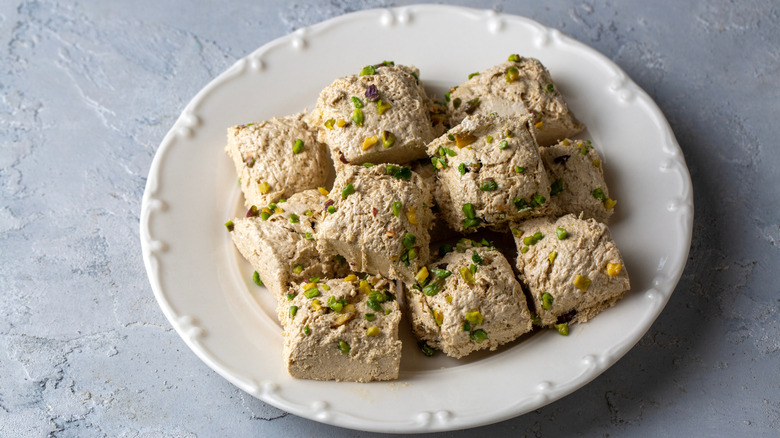
It's difficult to describe the sweet known as halva — which is consumed widely across the Middle East and beyond — to someone who's never encountered it. Perhaps fudge is the best comparison, in the sense that it's a relatively dense, sweet confection, though halva tends to have a grittier, flakier texture than fudge. The primary ingredient here is sesame seeds, ground into tahini, which is then mixed with sugar or honey to create the base treat, ready for flavoring.
Traditional styles of halva (sometimes written halvah, not to be confused with the Indian halwa) might feature nuts like pistachios or almonds, swirls of chocolate, or a kiss of spice such as cardamom. More modern, creative takes can offer a plethora of innovative ideas, from cookies and cream to yuzu or miso ramen halva. The treat can be enjoyed on its own — like fudge, a little goes a long way — used as a baking mix-in for brownies or cheesecakes, or crumbled atop bowls of oatmeal or ice cream.
Muhammara
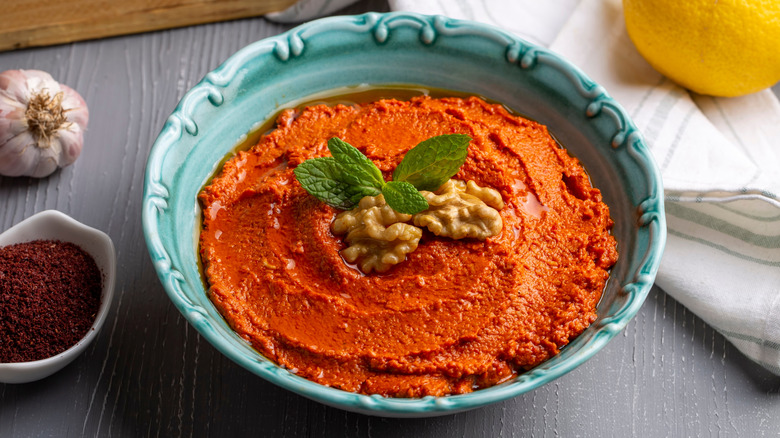
Muhammara is yet another iconic Middle Eastern dip or spread, this time made with roasted sweet red peppers, walnuts, pomegranate molasses, and spiced with Aleppo chile pepper. Like hummus and tabbouleh, it can be eaten on its own, served as part of a mezze platter, or used to flavor other dishes. It is particularly good as a sauce for grilled meat — with kebabs, of course, but really any cut will work.
For anyone who is at this point thinking, "another puree?", yes, it is indeed, but muhammara is still a must-try. When prepared well, it's a lovely blend of savory, smoky, and sweet, with the Aleppo pepper level providing a range of spiciness from mild to wild, depending on recipe and preference. Though Syrian in origin, this dish is also common in Armenian and Egyptian cuisine, as well as in Türkiye, where it is sometimes called acuka. It is also similar to the Spanish romesco sauce.
Halloumi
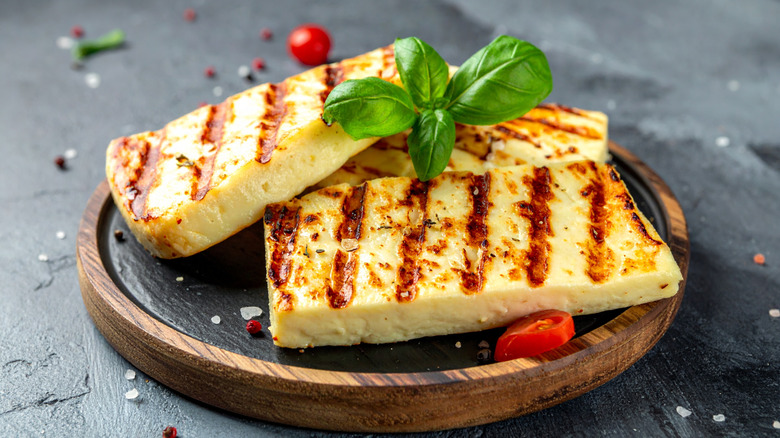
A rare semi-hard cheese that doesn't melt at high temperatures, halloumi stands out from other cheeses for being most commonly served grilled, though it can also be cooked in other ways. Its crispy exterior and firm, squeaky texture when warm make for a singular dining experience. It is often used as a simple appetizer, topped with lemon, olive oil, oregano, or za'atar. It can also be paired successfully with a sweet contrasting component, such as honey or jam. Other frequent preparations include deep-fried halloumi sticks — popular bar snacks in the U.K. — or including it as part of a mezze platter. Fresh halloumi is also eaten raw, but this is not as popular worldwide.
While the cheese might be most easily encountered in the U.S. at a Greek restaurant, it is actually a Cypriot product, produced on the Mediterranean island since at least the 16th century. Today, it remains not only an important economic product in Cyprus but also an important source of cultural heritage and pride.
Tahdig
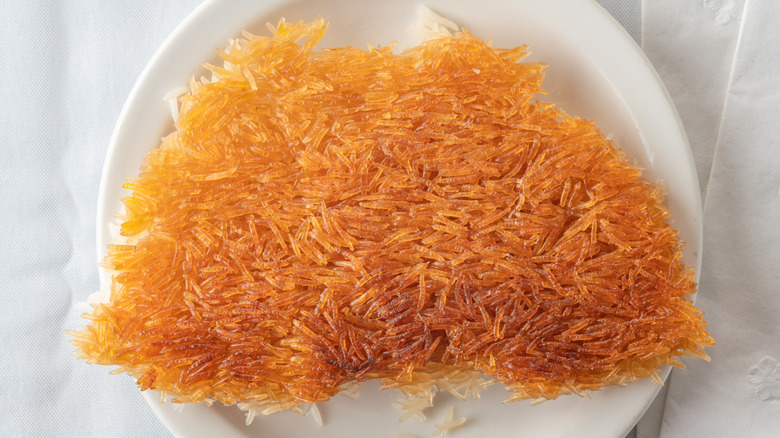
We've all felt the unwelcome crunch of biting into a burnt, hard piece of improperly cooked rice, but tahdig isn't that. Yes, it's part of a family of global dishes referred to as scorched rice, but this technique is a true art form, creating a crispy, buttery, nutty delight at the bottom of a pan of steamed saffron rice. As one might imagine, cooking the tahdig to a perfect golden color — without burning it while also perfectly steaming the rice above — is not an easy maneuver. But one taste will confirm it's worth learning (or at the very least, being around someone else who has).
Derived from the Farsi words "tah," meaning bottom, and "dig," meaning pan, tahdig is an icon of Persian cooking and, in particular, an Iranian specialty. Ask anyone who grew up eating tahdig, and you'll surely be regaled with intense fights over both the first and last pieces, and how there might have been leftover rice, but there was never any leftover tahdig. In other words, when there's tahdig up for grabs, it pays to act quickly.