

I'm A Former Server. Here's What Your Italian Restaurant Order Says About You
When you've been a server in an Italian restaurant, as I have, and when you're Italian-American, as I am, you wind up having strong opinions in the realm of dining out. Did I ask for these opinions? No. Are they conjured from within me anyway? Oh, yes. You can call it a gift, you can call it a curse, you can call it completely irrelevant. You'd be correct on all three. But they are there nonetheless, and they need an outlet.
So, what does your Italian restaurant order say about you, in my eyes? A whole helluva lot; more than I'm sure you even realize. For example, I know that if you walk into an upscale Italian eatery and ask the chef to make your pasta al dente, you probably have no idea that you're insulting said chef. Otherwise, you wouldn't even ask.
In short, you're being analyzed, either by the likes of me or your server — and the results are clear as day. Here, we look at some of the choices a patron can make in a ristorante, and how those define them as a human being — or okay, fine, as a diner. Sorry. Italians are dramatic.
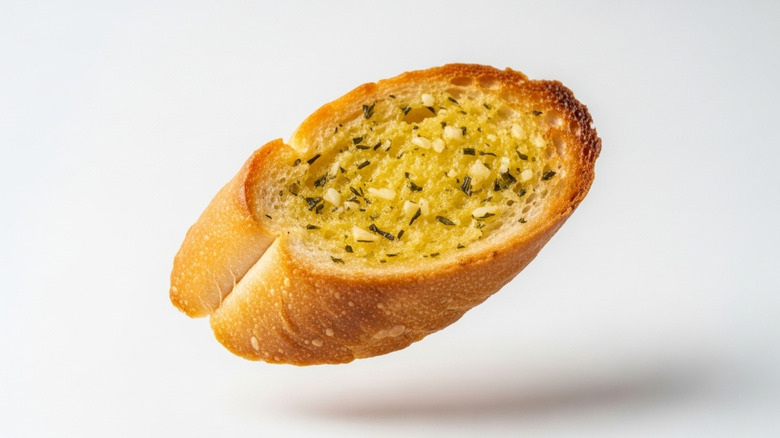
Ordering garlic bread means you just wanted Papa John's
One of the many pet peeves that actual Italians have regarding the way Americans eat Italian food is the absurd amount of garlic involved. It's as if Christopher Columbus landed on these shores in boats made of garlic. (I know, he was working for Spain, but he's still Genovese.)
The stateside staple that is garlic bread is — and I'll be reasonable here — an inauthentic monstrosity of a food sin. (Okay, I couldn't be reasonable.) Ordering bruschetta is one thing, but toasted bread with just butter and garlic? You might as well go to Papa John's.
It's not only the excessive garlic that real Italians eschew; it's also the excessive use of butter. That's two big strikes going against garlic bread. So, what does ordering it say about you? Well, it says that you're either confused about what real Italian food is or you don't really care — and both are fine, by the way. There's no rule that says you need to be an expert in every cuisine you eat. Still, blasphemy is blasphemy.
Ordering mozzarella sticks means you think you're in a bowling alley
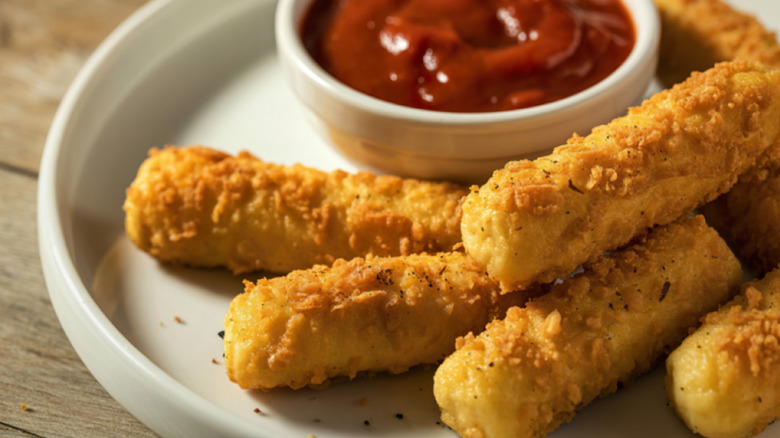
Oh, so you wanted a Polly-O string cheese wrapped in oily batter? Well, why didn't you say so? Let me just head to the kitchen and let the chef know, so he can burn his apron in a ritualistic fire.
Listen, in a cultural vacuum, there are few better pairings than mozzarella sticks and marinara sauce. It just works. But honestly, you could deep-fry a flip-flop, dip it into a good marinara sauce, and it would be a decent appetizer. The point is, it's the marinara sauce that saves the day here. Have you ever eaten a mozzarella stick without sauce, though? That's a chore.
Consuming a terrible, factory-produced mozzarella stick is akin to biting off a piece of wall insulation. If it's a "good" one, you're still dealing with a gooey, never-ending string of subpar cheese that has no rulebook for dispatching it. Do I chomp it off clean? Do I keep stretching it until the end of time? For you, orderer of mozzarella sticks, it doesn't matter. For you, self-consciousness is obviously not a priority — and there's a beautiful freedom in that. But look around. You do realize you're not in a bowling alley, right?
Ordering chicken parm means you've made a damn fine move
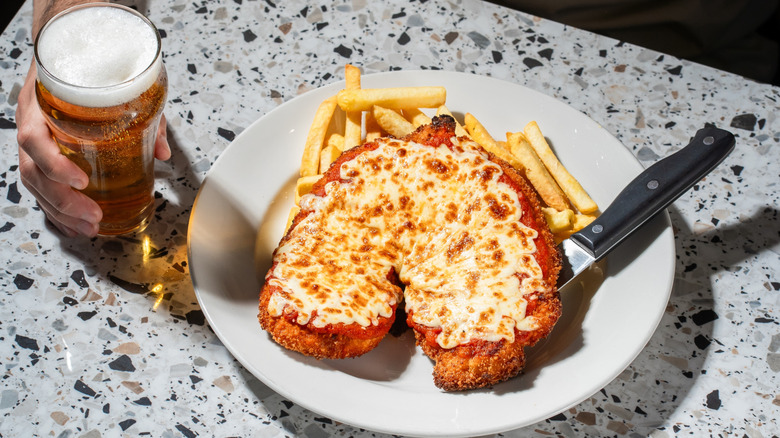
Respect — that is all I have to offer here. Chicken parmesan is in no way authentic Italian cuisine, and whether you call it parmesan or parmigiana, it has no bearing, as neither is an actual chicken dish in Italy. Chicken parm was created by East Coast Southern Italian immigrants (not even from Parma), with the first known recipe found in a New York newspaper during the '50s. These expats were able to get their hands on proteins that were too expensive for them in Italy, and this gave them a whole new canvas of meat — including chicken — to work with. Out of this emerged the cheesy, saucy, crispy cutlet we all know and love.
Chicken parm is an amazing meal that came from the Old World, then got mushed into the New World — and we are all the better for it. When you go into an Italian joint and order this, that tells me you're someone who knows what they want. Forget everything else that's possible on the menu. Forget the subtlety of high cuisine. Forget the finesse. You're indulging in a delicious, beyond satisfying plate of food (especially since, as we all know, chicken parm always tastes better in a restaurant). And for that, you've earned my respect.
Ordering fettuccine Alfredo means you want to digest cement
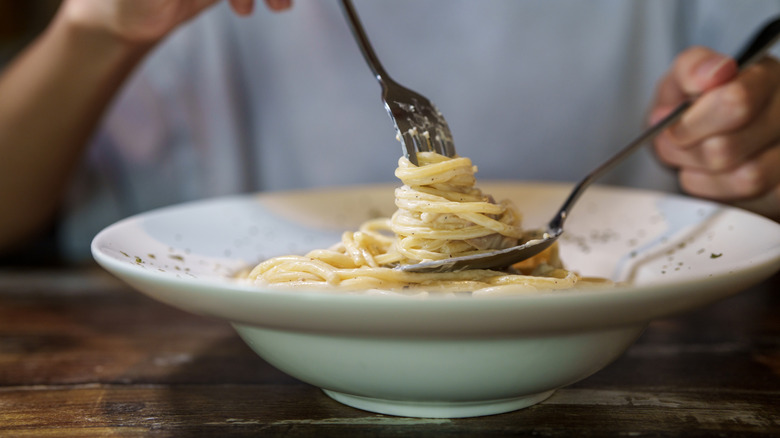
We may have now stumbled upon the the anti-chicken parmigiana order, because everything good and holy about a chicken parm is completely bereft in a fettuccine Alfredo. Ignoring all care for authenticity or self-care or good taste, you've gone and ordered fettuccine Alfredo, and that means that you feel like pouring slow-drying cement down your esophagus.
Look, it's one thing to order a pasta with Alfredo sauce. Sure, whatever, you've been to Olive Garden a few times, fine. Nobody's perfect, and Alfredo sauce is really just three ingredients: heavy cream, butter, and parmesan cheese. Simple means authentic, no? But for pasta-making Italians, the words "heavy" and "cream" might be as foreign a word combination as "base" and "ball." And then throw in fettuccine on top of that? That's like serving the already weighty sauce with carpet trimmings. There's no zip or refinement in the taste of the dish to offset the sheer volume of stuff you're ingesting. Therefore, I can only pose this question: What are you doing here?
Ordering Caesar salad with anchovies makes you a boss
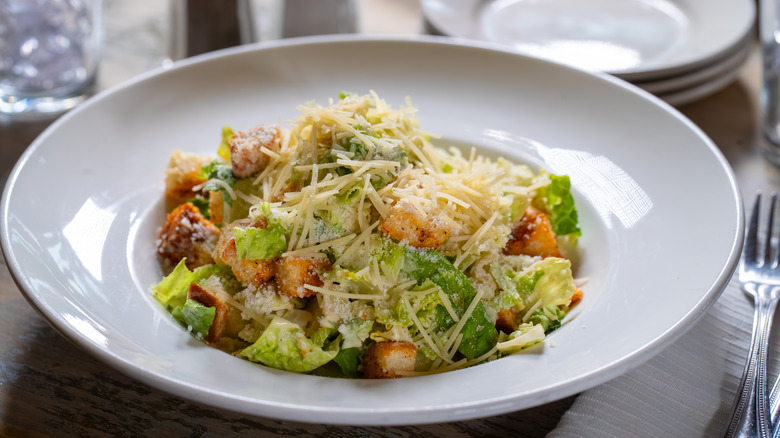
You probably already know this, but Caesar salad isn't Italian, and its name has nothing to do with Julius Caesar. It was invented over 100 years ago in Tijuana, Mexico, and it has since had one of the most bizarre and fortuitous journeys in modern cuisine.
Let's break it down: An Italian-American named Caesar Cardini opened up a restaurant just south of the border called, aptly, Caesar's Place. (He had a knack for naming things after himself.) His namesake salad was born here, amid a hectic Fourth of July weekend that had Caesar stuck with limited supplies and lots of Prohibition-escaping American tourists. He took what he had and threw something together. That something is what we know today as Caesar salad dressing, and it's iconic.
Making sure your Caesar salad of today comes with anchovies is, to me, a boss diner move. It's what I try to do, if possible. Unfortunately, many places don't do it, because, I don't know ... fear? A weirdly specific pact with the sea god Poseidon? Nonetheless, I approve of your effort. And my approval is what you seek, isn't it? (Cue your incredulous laughter.)
Ordering Italian dressing is almost immoral

We're sticking with salads here, but adding a small side of snobbery. Sorry, but it can't be suppressed when such an egregious entry to this list comes up. I'll get right to it: Italian dressing is just unnecessary. Please go with oil and vinegar, like the Italian food deities intended, instead of ordering some dressing concocted by a Massachusetts housewife named Florence Hanna (respectfully).
Italian dressing is a whole mess of things, some of which are not Italian: It's got lemon juice, white wine vinegar, Dijon mustard (huh?), garlic, honey (whuh??), parsley, oregano, thyme, olive oil, salt, and pepper. Good lord. The cultural intermixing has me dizzy — but maybe I'm being harsh. After all, if I went to a Mongolian restaurant and they offered "Mongolian" dressing on a salad, I'd probably go for it, assuming it was the way of things. So there's nominally nothing wrong with what you're doing. You're just as ignorant as any of us can be. This time you happen to be ignorant about Italian food. That's no crime. But if you want to avoid the blinking stares from your server at a real-deal Italian joint, learn to order salad like the Italians do.
Ordering grilled chicken on your pasta makes you strategic
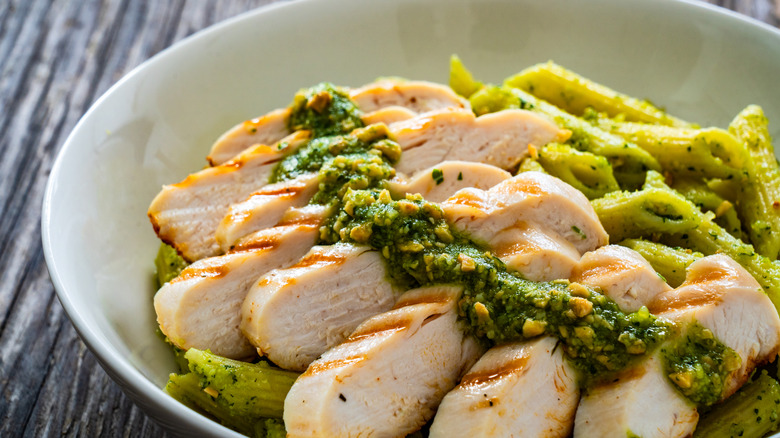
Most of Italy would shudder at the notion of grilled chicken on pasta. Like, they'd actually vibrate with displeasure. The very mention of this to your waiter could bring a chill to the universal Italian soul, from the prime minister all the way down to an old lady sweeping her Sorrentine stoop.
Admittedly, this is where Italian snootiness comes into play, big time. To be straight, it's sort of justified. But so what? Who cares if the idea of mixing two courses — a protein and a pasta — is akin to heresy in the motherland? Food is about adaptation, isn't it? And what's really authentic, anyway, since everything has been changed and tinkered with at some point? Are tomatoes, for example, authentic to Italy? Not a chance.
What you're thinking when ordering grilled chicken on a pasta dish is, probably, "Even if I don't like the pasta, I'll at least have a meal in my belly." And honestly, that's fair bet-hedging. Maybe the Italian place you went to makes a crap carbonara. Lord knows it's possible. What I would say about the individual ordering grilled chicken with their pasta: They are not walking out of that restaurant unsatisfied, come hell or high San Pellegrino.
Ordering while attempting authentic pronunciations does no one favors
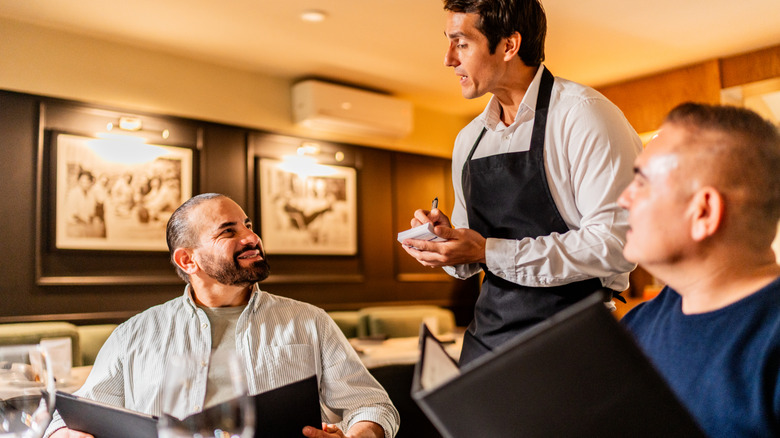
Taking pains to "properly" pronounce Italian menu items can say one of a few things about you. One, you consider yourself a worldly gourmand who will dazzle us all with your linguistic acuity. Two, you are in that moment having a stroke. Three, you have been misled to think it makes it easier for the waiter. Four, are you sure you're not having a stroke?
Take it from an ex-server: This move is beyond unnecessary. You're either going to come off as patronizing and snobbish, or unwittingly comical. And it's not as if Italian-Americans even pronounce the Italian names on menus properly. They're usually giving their own New York-y approximation of actual words (e.g. "gabagool"). So, unless you've actually received some training in the Italian language, go ahead and say "mah-zuh-rella" instead of a mangled "mut-a-dell;" "cal-uh-mah-ree" instead of something like "gah-la-maad." "Parm-ee-jah-nyaaah" — I'm begging you to stop. And please, don't even dip your toe into attempting "all'arrabbiata." You might actually hurt yourself.
Saying mangia is the dad joke of eating prompts
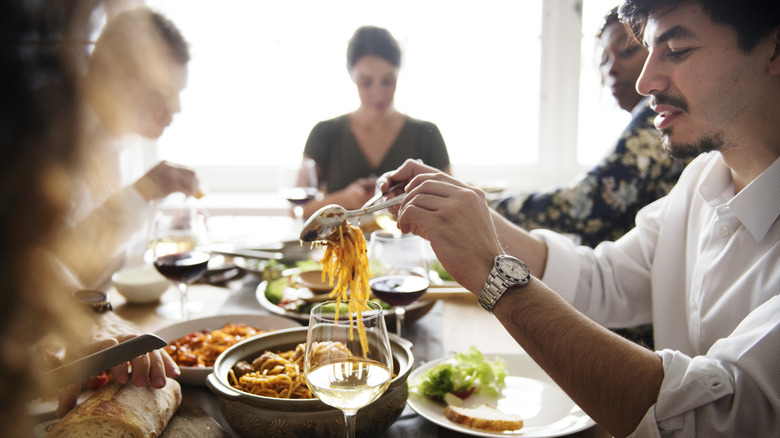
Would I blame you for declaring "mangia" before digging into your food? No more than I'd blame you for kicking a soccer ball rolling towards you, or following the flight of a butterfly that happens upon your sunny-day stroll, or hugging your favorite sports mascot. In other words, you're just being human — all too human.
Can one be a total grump and demonize this harmless exclamation as a corny, overdone mockery of Italian eating? Of course. Anyone can be a total grump about anything, which is often half the fun. But justifiably attacking this shameless act of food love seems a bridge too far. How can you even say the word "mangia" without sounding happy? The word itself might actually be an anti-depressant. So, go on with your trite self, and proudly. In a cynical world, the spirit of mangia is most welcome, like a cheesy dad joke that makes you giggle nonetheless. I'll say it right along with you. And I dare anyone else to resist as well.
Ordering grilled steak means you're confused
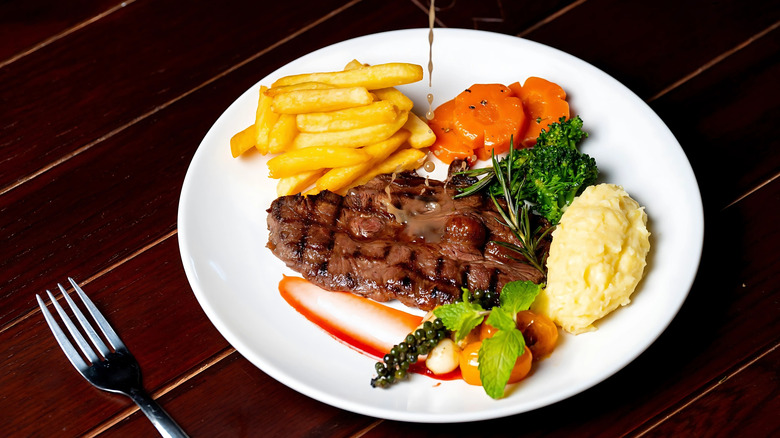
We all see it. It's always on the menu. At this point, it feels obligatory, if incongruous — like a Chinese takeout place offering French fries, or a Mexican deli having a cold-cut hero if you want it. The grilled strip steak is just a part of Italian restaurant menu furniture in the U.S.
Hey, maybe you know how to order steak like an expert. And hey, maybe the Italian place you go to grills a solid strip. Actually, they probably do, because nearly any restaurant can grill a solid strip. But is a cook in an Italian kitchen going to hold those tongs and flip the meat in a unique, special way? Probably not.
Explicitly choosing to go to an Italian joint just to have meat and potatoes is, to say the least, curious. Maybe it wasn't your turn to choose the restaurant, and you were dragged to Italian — in which case, fine, that's fair. But otherwise, if this was done fully of your own volition ... why? Like, why? There are plenty of steak-centric restaurants out there; houses of steak, in fact. They're known as steakhouses. Maybe you like to go to steakhouses to order linguine in clam sauce. Then you're just a devout contrarian.
Ordering extra sauce means you really wanted chili
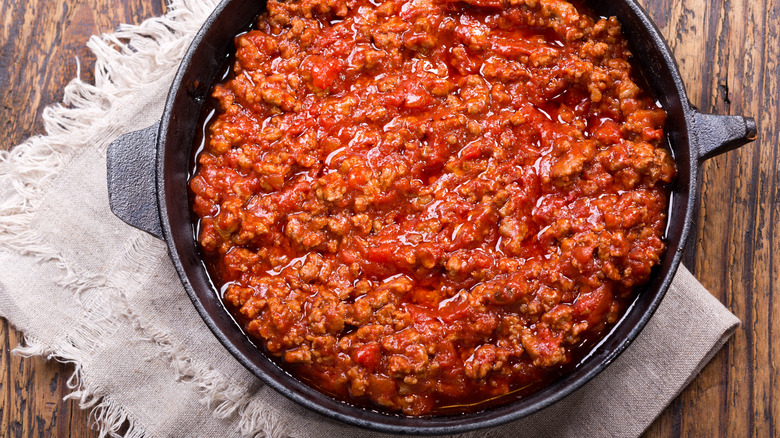
If asking for extra sauce won't make an Italian clap their palms together and shake them in despair, then I'm not sure what will. The sauce extravaganza that is American Italian food is sometimes in direct contrast to the cuisine on The Boot. The best thing about Italian food is the simplified, thoughtful use of fresh ingredients to construct a superior eating experience.
Imagine for a moment that you took the time to perfect a landscape painting. You went out into nature, set up your canvas, and delicately, painstakingly recreated the lakeshore before you as art. Then, once it was finally finished, you threw a bucket of paint all over it. That's what you're doing when you drown your pasta in sauce.
This is an Italian-American transgression as much as anybody's. I grew up going to traditional Sunday dinners at my grandparents', where people would pass around the "gravy" boat to submerge whatever fresh, delicious noodles were already in front of us. You have plenty of company in your sauce-greed. That doesn't make it okay. Might I suggest heading to a chili cook-off instead next time?
Ordering more bread means you'd fail the Stanford Marshmallow Experiment
There was a famous research test conducted by psychologist Walter Mischel in the 1960s called the Stanford Marshmallow Experiment. In it, children were individually given a choice: They could either have one marshmallow immediately or two marshmallows later, after the researcher returned. It was a challenge to see who could delay their gratification.
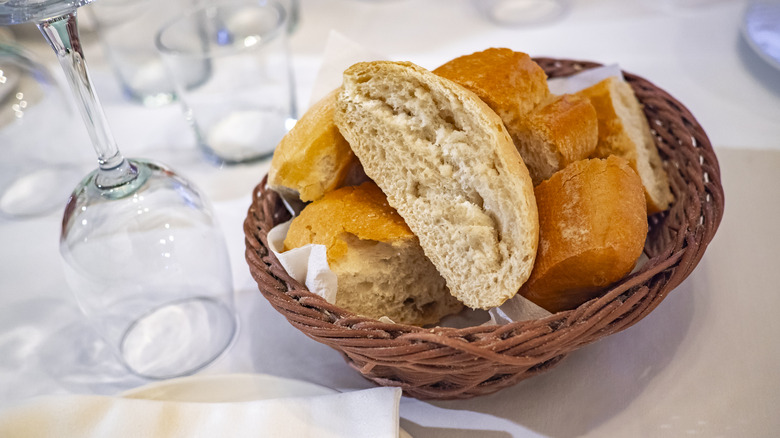
If you run out of the bread served to you at the beginning of the meal, and need to ask for more to mop up your sauce, this means that you were unable to delay your gratification. You were hungry, the bread came out right away, and you expended a good portion of your hunger on eating all the bread.
We've all done it, by the way. We've all been there. And once the bread is polished off, often before we even realize it, there's no going back. The bell has been rung. So, what to do with the leftover sauce from your main course? Either you're asking for more bread to soak it up or you're just spooning the stuff into your mouth. The latter is not really an acceptable option in polite society, so you're left to reap what you sow. I empathize — and I offer you a Pepto-Bismol to relieve the inevitable bloating.
Ordering Italian cheesecake deserves a knowing nod of admiration
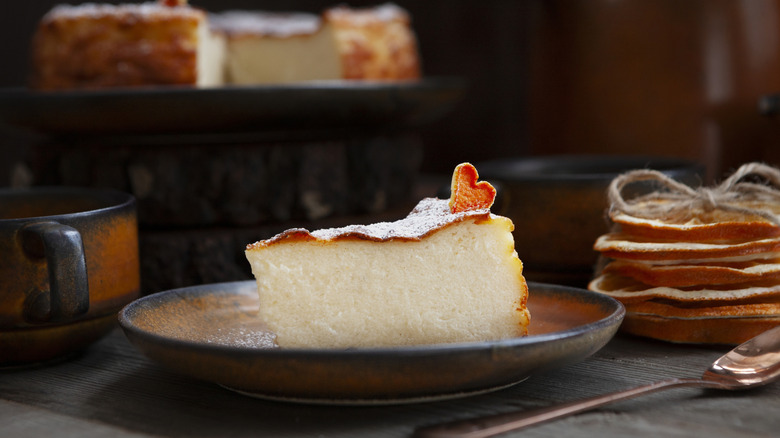
I have a confession: I love Italian cheesecake. The citrus, the moisture, the fluffiness, the slightly hardened roof — to me, the ricotta-based dessert is far superior to the cream cheese-based New York cheesecake (though I do appreciate that there are so many cheesecake variations out there).
My family owned and operated Italian restaurants for generations, and their Italian cheesecake recipe was passed down from establishment to establishment. This certainly puts me at a bias. Still, most people I've been out to eat with it — even fellow Italians — can't understand how I could choose one over the other.
To me, New York cheesecake is just like so many other sweet, heavy, American desserts. You might as well order a blondie or a milkshake. But when I see someone order an Italian cheesecake, I nod knowingly. I say to myself, "There's a diner who's different." Accompany that with a Sambuca and an espresso with a lemon peel, and you're flying high, my friend.