

The Unique Cultural Reason Fruit Will Cost You More In Japan
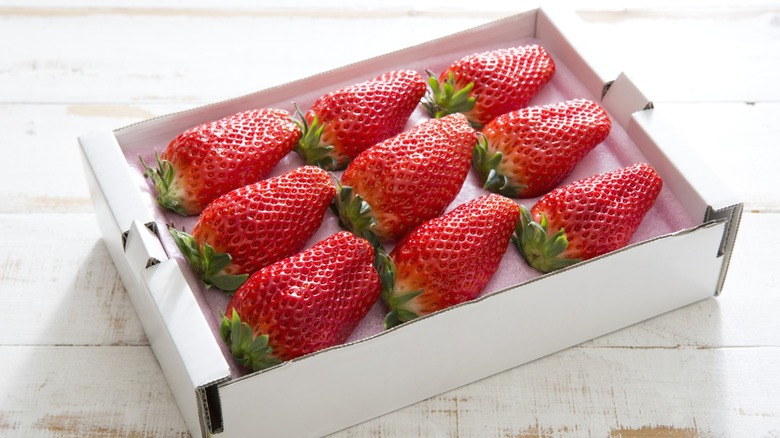
There are some things you can get in Japan much cheaper than in America. You can rent an apartment in Tokyo for a much more reasonable price than in New York or London, and a one-way bullet train ticket from Tokyo to Kyoto (about 282 miles) costs less than a one-way Amtrak ticket from New York to Boston (about 216 miles). But if you've ever been to a supermarket in Japan, you'll know that some fruit is a lot pricier there than it is here. It's not universally true — while the country's geography is such that farmland for growing fruit is limited, Japanese people often eat fruit without needing to take out a loan from the bank — but you may find a carton of strawberries going for the equivalent of $14. Why is that? Well, it's because there is a long tradition of gift-giving in Japanese society, with fruit being especially popular.
Japanese people give gifts for many different occasions, including returns from a trip or as thanks for hospitality, and fruit is considered an ideal offering for a few different reasons. Not only is it a tasty, aesthetically pleasing present, it also has a built-in expiration date, meaning it won't take up space on somebody's shelf from here to doomsday. But an apple from the corner store won't do, even if you polish it with your shirt: You have to spring for the good stuff packaged for gifting, whether that's a box of sweet, juicy Muscat grapes or a succulent Tottori pear.
Some of Japan's priciest fruits
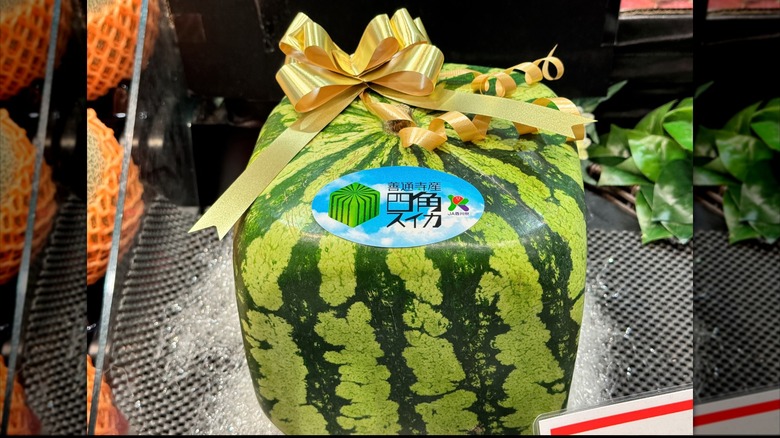
If you need to ingratiate yourself to a Japanese person quickly, you have a few different options. Some of those high-quality fruits from the supermarket we mentioned earlier will do the job, like the Dekopon orange ($13 per fruit) or the Sekai Ichi apple ($21 per fruit) — they're juicy, sweet, and generally renowned for a reason. If you're willing to stretch your wallet a little further, or if you want to rack up some reward points on your credit card, spring for a cube-shaped Zentsuji watermelon ($100-200) or a Taiyo no Tamago mango (around $100), whose name means "egg of the sun".
But what if you really need to make an impression? What if money is no object? What if you couldn't get your hand on the world's most expensive ice cream – sold in Osaka, Japan — but you still wanted to express your affection through pricy foodstuffs? You could go for some luscious Ruby Roman grapes, which sell for hundreds if not thousands of dollars a bunch. Or perhaps shell out for Bijin-hime strawberries, which are beautifully sweet, apple-sized berries which go for $4,000 a pop. Bigger isn't necessarily better with strawberries, but in this case maybe it's true. In any case, you're sure to be best friends immediately after giving these pricey fruity gifts.