

Walmart's In Hot Water Over Alleged 'Law Breaking' Overpriced Meat — Here's What We Know
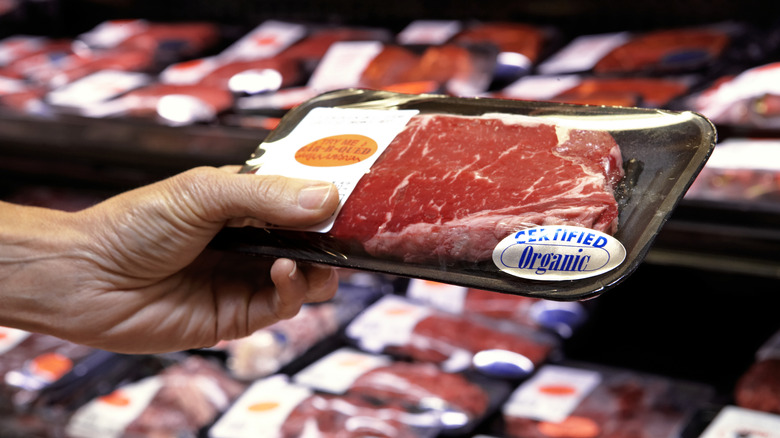
We've all heard of shrinkflation. It's a common phenomenon: Companies subtly reduce the size of their products or packaging while also keeping the price the same. But when products are sold by the pound, like meat, you can assume you're getting what you paid for. Right?
Not necessarily, alleges TikToker Jimmy Wrigg, who posts under the username @james_wrigg. On January 17th, he posted the first of a series of videos where he recorded himself weighing Walmart meat. "That don't weigh no 4.66 pounds," said the TikToker as he picked up a package of chicken tenderloins priced at $19.20. When he placed it on the scale, it came up short.
We're not talking about a few decimal points here. According to the video, the meat weighed 2.37 pounds — nearly half the advertised weight. The video wracked up millions of views. "They're banking on people not checking," wrote one commenter. Others urged boycotts or suggested that Wrigg contact the Department of Weights and Measures.
In subsequent videos, Wrigg weighed cuts of meat at other Walmart locations. "They're saying this ham here ... is 5.43 pounds," he said in one video before taking the meat over to the produce section to check the weight. The display read 2.24 pounds. In another video, Wrigg checked the accuracy of the scale with a weight. According to the video, the scale was off by .02 pounds. Each piece of meat he weighed was off by several pounds.
Walmart has been sued for misrepresenting weights in the past
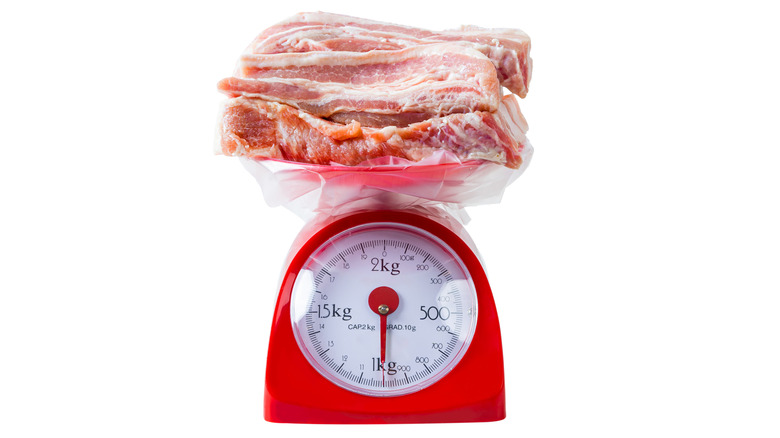
It's illegal to mislabel the weight of consumer goods, and customers can contact their state's Office of Weights and Measures if they find mislabeled food. Walmart has settled three lawsuits since 2024 over inaccurate weights. According to the first and largest of the three lawsuits, the inaccurate weights weren't just human error. "At the register, when the customer checks out, Walmart's point-of-sale (POS) system deceptively, systemically, and artificially increases the weight of the product at checkout, resulting in the customer paying an inflated price," claimed the suit. Walmart denied allegations, but agreed to settle for $45 million.
Customers already say that Walmart meat is overpriced. But if the info in Wrigg's videos is accurate, they could be paying over $15 extra for mislabeled meat. He said that management "basically kinda shrugged it off," and explained that he'd reported the issue to the Georgia Department of Agriculture, which referred him to the Inspector for Weights and Measurements. "I want ... an explanation on why [there] were not better controls in the grocery department," he told Brobible.
Reddit offered a different solution. "Support your local butcher if you can," wrote one redditor. Butcher's shops aren't known for low prices, but butchers build relationships with their customers based on trust (in fact, it's a red flag if they don't ask you questions about your order). And, if Walmart really is overcharging customers as much as Wrigg shows in his videos, your local butcher might actually be the cheaper choice.