

Don't Ask For This Popular Steak Sauce At Top-Tier Steakhouses
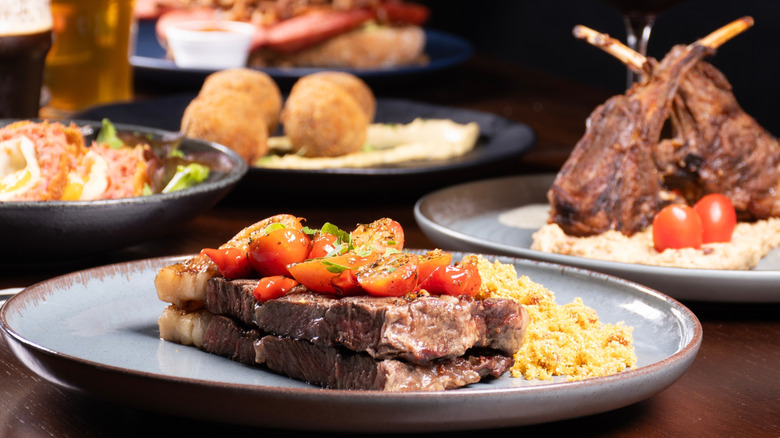
A good steakhouse provides an experience worthy of special occasions. Unlike regular restaurants, these specialized eateries offer a more elegant atmosphere and promise a steak so perfect that you won't be able to recreate the taste at home. (After all, no one wants to spend their hard-earned money on a good-enough steak they could've cooked themselves.) Yet one of the biggest mistakes that people make when visiting top-tier steakhouses is asking for A.1. sauce, according to Chip Carter, producer and host of "Where The Food Comes From."
The ever-popular product is one of the best steak sauces that you can buy at a store. It is perfectly fine for a cook-out with friends or for a homemade steak dinner, but you don't want store-quality sauce at a restaurant. As Carter puts it, "why on Earth would you deluge a high-end steak with what's basically gussied-up ketchup?" He believes this sauce is best fit for hamburgers or cheap round steak.
If you want sauce to accompany your steak, there are plenty of options that complement the dish without taking over. "My favorite [is] cognac and peppercorn – decadently elegant and not overpowering. Certainly, there's garlic-studded chef's butter. Occasionally these days we see a chimichurri coming into play. Wine-based sauces are [also] deservedly popular," he notes. Almost any steakhouse will probably have A.1. sauce, but, according to Carter, "they don't want you to ask and they don't want to give it to you. You should not embarrass yourself like that."
Why you won't need A.1. sauce at a high-end steakhouse
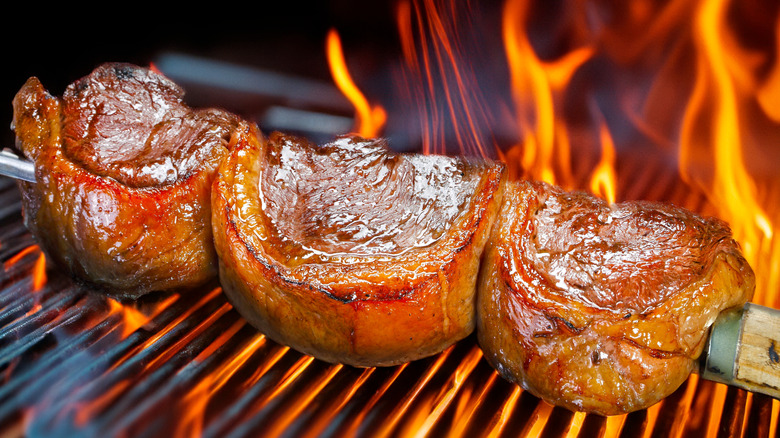
Aside from the specialized sauces that Carter mentions, a good steakhouse won't be drowning its cuts in a generic sauce. If any is added, it will serve to add a hint of flavor to the cut rather than make up for a lack of quality. "The very best places are going to simply season with salt and let the beef speak for itself," Carter says. He believes that "[steakhouses] don't really have to do much with a ribeye except cook it right" and that you don't need to "overcook or over-season it [when] you're already starting with virtual perfection."
The absence of A.1. sauce is often a sign that a steakhouse is confident in how it cooks its meat. Cooking methods will vary depending on the signature style of each steakhouse. "Some are famous for their flame-grilling. Others are committed to a high-temp griddle. Others might actually roast or broil — or combine that with other techniques," Carter shares.
If you're wondering whether to trust a new spot or not, dig around and find out if they're known for a specific cooking style. Any place that takes steak seriously should have a strong opinion on how to cook it. Carter also recommends skipping steak altogether to see if a restaurant is actually good. "Ordering chicken at a steakhouse is a quality test the restaurant never sees coming." Basically, if a steakhouse can cook chicken well (which you can perfect at home with salt and butter), it will certainly get its steaks right. So, if you're new to the world of high-end steakhouses, keep Carter's advice in mind, and skip the A.1. sauce.