

What's The Difference Between Colombian And Venezuelan Arepas?
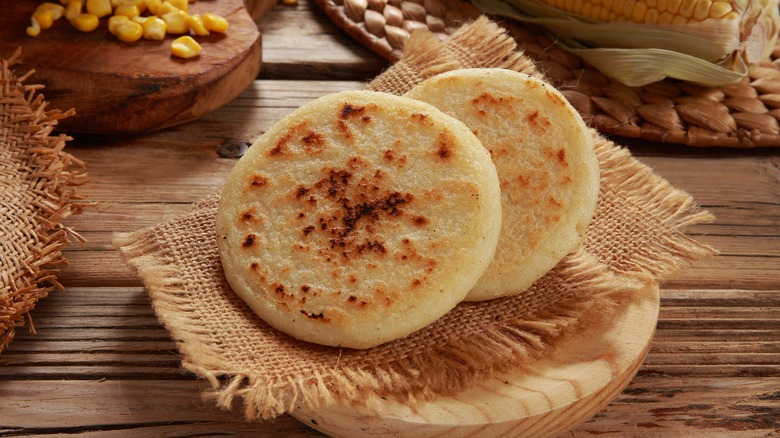
I was lucky enough to have been born in Colombia, so my mornings have always started with a hot, comforting arepa. These round corn or flour "patties" are a staple food of both Colombia and Venezuela, and it's not unusual for people in both countries to eat them on a daily basis. Though we share an unfailing love of arepas, we have very different approaches to the dish and are fiercely proud of our own versions. Confusing one for the other is one of the easiest ways to insult us. Luckily, it's actually fairly easy to tell Colombian and Venezuelan arepas apart. But before getting into it, I should mention that each nation has an estimated 40 to 80 types of arepas and that family recipes vary widely. Any explanation given will be a simplified generalization of this varied dish.
Overall, Colombian arepas are simpler and more traditional. Many are made only with maize (or flour), water, and salt, though cheese is sometimes added to the mix. Other ingredients are normally served as toppings rather than fillings. Arepas here are usually griddled or deep-fried and served as snacks or side dishes. (Pro tip: Try them with hot chocolate with cheese.)
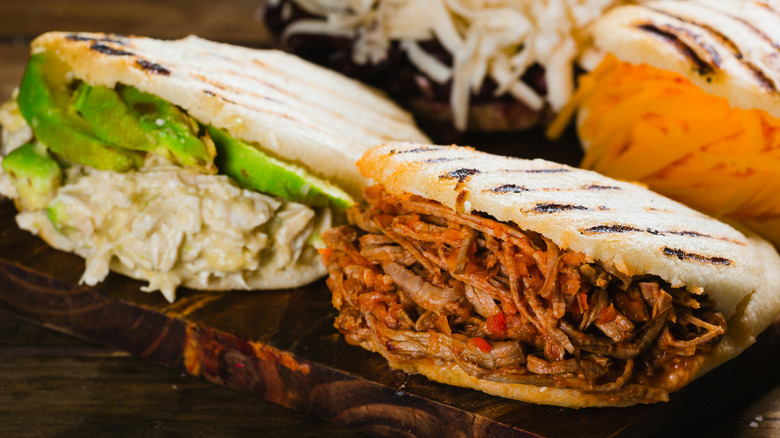
Venezuelan arepas, on the other hand, tend to be thicker, and are typically opened and stuffed with various ingredients. Different meats, vegetables, cheeses, and sauces are used as fillings to make a hearty main meal. It's also acceptable to boil, steam, or even bake them.
Which country invented arepas?
Colombians and Venezuelans have been fighting over who invented the arepa for centuries. Unlike other food rivalries — such as Peru and Chile's war over pisco — the question hasn't been settled yet. Those on Venezuela's side often argue that the name of the dish comes from the country's Indigenous Cumanagoto word, "erepa." But this only proves that Spaniards eventually adopted the word from this tribe. People who back up Colombia's claim point out archaeological evidence that suggests maize came into the country around 3,000 years ago; 200 years before it reached Venezuela. It would make sense, then, that arepas would've been created in Colombia first. This argument is spotty, however, since it reflects the oldest records that we've found, not necessarily the oldest arepas that actually existed. It's also a bit ridiculous to use modern geo-political borders to define the dish's origins because arepas existed thousands of years before either Colombia or Venezuela. The reality is that arepas are indigenous and belong to the area at large.
Besides, does this question even matter? If arepas were invented first in the territory that we now call Colombia, would that mean Venezuela couldn't claim them, or vice versa? Of course not! That's not how food works. Instead of paying attention to this silly little rivalry, we should all focus on enjoying both types of arepas and celebrating their differences. There's simply no time to waste when there are dozens and dozens of delicious arepa styles to try.