

Peanuts Vs Almonds — Which Are The Most Nutritious?

Although peanuts are actually legumes, we enjoy them the same way we do nuts, particularly almonds (albeit not the kind of almonds with cyanide). That's because peanuts and almonds are similar in many ways, especially when it comes to their nutrition. Both are an excellent source of healthy fats and they're both high in protein, fiber, essential vitamins, minerals, and antioxidants compared to other nuts. However, one is slightly more nutritious than the other.
When comparing calories and macronutrients (protein, fat, carbohydrates, and fiber), almonds are arguably superior than peanuts. At 100 grams, peanuts and almonds have negligible calorie differences, but sources report peanuts have slightly more (564 calories) than almonds (554 calories). Peanuts also contain more protein at 25 grams, compared to almonds' 21 grams. Both peanuts and almonds are rich in heart-healthy unsaturated fats, but peanuts contain more saturated fat, approximately 6 grams while almonds have 4 grams. Saturated fat can be harmful in high amounts, depending on the individual. And although almonds have more carbohydrates at 21 grams, this is due to their higher fiber content — 13 grams. Peanuts contain less carbs, 16 grams, along with less fiber, 8 grams.
In the vitamins and minerals department, peanuts are higher in 5 types of vitamins: B1, B3, B5, B6, and folate. Almonds are only superior than peanuts in vitamins E and B2. As for minerals, almonds are higher in 6 types of minerals: magnesium, calcium, phosphorus, sodium, manganese, and potassium. Peanuts, meanwhile, are higher in iron and selenium. Almonds also contain 12 grams of anti-inflammatory omega-6 fatty acids.
Peanuts and almonds are sometimes better as a butter
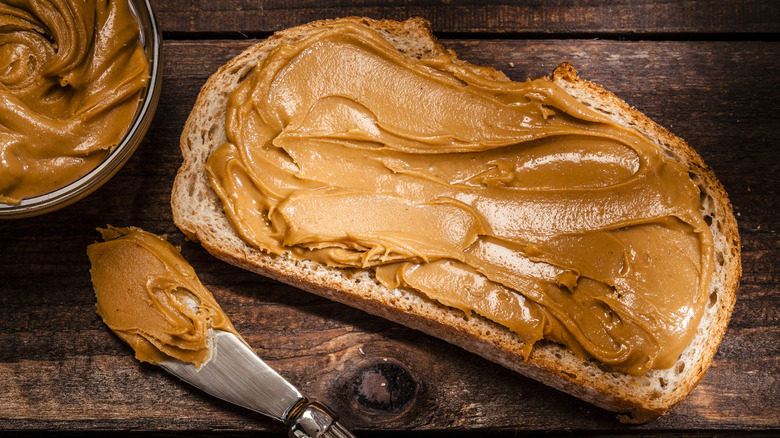
If you're like me and prefer peanuts or almonds ground into nut butter, you may be surprised to learn their nutritional values will change when in this form. When peanuts and almonds are ground into nut butter, their nutrients become more bio-available. Granted, this benefit is quickly overshadowed if certain ingredients like oils, artificial fats labeled as hydrogenated oils, and sugar are added. This is a tactic manufacturers use for preservation, to cut costs, and enhance flavor and texture, but their inclusion decreases nutritional quality and promotes adverse health outcomes.
Added oils, fats, and sugar appear on the ingredient list of peanut butter brands more often than almond butter brands, which tend to have better quality ingredients. Make sure to always choose a peanut or almond butter free of added oils, fats, and sugar to maintain nutritional quality. If you don't want to sacrifice flavor, leave this peanut butter off your shopping list and go for a lightly salted, naturally sweetened nut butter variety instead.
The almond versus peanut debate is one that nutrition professionals and enthusiasts go back and forth about, like fast food restaurants selling Pepsi or Coke products. Almonds have a slight nutritional edge on peanuts, but in the end the nut that's most nutritious is the one that's right for your dietary goals. If you prefer the taste, texture, and higher protein content in peanuts over almonds, then by all means, enjoy yourself some peanuts!