

The Best Ways To Brew Up Espresso-Like Coffee (Without Expensive Gadgets)
We may receive a commission on purchases made from links.
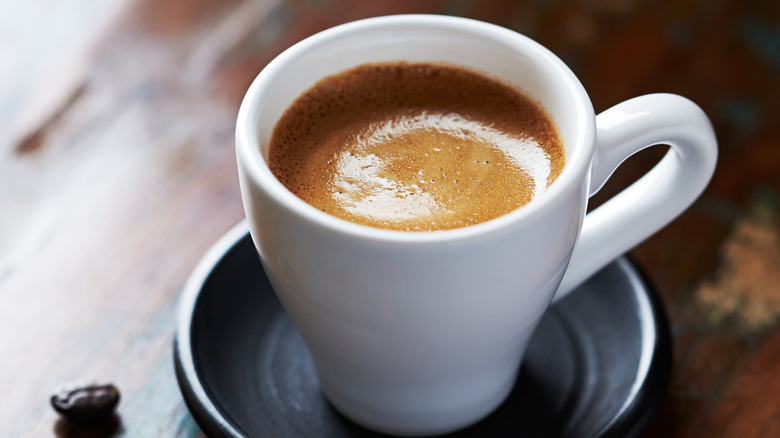
Espresso is something we're more likely to order at coffee shops than brew ourselves. This may be partly due to the well-trained baristas who ensure that cafe espresso often tastes better, but it also may be because we're reluctant to shell out big bucks — not to mention allot precious counter space — to a pricy single-use gadget. If you don't have an espresso machine, though, is there a way to make it at home? There's always instant espresso; my Italian-American dad enjoys Medaglio D'Oro, while chef Ina Pinkney favors pricier brands such as Davidoff Crema Intense (which sells for nearly $25 a jar on Amazon). Rachel Stuart, a coffee trainer at La Colombe's L.A. cafes, isn't a fan, though, telling us, "Coffee is living, breathing food and fresh is always best!" She prefers to make her espresso using a lever-operated machine made by Flair.
The lowest-priced Flair model, NEO Flex, currently sells for $119 on Amazon, which is comparable to lower-end automatic espresso makers like the $109 Nespresso Vertuo. It is, however, much cheaper than a high-end model like the De'Longhi Magnifica, which may cost around $750. Apart from the lower price point, Stuart explained what she likes about the Flair: "It's fully manual, meaning you are the one creating the pressure, not a machine. It always makes me feel so connected to my coffee and challenges my skills as a barista." She did say, however, that it doesn't make much foam (aka crema). Because of this, she told us, "If I am making espresso on the Flair instead of an espresso machine, I prefer to drink it with milk or tonic water."
These cheaper immersion brewers can also get the job done
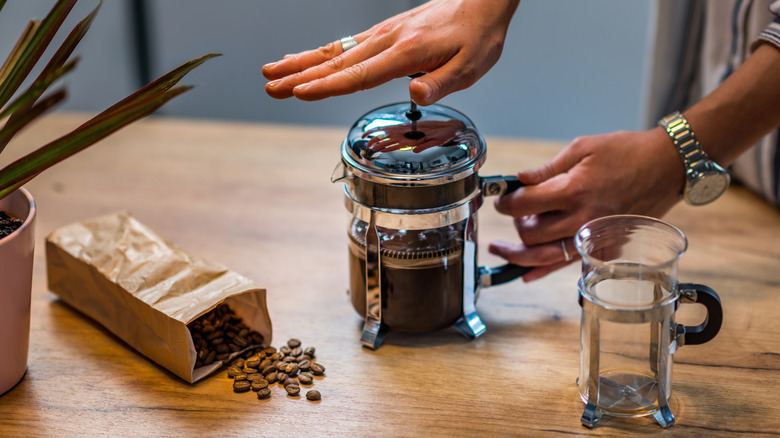
One popular, and very budget-friendly, model of coffee maker that can also be used to brew espresso is the French Press — Ikea sells its Uphetta French press for just $14.99. Yet another option is the AeroPress, which will run you about $35 on Amazon. Both of these are what is described as immersion brewers, which, according to Rachel Stuart, " ... mean[s] that the ground coffee and water hang out for most, or all, of the duration of your brew."
Both of these items work in a similar fashion, but the AeroPress isn't just a more expensive version of the standard French press. As Stuart explained, "AeroPress and French Press both use a plunging method at the end of your brew to separate the coffee grounds from the liquid. AeroPress utilizes a paper filter to help hold back some sediment and oils, while the French press utilizes a mesh screen that doesn't hold back those oils and as much sediment, impacting the body and texture of your final brew."
If you want to use one of these coffee makers for espresso, you'll need to use a medium grind and double the amount of coffee per cup of water — about two tablespoons instead of the one you'd need for standard coffee. Let the coffee steep for at least three minutes, then slowly push the plunger down halfway. Pull it up again, then push it down to the bottom to create some foam. If you're using a French press instead of an AeroPress, you may also want to filter the coffee to remove any floaters.
As can an Italian invention called the moka pot
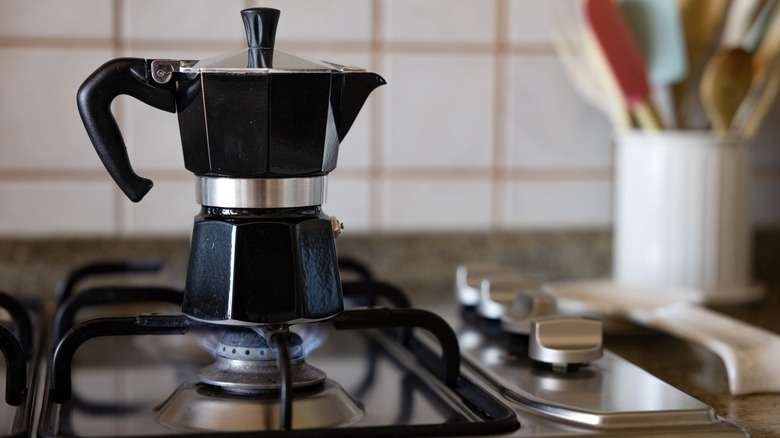
Italy is not only where espresso originated, but it's also the home of the moka pot. This coffee maker — another immersion model, albeit one that sits on the stovetop — was invented there in 1933, and was the first real model of home coffee maker to gain widespread use in that country. Surveys have found nearly 90% of Italian homes own such an item, and it is also quite popular in Latin America. According to Rachel Stuart, it can be used to make espresso, or at least an espresso-coffee hybrid.
"Moka pot, while an immersion brew, uses heat to create steam pressure that pushes the water up and through the coffee grounds into a chamber through a metal filter," she tells us. "Moka pot provides a very strong and concentrated coffee that falls somewhere between an espresso shot from a machine and a drip coffee, like what you would brew on AeroPress or French Press." A moka pot can also be found for a pretty low price, too — the three-cup Primula Classic model is selling on Amazon for under $16.
The coffee grind also matters
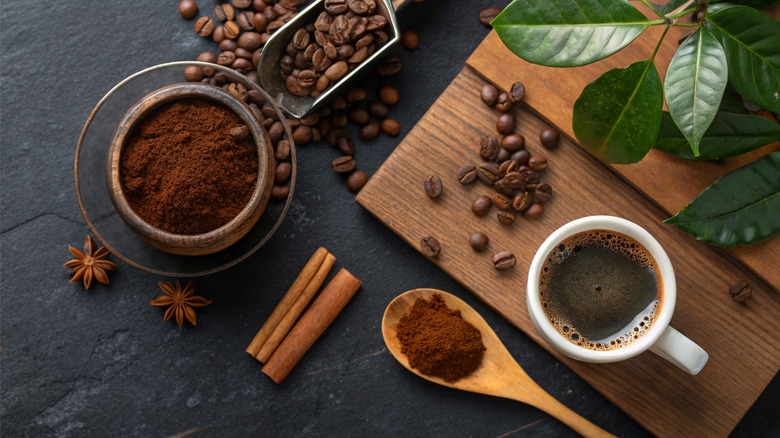
According to Rachel Stuart, there really isn't any one type of coffee bean that is more suited to espresso than another. "All coffee can be brewed as espresso or a drip coffee," she assured us, but added, "However, your grind size very much impacts your brew."
An automatic espresso machine requires a very different grind than a manual gadget like a French press or moka pot. As Stuart explained, "Espresso machines utilize around nine bars of pressure to give us that beautiful concentrated textured shot — your grind must be compact and tight to manage all that pressure! When you are brewing without the pressure, i.e AeroPress or French press, you'll want a bit of a courser grind to allow for the extraction to be even and balanced. If it's too fine, you will get too much of the coffee's soluble fibers, and your coffee will be bitter and less enjoyable." In other words, you'll need a coarser grind than you'd use for espresso, but you still don't want it too coarse, so a medium is likely your best bet.
Of course, the grind — and the coffee type — are affected by how you choose to drink it, too. For black coffee sipped slowly, Stuart recommends a coarser grind used to make drip coffee rather than espresso. For a milky coffee beverage, though, espresso is exactly what's needed. "If you want to make a latte, go for a more concentrated expression of the coffee to balance the milk and sugar," said Stuart.
As does water temperature
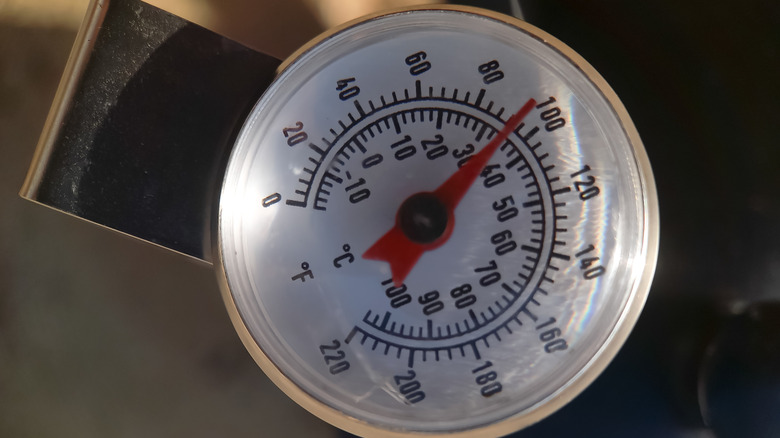
With most types of hot, infused drinks like coffee or tea, water temperature matters quite a bit when making the perfect cup of coffee — and espresso is no exception to the rule. As Rachel Stuart put it, "Water temp is super important for your brew. If the water isn't hot enough, you won't extract the right amount, but if it's too hot, you can burn the coffee, resulting in a bitter cup." Her recommendation for the perfect coffee temperature is anywhere in the 195 to 205 degree Fahrenheit range, which is optimal for espresso, too. Stuart also likes to use distilled or reverse osmosis water to brew coffee, while water filtered through a pitcher is another good option for espresso. The reason she offered for why you shouldn't just fill the pot straight from the tap is: "Minerals are delicious and important to our final brew. However, too much of a good thing is not always a good thing."
If all of this advice seems a bit overwhelming — use this pot, these beans, and this water — don't stress about it. Espresso should be enjoyable, after all — otherwise, why bother drinking it? Stuart herself offered the following advice: "Don't be afraid to make mistakes and not have a perfect brew every time. Coffee is food, and it changes every single day. Your perfect brew yesterday might not be as good today — that's perfectly normal. Always remember to have fun while you are brewing!"