

The Only Salad Dressing Option You Should Ever Ask For At An Italian Restaurant
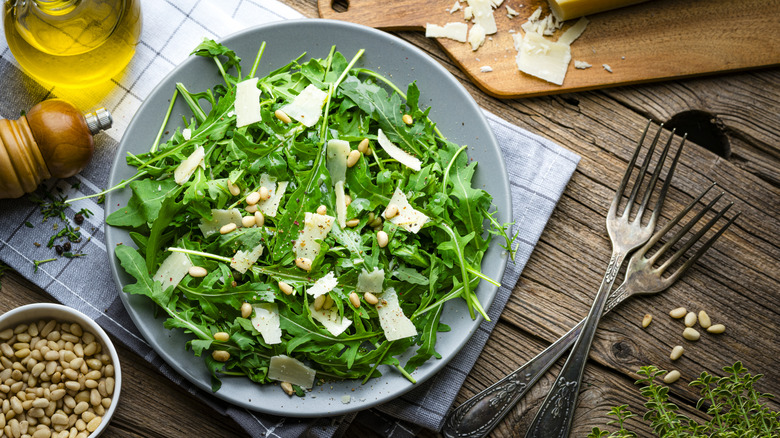
Lately, describing food as authentic has become a bit taboo. Culinary traditions are nuanced and complex; foods change over time and from person to person. Besides, inauthentic doesn't necessarily mean bad. Italian American food is a unique, respected cuisine in its own right, and Italian American restaurants have their place. But sometimes, you crave Italian food that tastes the way it does in Italy: simple, fresh, and lighter on the tomatoes, even when it comes to the salad.
So The Takeout asked Devin Sansone, executive chef at South Carolina's Abbracci Italian Cuisine & Cocktails, for tips on picking the best Italian-style dressing. Ironically, he recommended avoiding Italian dressing. "Italian dressing is found in some establishments, although not found in traditional Italian cuisine," he explained. " ... Italians don't eat 'Italian' dressing; it is more Italian-American."
Instead, Sansone suggested opting for a house dressing, commonly consisting of high-quality olive oil. "It is worth ordering because — [the] same as a family recipe — a restaurant's house dressing is unique and special to them," he said.
Why should you pick the house salad in an Italian restaurant?
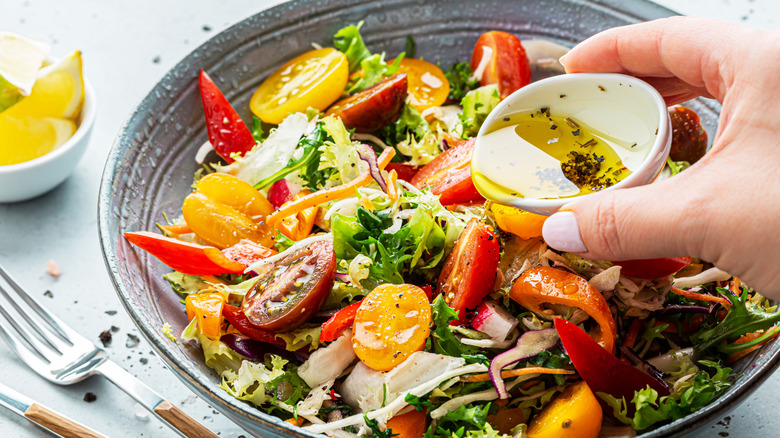
For Devin Sansone, subpar ingredients are a no-go. Store-bought Italian dressings are often full of sugar and additives, but even some house-made Italian dressings laugh in the face of traditional Italian tastes. " ... In Italy, they use high-quality oil and vinegar. Here in the U.S., there are fewer quality ingredients and too many of them," he explained. "Simplicity is key. In Italy, you usually dress your salad with either apple or balsamic vinegar, olive oil, salt, and pepper."
Ask about the ingredients if you're not sure. "Balsamic, Caesar dressing, and lemon vinaigrette may be found in an authentic Italian restaurant," said Sansone. "On our Insalata al Limone, we dress it with a lemon vinaigrette: D.O.P. olive oil, lemon, thyme, and honey."
The Italian government certifies that certain foods like olive oil and balsamic vinegar are made in specific locations to strict quality standards, so top-quality Italian olive oil is marked D.O.P., which stands for "Denominazione di Origine Protetta" or Protected Designation of Origin. Balsamic vinegar will be marked with a PDO or PGI stamp, indicating that it came from Modena or Reggio Emilia, where traditional balsamic vinegar is made following the set standards. When restaurants take care to source the best ingredients, it shows. "It is the small gestures behind the scenes, such as sourcing D.O.P. olive oil from Italy, that [are] our way of giving love, appreciation, and authenticity to the customers," said Sansone.