

11 Tips For Eating Dim Sum Beginners Need To Know
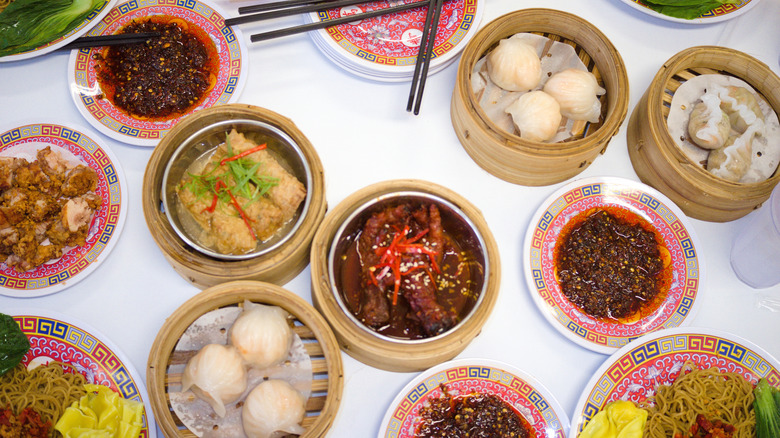
A traditional part of Cantonese Chinese cuisine, dim sum is a leisurely meal made of multiple small dishes served with tea. However, it is so much more than just different plates of dumplings. Rather, it is an art form with its own set of rituals, and where tea, small bites, and conversation combine to produce a rich, and shared, experience.
The history of dim sum can be traced back many centuries to the ancient Chinese teahouses that served a variety of dishes such as steamed buns, dumplings, and pastries. Modern-day dim sum houses continue to serve an array of small plates, each with its own distinctive flavors that showcase the skill, and care, that went into its creation.
Since tea is central to the tradition, timing is an important element to consider if you want an authentic dim sum experience. Traditionally, yum cha, which translates to "drink tea", runs from late morning to mid-afternoon, so that is ideally when you would enjoy a dim sum feast. If you're heading to a dim sum restaurant, arrive early if you want the best dishes. Otherwise, you may find that many of the favorites bites are gone, and that would be a shame. Read on to learn the other ins and outs of dim sum, including what you should know ahead of time, how to order, and when to say you've had enough.
Understand that dim sum is an art form
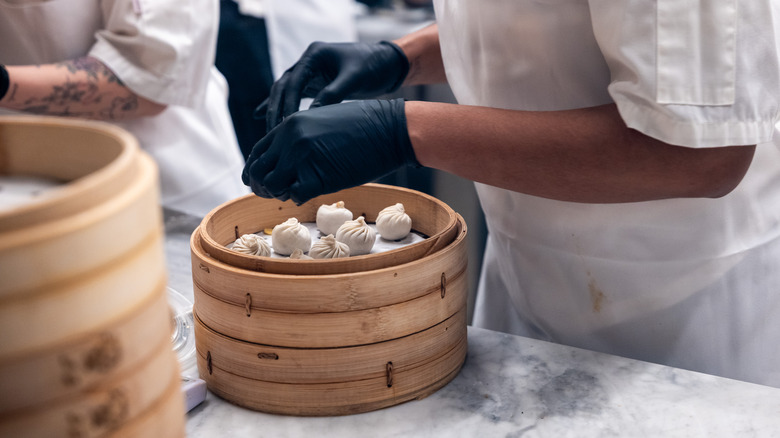
Dim sum is a fun, and unique, part of traditional Chinese food. It's a meal that lets you try lots of different dishes in small portions, and is closely linked to the tradition of yum cha, which combines drinking tea with enjoying tasty bites. Dim sum loosely translates to "touch the heart", alluding to the fact that these small, delicious dishes are meant to not only be eaten, but also touch the diner's heart. The whole point of enjoying dim sum is to have a shared dining experience accompanied by tea, and a relaxed ambiance that brings everyone closer together.
Eating dim sum is an art form that is governed by its own set of rules. Every part of the meal is a ritual, from the choice of tea, and how it is served, to the selection of the dishes, and the manner in which they are eaten — right up to the final dish, and then the paying of the bill. There is a defined set of expectations running the show, and although nothing is likely to be said to a newcomer who makes a mistake, knowing and abiding by the rules will surely help to create an experience that is comforting, and familiar.
Learn how the menu works, and what to expect
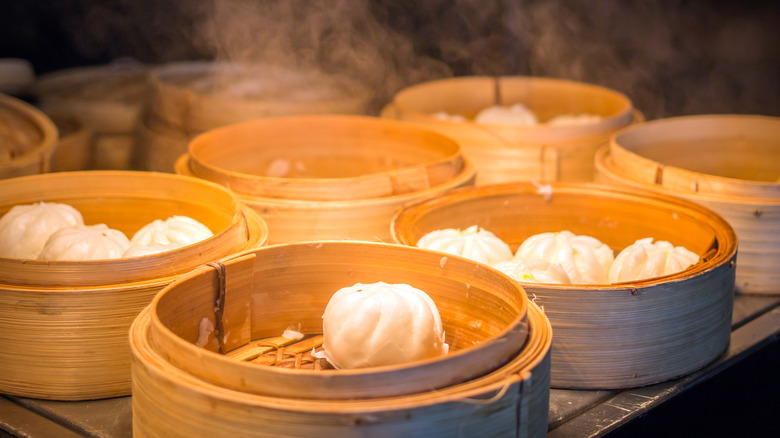
Dim sum includes dishes that can be steamed, fried, or baked, and they are all enjoyed slowly around a communal table. While, at first glance, the menu may seem very complicated, it's actually fairly simple to learn how to eat dim sum like a pro. Custom states that you must start with tea, which acts as a palate cleanser. The lighter dishes — usually steamed — are next, followed by richer, heavier, and fried foods. Good manners suggest you try at least one of everything, helping yourself to more only once everyone at the table has had their share. And, ideally, you end the meal with sweet dumplings.
The steamed dishes are at the core of the dim sum experience. These showcase the precision, and heart, of Cantonese cuisine, and offer the best starting points if you are new to the ritual. Examples include har gow, which are prawn dumplings with a filling of seasoned, chopped prawns, in a light wrapper made of wheat and tapioca flour. Siu mai, another favorite, are dumplings made with minced pork, and prawns. They're known to have a soft, juicy texture. Cheung fun, or rice noodle rolls, are topped with a light soy dressing. To follow, you might be served dishes like asparagus beef dumplings, or an array of fried dumplings or other delicacies. Try a bit of everything, taking your cues from the more experienced diners at your table or at those around you.
Start with tea
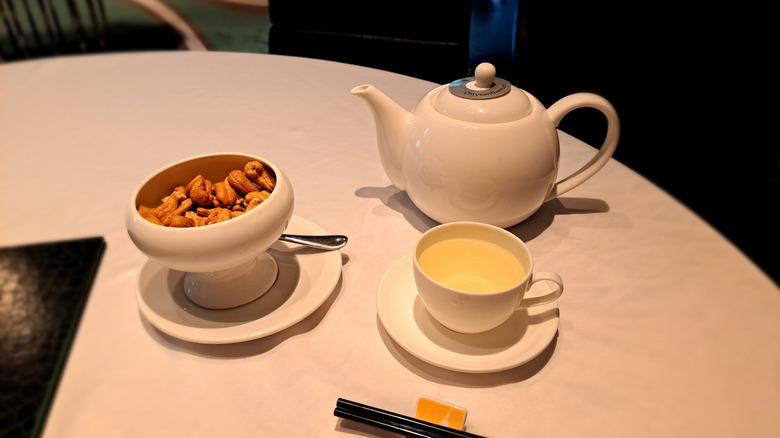
At the core of the dim sum experience is the tea that helps to clear the palate for each new round of dishes. The types of tea served may vary, but jasmine, pu-erh, chrysanthemum, and oolong are all popular choices. Jasmine tea is light, and floral; and pu-erh has a strong, earthy flavor that pairs better with the richer dim sum dishes. Oolong strikes a balance between jasmine, and pu-erh; and chrysanthemum is a mild, soothing variety. If you feel overwhelmed by the choice of teas on offer, consider starting with something lighter, such as an oolong. It will help you to better appreciate the more complex flavors of the dim sum.
Whatever your choice of tea, remember that eating dim sum is a communal affair, and that there is a certain etiquette involved right from the beginning. If you are doing the pouring, be sure to pour for others before pouring for yourself. It's a sign of respect to serve the eldest at the table first. If someone pours the tea for you, say a proper "thank you" by tapping the table lightly with two fingers. If you require a refill for the table, leave the lid off the teapot to signal your request to your server.
Order for the whole table, and share
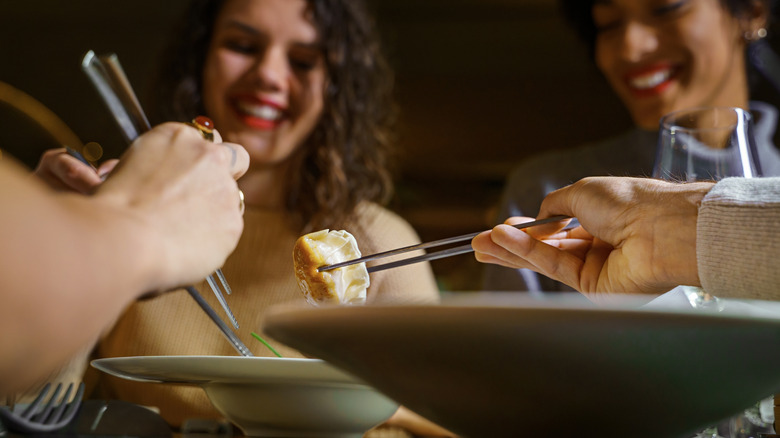
When eating dim sum, it's customary to share all dishes with your party. These dishes are placed at the center of the table, and everyone samples the lot. Hoarding your favorite dumplings would be considered poor behavior. If there are three dumplings to be shared between four people, the polite thing to do would be to order two portions. In some restaurants, the server may offer to increase the quantity so that all may share a dish equally.
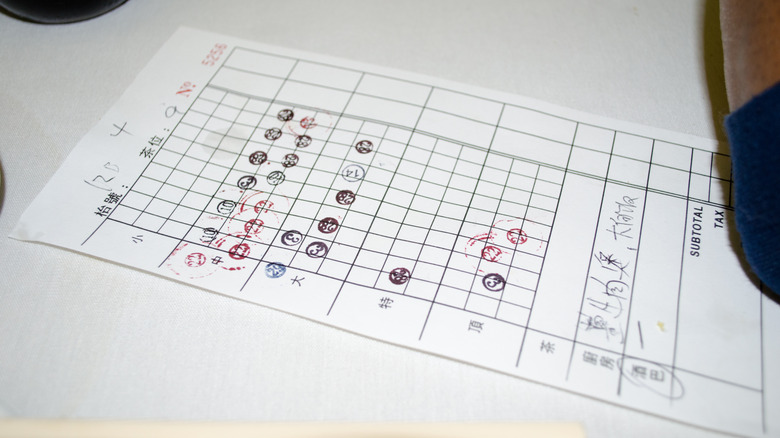
At many traditional dim sum restaurants, you'll find a checklist at your table, whereon you're meant to check off the menu items that you want. You may also have servers visit your table with plates of assorted dim sum — not the ones you've ordered, but others you may like to try. Be adventurous, and try some. Your senses are in for a treat.
Proper dim sum etiquette requires you to order for the whole table. First, check with your party to see whether anyone has a personal preference or dietary constraints. If you are new to this cuisine, allow someone with more experience to order for the table. Once the food arrives, it's polite to serve others before you serve yourself. For this, you should use the communal chopsticks, not the ones you're using to eat. If you must use those, use the other side of the sticks rather than the side you eat with.
Eat in small bites
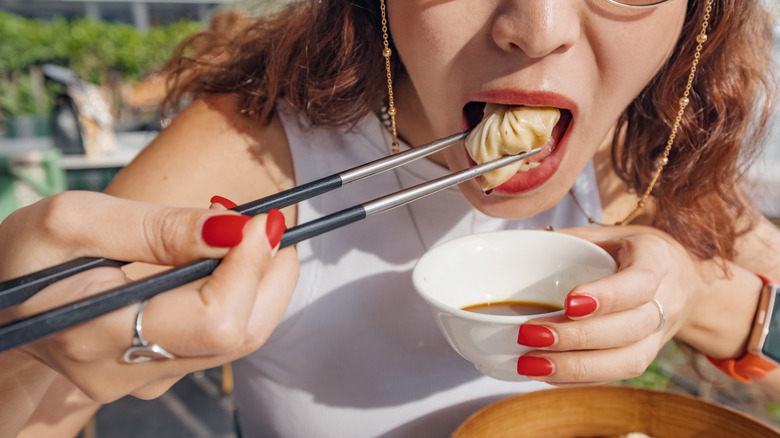
Eating dim sum is not something that should be rushed. It is a time to savor each bite while enjoying the company at your table. The sheer range of dishes — all with their varying tastes, textures, and fragrances — is a sensory voyage that is meant to be enjoyed at a leisurely pace. Enjoying a dim sum spread is all about being in a familiar, comfortable space, and eating at a relaxed pace. Enjoying your dumplings in small bites will help you to savor each one, and enjoy individual flavors, and textures. Rushing through the meal, or wolfing it all down whole, would negate the whole concept, and could also be considered rude.
Note that your expertise with chopsticks will now be on display, and if this is something you are not comfortable with, ask for a spoon, and fork. Avoid spearing your dumpling, as it shows little appreciation for the chef's craft. Instead, use a spoon, and handle the food with care. Do not worry about liquid leaking onto your plate — but, for Heaven's sake, avoid fishing for bits and pieces from the shared plates.
Enjoy the condiments
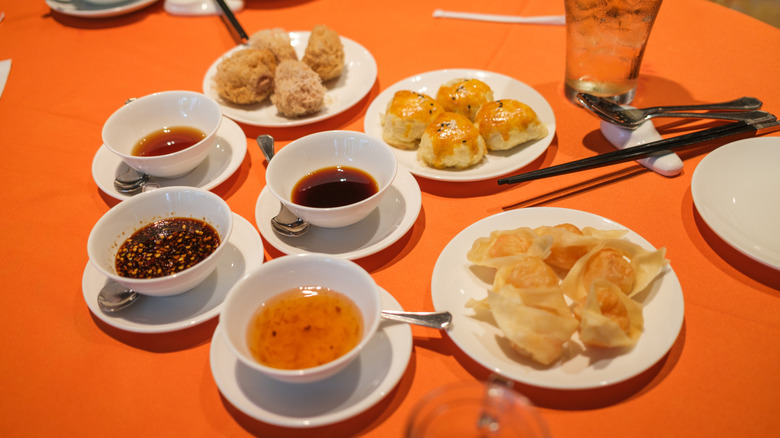
The condiments are a big part of any dim sum meal, and you will find several placed at your table. Your server will usually tell you about each of them, identifying the soy sauce, chili oil, sweet and sour sauce, and others. Dim sum is usually well seasoned, but the condiments can add even more flavor, and are typically meant to be mixed together in your personal dipping bowl. Go ahead, and experiment, but remember one cardinal rule: Add the sauces to your bowl slowly, as it is easier to add more than to compensate for too much of one type. The idea is to use the sauces to complement, and enhance the flavors of the dim sum, not overpower them.
If you are new to the experience, start slowly by trying just a bit of the soy sauce. If you want additional fire, add some chili oil. The sweet and sour sauce usually pairs well with fried dim sum. You can also request other sauces, such as hoisin or sesame oil, but these should be used sparingly as they are quite strong, and could smother the delicious flavors of your dim sum. At the end of the day, keep in mind that what condiments you choose to add to your sauce is a very personal choice. Use them wisely, and they will add a new dimension to your meal.
Know the rules regarding how to use chopsticks
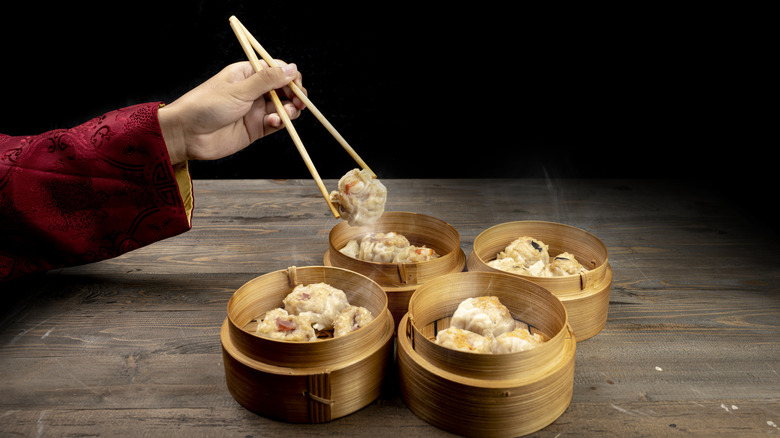
Learning how to hold chopsticks properly may seem like a difficult task, but mastering the technique is just half the battle. You must also learn chopstick etiquette if you want to fit in at a dim sum restaurant. If you are still not comfortable with chopsticks, it is okay to ask for cutlery; most restaurants will accommodate you.
One of the first rules of chopstick etiquette is to never use the ends that go into your mouth to serve yourself from the communal dishes. Always reverse the chopsticks, and use the other end, then flip them back once you resume eating from your plate. This little action prevents cross-contamination, and is a show of respect for the other diners at your table. Alternatively, you should use the serving chopsticks, especially when serving other guests. The whole setup is similar to dining in Western culture, where different sets of cutlery are used for serving, and eating.
Other rules to keep in mind: Never play with your chopsticks, or poke them into a dumpling, or around your mouth. If the urge to practice your drumming skills arises, resist. And, finally, do not ever stick your chopsticks vertically into rice. In Chinese culture, this is considered unlucky, and is mainly reserved for funerals. When you are done, set your chopsticks across your bowl or leave them on the chopstick rest provided.
Wait for the cart to come to you
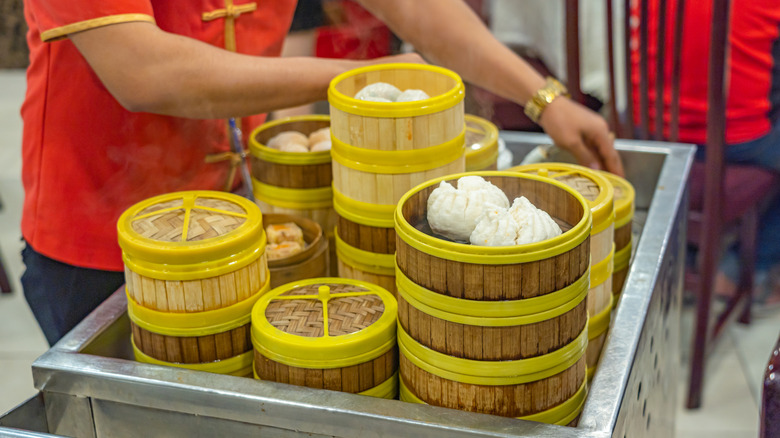
Some traditional dim sum eateries feature carts that are wheeled around the restaurant, stacked high with bamboo steamers, and small dishes. You can flag one down, and the server will come over to explain the dishes. You can choose what you like, but remember to be polite. A hand raised, along with a smile, will usually suffice to get attention. Do not interrupt the server while they are serving another customer.
Once the cart has arrived, have a look at its contents, and see what catches your fancy. Pointing to a dish that appeals to you is perfectly acceptable. You can also nod politely to signal your choice. A tip to remember is to avoid choosing from a cart that has been circulating for a while, as that food may no longer be at the optimum temperature.
There may be times when you have to exercise patience while waiting for the cart. Do not worry, we promise, it will come to you. Chasing after it can be considered unseemly, so avoid doing that. Subtly catching the server's attention is a better way. If you don't see a dish that you want on the cart, you can always ask the server for something else. Some dishes, such as shrimp dumplings, have a habit of disappearing all too soon. Don't be afraid to request more.
Don't be afraid to experiment
The variety available at a dim sum restaurant can be quite overwhelming, but once you have a basic understanding of how to order dim sum, you can begin to experiment. And, if you are to do justice to this gastronomic adventure, experiment you must.
Think about the feast ahead. You have different types of steamed dumplings, open-top dumplings, deep-fried dumplings, purple taro dumplings, steamed buns, baked buns, and so on. The list seems endless. To top it all off, you have an array of wonderful sauces to complement, and enhance, the flavors of the dim sum. And don't forget the different teas to be enjoyed as a palate cleanser, and digestive. The point is that the permutations, and combinations, are endless. Which dumpling goes best with which sauce? The best way to find out is to experiment. That way, you can sample the range of dishes on offer.
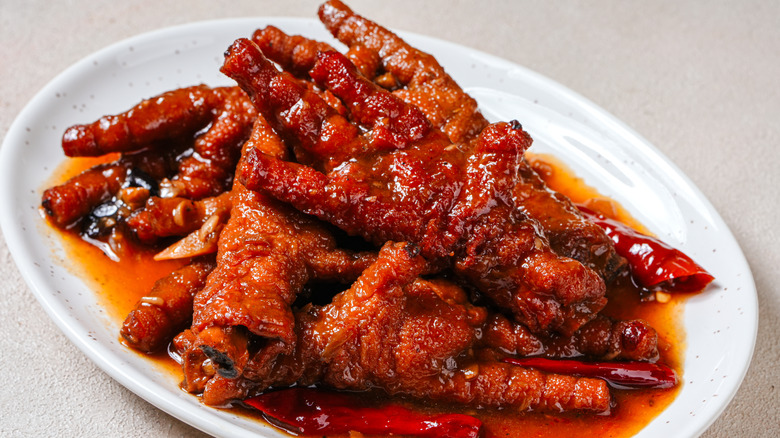
Do not fall into a rut of ordering the same old dishes that you always try. We urge you to not play it safe, as this could lead you to miss the best thing you're not ordering at a dim sum restaurant. Instead, once you've sampled your favorites, try something new, like chicken feet, or goose intestines. You never know when you will discover a new favorite.
Don't skip dessert
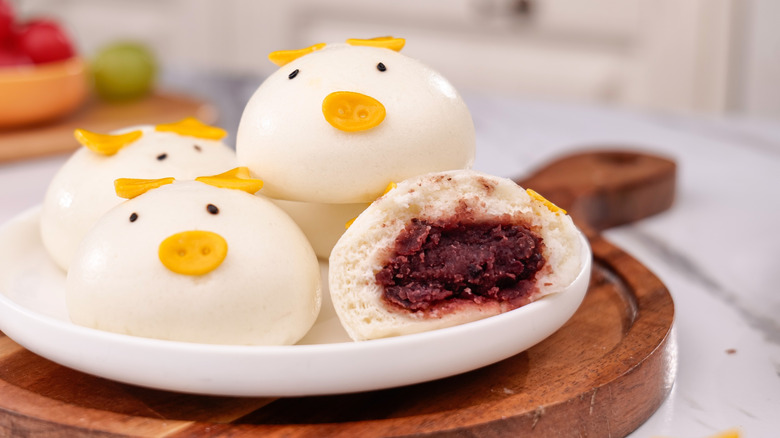
Dim sum desserts are an integral part of the entire dim sum experience. Leave some space to try a few in keeping with the spirit of adventure. You may be pleasantly surprised. With several sweet selections, each with its own fanbase, it would be a crime to neglect dessert. Choose an option, or a few, and savor the perfect finish to a thoroughly enjoyable meal.
Popular desserts at a dim sum restaurant include daan taat, or Hong Kong-style egg tarts. These Chinese egg tarts are similar to Portuguese egg tarts, which are more famous, albeit with a stronger egg flavor. Their flaky outer shells give them a nice crunch that contrasts against the soft, creamy interior. Another sweet treat worth trying is jin deui, glutinous rice balls with a mochi-like texture. These are deep-fried, coated with sesame seeds, and filled with a sweet paste. If cake is more your style, try the Malaysian sponge cake, or Ma Lai Go. The soft, eggy, steamed sponge cake may surprise you. Another dessert worth ordering is mango pudding, a chilled dish that has a silky texture, and fruity flavor. Custard-filled buns, lightly steamed, are yet another wonderful way to end a dim sum feast.
Properly signal when you are done
As with every other stage of a traditional dim sum feast, there is an etiquette involved in indicating when you are done eating. You can do this by resting your chopsticks across your plate. That said, it is good manners not to rush. Dim sum is, after all, enjoyed at a leisurely pace. It is a communal meal that requires you to pay attention to the mood, and the flow of conversation. The conversation can go on, with numerous cups of tea enjoyed, after the meal has ended. This is normal.
Once everyone at the table has finished, it is time to pay the bill — and that, too, has its own set of rules. Unless you are with a bunch of friends who have previously agreed to go Dutch, you must offer to pay the entire bill. This is considered good manners. Chinese people will typically argue over who will pick up the tab, each vying for the chance, and the winner always gains great respect. So, if you want to be accepted into the fold, you know what you have to do.
Finally, avoid asking for a to-go box, no matter how much you loved the food, or how much is left on the table. Dim sum is best enjoyed while it is fresh, and hot. Asking to take home leftovers shows a lack of appreciation for the entire concept.