

Not All Restaurants Fully Support This Common Saying Regarding Their Customers
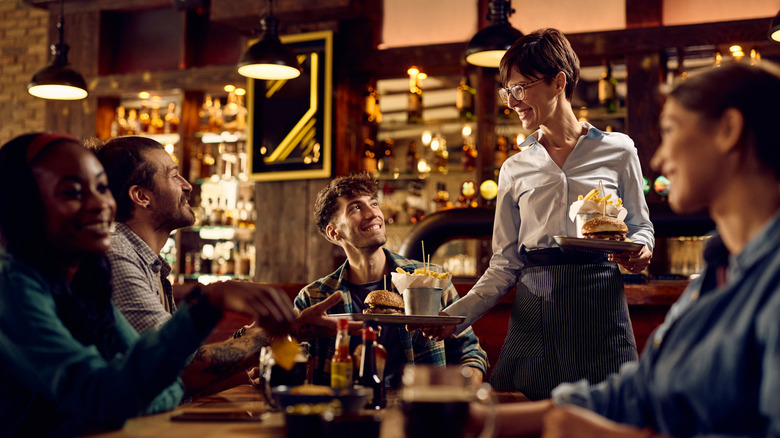
What would a restaurant be without customers? A big empty building with tables in it, that's what. Any business relies on customers to keep it afloat, and when you're in the hospitality industry (which encompasses hotels, nightclubs, and indeed, restaurants), keeping your guests happy is especially important. But in case you want to whip out that old chestnut — "the customer is always right" — you should know that the dynamic between guests and staff is considerably more nuanced. We talked to Charles Richardson, the food and beverage director at Double Eagle Hotel & Casino in Cripple Creek, Colorado, and he told us that customers, as important as they may be, are not always right.
"For me, [the phrase] means respecting the guest's expectations, as long as they do not contradict the restaurant's rules and common sense," Richardson said. Unfortunately, some guests take it to mean that they are genuinely infallible and carry themselves like King Louis XIV. "Some guests take [the phrase] literally, allowing themselves to pressure the staff or ignore the rules, but thankfully this does not happen often," Richardson said. Just be sure to do your part and avoid complaining about prices to the waitstaff, as well as refraining from hemming and hawing at the drive-thru window.
Why some restaurants take 'the customer is always right' ethos to heart

Charles Richardson noted that certain kinds of restaurants — namely, fast food franchises — will often operate under the assumption that the customer is always right, simply because they can afford it. "Chain restaurants and corporate franchises generally adhere to this principle because their business model is built on mass appeal and avoiding conflict," he said. "It is easier for them to refund money or give a free dish than to deal with the situation." If someone comes storming into a McDonald's demanding a fresh sandwich, it would probably be quicker and cheaper to appease them.
But if you don't have McDonald's money kicking around (if you're running a restaurant with notoriously tight profit margins, you probably don't), you'll have to behave differently. "Independent restaurants and establishments with hands-on staff more often focus on balancing interests, as their model is built on values and clear rules, not on avoiding dissatisfaction at all costs." What's a better approach for running a restaurant? Richardson has a suggestion. "My principle is mutual respect and reasonable expectations. The guest deserves quality food, honest service, and attention, while the staff deserves politeness, fair pay, and a safe working environment."