

127 Common Phrases On A Menu (And What They Mean)
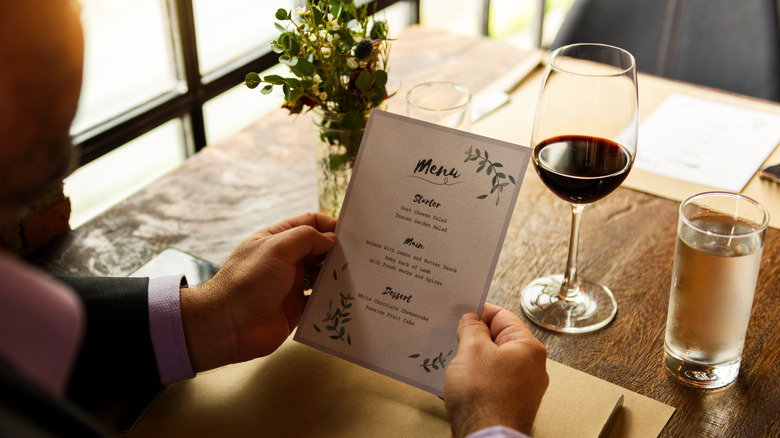
The further up the food chain you get, the more difficult the menus are to understand, to the point where deciphering them can become an absolute nightmare (much like "The Menu," a 2022 horror comedy set in the world of fine dining). Okay, so maybe fine dining establishments aren't going to start using pictures on the menu a la Denny's, but would it kill them to use familiar descriptors instead of trying to sound fancy with obscure terminology?
As that isn't likely to happen anytime soon, we present to you this handy guide to decoding menu-speak. Some of these terms you may have encountered before, but never dared ask the server to explain. Others may be new to you, but at least you'll be prepared if they do pop up unexpectedly. After all, it's important to know just what you're ordering; otherwise, how will you know you won't be getting a "three-decker sauerkraut and toadstool sandwich with arsenic sauce?" (With all due apologies to Mr. Grinch, who's more of a cuddly Christmas cookie these days). What's more, familiarity with menu terminology might even save your life — if you read the menu ahead of time and decide on the steak Diane "en flambé," you can avoid any potential fire hazard by wearing a non-flammable shirt.
Different types of restaurant terms

Many menu terms are difficult to understand because they come from other languages. If you're ordering off a menu in Italy, of course, all of the words are going to be in Italian, so you'll know to have Google Translate on standby if you're not fluent in the language. If you're dining in Brooklyn, however, and the rest of the menu is in English, a random Italian word or phrase can throw you (The same goes for French, Japanese, Spanish, or even industry jargon). Other menu terms may describe unfamiliar ingredients or refer to particular preparation methods or types of cuisine. Without further ado,here are some terms you might want to familiarize yourself with:
| À la broche | Cooked on a spit or skewer |
| À la carte | Dish ordered as a stand-alone item |
| À la mode | Either prepared in a certain popular style (if an entrée like steak) or topped with a scoop of ice cream (if a dessert) |
| A la plancha | Cooked on a heated metal plate or griddle |
| À point | Medium-rare |
| Abalone | Type of edible sea snail |
| Aioli | Creamy garlic sauce with egg and oil (also used to describe flavored mayonnaise) |
| Amaranth | Tiny ancient grain or seed with a nutty flavor |
| Amuse-bouche | Bite-sized appetizers (usually chef's choice and often offered free of charge) |
| Al dente | Firm and slightly chewy |
| Antipasto | Cold Italian-style appetizer course often including cured meats, cheeses, and olives |
| Apéritif | Type of drink meant to enhance the appetite before a meal |
| Au jus | Meat served in its own juices |
| Ballotine | Slice of roasted meat stuffed and rolled into the shape of an egg |
| Béarnaise | Sauce made with butter, egg yolk, and vinegar |
| Bechamel | Sauce made with butter, flour, and milk |
| Beurre blanc | Sauce made with butter, white wine, and vinegar |
| Bien cuit | Well-done meat |
| Blue (or bleu) | Very rare meat |
| Bisque | Creamy shellfish soup |
| Bomber | 22-ounce (or larger) bottle of beer |
| Bouquet garni | Bundle of fresh herbs (usually bay leaf, parsley, and thyme; may include other optional seasonings) |
| Braised | Meat that has been slow-cooked in liquid until it becomes fall-apart tender |
| Burrata | Mozzarella filled with cream and curds |
| Cannon | Tenderest and leanest cut of lamb or venison loin |
| Canapé | Small appetizer served on bread or a cracker or encased in a pastry shell |
| Carpaccio | Raw, thin-sliced meat or fish |
| Cassoulet | French-style casserole of beans and meat |
| Ceviche | Raw fish "cooked" in a citrus juice marinade |
| Charcuterie | Cured or prepared meats (can include confit and pâté) served cold |
| Chateaubriand | Filet mignon roast |
| Chaud | Hot |
| Chèvre | Goat cheese |
| Compote | Whole or chunked fruit cooked in a sugar syrup |
| Confit | Meat cooked in its own fat |
| Consommé | Clear broth |
| Cornichon | Tiny pickled gherkin |
| Coulis | Sauce made from pureed fruits or vegetables |
| Cremeux | Sweet, creamy, pudding-like dessert; not as airy as a mousse |
| Croustade | Crispy bread or pastry shell |
| Crudo | Raw |
| Crudites | Raw vegetables often accompanied by a dip |
| Decanted | Liquid poured into a different container to remove the sediment |
| Deconstructed | Dish where the parts are left unassembled |
| Demi-glace | Reduction of brown gravy and wine |
| Digestif | After-dinner drink meant to help you digest your food |
| Du jour | Of the day |
| Edamame | Green soybeans; usually steamed in their pods |
| En brodo | Cooked in broth |
| En cocotte | Cooked (and often served) in a covered pot |
| En croûte | Encased in a pastry crust |
| En papillote | Steamed in a paper or foil wrapper |
| Entrecôte | Thin-cut boneless ribeye steak |
| Escabeche | Cooked meat or vegetables marinated in seasoned vinegar |
| Escargot | Edible land snail |
| Étouffée | Cajun or Creole dish consisting of shellfish in a thick sauce; usually served over rice |
| Farci | Stuffed |
| Fines herbes | Combination of chervil, chives, parsley, and tarragon |
| Flambé | Doused in flaming booze |
| Foam | Airy, whipped substance (can be vegetable or dairy) |
| Foie gras | Fattened duck or goose liver |
| Frenched | Meat that's been cut away from the bone and fat |
| Fricassée | Stewed meat served in a white sauce |
| Fusion | Cuisine that combines elements from two or more different cultures |
| Ganache | Chocolate mixed with cream |
| Gastrique | Sauce made with caramelized sugar and vinegar |
| Ghee | Type of clarified butter often used in Indian cooking |
| Gnocchi | Dumplings made from potatoes or semolina |
| Gnudi | Dumplings made from ricotta cheese |
| Gougere | Cheesy choux pastry puffs |
| Granita | Partially frozen into a slushy state |
| Gratin | Topped with a crust of cheese or breadcrumbs |
| Gremolata | Sauce made with garlic, lemon zest, and parsley |
| Guanciale | Italian cured meat made from spiced pork jowls |
| Haché | Finely chopped or ground |
| Haricots verts | Green beans |
| Heritage | Traditional produce (small crop, not mass-produced) |
| Hollandaise sauce | Sauce made with butter, egg yolk, and lemon juice or vinegar |
| Hors d'oeuvre | Savory appetizer |
| IBU | International Bittering (or Bitterness) Units; used to measure the bitterness of beer |
| Jeroboam | Extra-large bottle of wine that holds about three liters (equivalent to four 750 ml. bottles) |
| Julienne | Sliced into thin strips |
| Kobe | Premium Wagyu beef produced in Japan's Kobe region |
| Langoustine | Small saltwater crustacean similar to crayfish and related to lobster |
| Lardon | Small piece of salt pork used to season meat |
| Maki | Sushi roll |
| Meuniere | Lightly coated with flour and pan-fried in butter |
| Mezze | Mediterranean-style small-plate appetizers (can be hot or cold) |
| Millefeuille | Dessert of puff pastry layered with pastry cream |
| Moelleux | Cake with a molten center (aka lava cake) |
| Nigiri | Raw fish served on seasoned rice (standard sushi presentation) |
| Omakase | Japanese term meaning chef's choice |
| Panisse | Snack made from fried chickpea flour |
| Pappardelle | Wide, flat noodles (aka ribbon pasta) |
| Pavé | Certain square or rectangular-shaped foods (can be desserts, potatoes, or steak) |
| Pâté | Spread made with meat that's been finely chopped or pureed |
| Pimenton | Smoked paprika |
| Piri piri | African Bird's Eye chile |
| Pistou | Provençal sauce made with basil, garlic, and olive oil (and sometimes parmesan cheese and tomatoes) |
| Pommes purée | Mashed potatoes |
| Primo | First course of an Italian meal (typically pasta) |
| Prix fixe | Fixed price (often applies to a complete meal) |
| Provencale | Cooked with anchovies, olives, and tomatoes |
| Ragout | French-style slow-cooked stew made with meat, fish, or vegetables |
| Reduction | Liquid that's been concentrated by simmering to intensify the flavor |
| Rémoulade | Sauce made from mayonnaise flavored with anchovies, capers, gherkins, herbs, and mustard |
| Rillettes | Potted meats cooked and packed in their own fat |
| Roe | Fish or shellfish eggs |
| Romesco | Spanish-style sauce made with almonds, garlic, peppers, and tomatoes |
| Rouille | Provençal sauce made with breadcrumbs, chiles, garlic, and olive oil |
| Saignant | "Bleeding" (very rare) meat |
| Samphire | Edible marsh grass with a somewhat briny flavor |
| Sashimi | Japanese dish of thinly-sliced raw fish(differs from sushi in that rice isn't part of the preparation) |
| Sauce Vierge | Uncooked Provençal sauce made with herbs, lemon juice, olive oil, and tomatoes |
| Semifreddo | Partially frozen Italian dessert that resembles a cross between ice cream and mousse, but is sliced like cake |
| Shiso | Aromatic Japanese herb with a citrus-like flavor that often accompanies sushi |
| Socarrat | Crunchy layer of rice that forms on the bottom of a pan (especially in paella) |
| Sous vide | Food sealed in a bag and simmered in water |
| Tabbouleh | Lebanese-style salad made with cracked wheat, lemon juice, mint, onions, olive oil, parsley, and tomatoes |
| Table d'Hote | Set menu |
| Tapas | Spanish-style appetizers or small plates |
| Tartare | Finely-chopped raw meat (typically beef or tuna) |
| Tempura | Vegetables, fish, or meat fried in a light, Japanese-style batter |
| Terrine | Either an earthenware pot or chopped meats or vegetables served in such a pot |
| Velouté | Sauce made with meat or fish stock, cream, and a butter-flour roux |
| Wagyu | Well-marbled beef from a specific type of Japanese cattle (or a crossbreed, in the case of American Wagyu) |
| Yōshoku | Japanese-style versions of European or American dishes |