

How To Understand PPU Labels At The Grocery Store
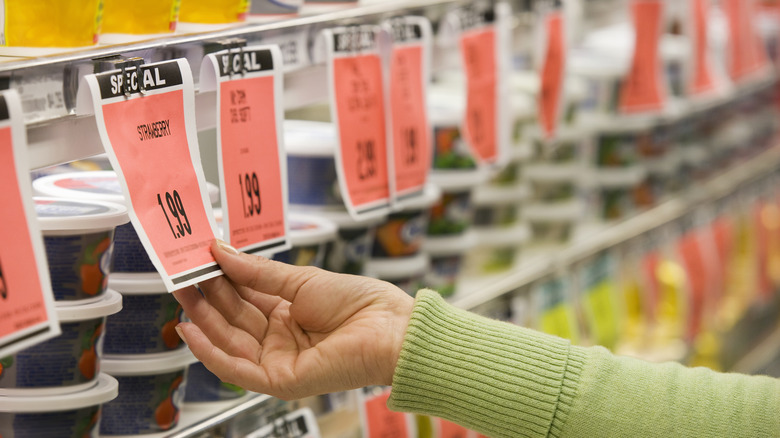
We've all been there: after standing frozen in the grocery store aisle for a small eternity trying to crunch the numbers and determine if 16 ounces of cereal for $5.95 or 12 ounces for $4.78 is a better deal, you throw caution (and your grocery budget) to the wind and chuck a random box in the cart. Grocery shopping can involve a lot of math, and to make matters worse, stores often take advantage of this confusion with complicated supermarket sales that trick you into spending more money. Luckily, savvy grocery shopping can involve a lot less arithmetic if you know how to understand price per unit (PPU) labels.
In most American grocery stores, you'll find PPU labels for many items. Formatting can vary widely, but the unit price is usually found in smaller print next to the total price on the shelf label. The unit price breaks down how much an item costs per unit, such as ounces, pounds, grams, or milliliters. This makes it easy to determine which brand or size of a product offers the best bang for your buck (and whether you'll really save money by buying in bulk, which isn't always the best shopping method).
Why PPU labels can be confusing
In theory, price per unit labels should be incredibly easy to understand – the product with the lowest unit price is the best deal. In practice, however, things can get quite confusing. For one thing, what constitutes a unit can vary widely and is often extremely inconsistent even within the same supermarket. For example, bottles of juice might be measured in milliliters or ounces, and paper towels could be broken down by rolls, feet, or yards.
Adding insult to injury, there's no one uniform format for unit price labels in the United States. Unit pricing laws vary by state, and at the time of writing, the majority of states have no laws or regulations regarding PPU labels, meaning it's totally voluntary for retailers. Although the federal government has published best practices for unit pricing, unsurprisingly, not all stores follow these guidelines to a tee. As a result, PPU labels are often printed in impossibly tiny text or (perhaps intentionally) confusing formats. That said, unit pricing labels are a great tool to save time and money while grocery shopping, and it's definitely worth taking a few minutes to study and understand the PPU labels in your favorite American grocery store.