

Never Be A Customer Who Complains About This To Restaurant Employees (It's Not Their Fault)

There are plenty of restaurant etiquette rules that customers break when dining out. It's sometimes understandable, as folks may not always be aware of the various formalities they are supposed to observe. In many establishments, it's considered polite to comply with napkin etiquette, and there are a dozen rules for the drive-thru that are likely unknown to most. Still, some behavioral standards are obvious, and there is really no excuse for ignoring them. One of those straightforward practices is treating the staff with respect, and if you start complaining about the menu prices to your server at a restaurant, you're breaking that very simple rule.
With the price of eating out having risen by roughly 33% in the last five years, according to the U.S. Bureau of Labor Statistics, it's reasonable to experience sticker shock at a restaurant these days. But that server you're interacting with, or the cook you see behind the line, typically has no say whatsoever over what the establishment charges for its food. Numerous factors play a role in how menu prices are set, but employees don't make those decisions. Taking out your frustrations over a meal being too expensive on the person bringing you your food is not only a waste of your time and theirs, but you're going to come across like a jerk.
Restaurants aren't in business to pilfer customers
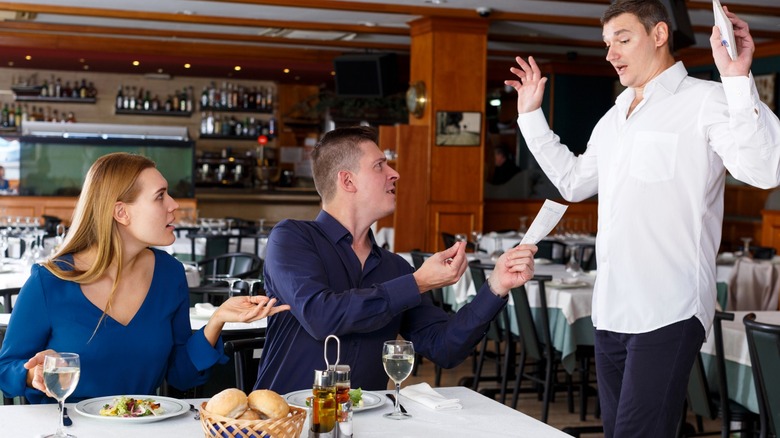
Some folks assume menu prices that don't fit neatly into their budget are established to extract every last cent from a customer's pocket to enrich corporate actors. While there are surely instances of that occurring, it's not the norm, especially at your mom and pop shops. At the end of the day, all restaurants exist to make a profit, and menu prices have to reflect various considerations so a business can stay out of the red.
Food cost is typically the primary factor that determines prices in a restaurant. That is something most people can understand and relate to. Grocery bills have increased by about 29% since 2020, per the U.S. Bureau of Labor Statistics, and restaurants aren't immune to that phenomenon. When they pay more for ingredients, at least some of that cost is passed on to customers to keep the business' financial head above water.
A sharp increase in wage demand over the past few years has also influenced restaurant pricing. Employees justifiably want to be fairly compensated for their labor, but a business is not a charity. When servers and cooks are paid more, your appetizers and entrees will be a bit more expensive to cover that cost.
Overhead expenses, such as rent and energy costs, also play a role in what your bill reads at the conclusion of your meal. Restaurant employees have no control over these circumstances, even if they were in charge of setting prices. In fact, in some corporate chains, you won't find anyone in the building who has a say over prices because that occurs at corporate headquarters. Complaining about the cost of food to employees or even managers is the restaurant equivalent of tilting at windmills, and it won't result in a cheaper meal.