

The American Bread Ingredients You Won't Find In European Loaves
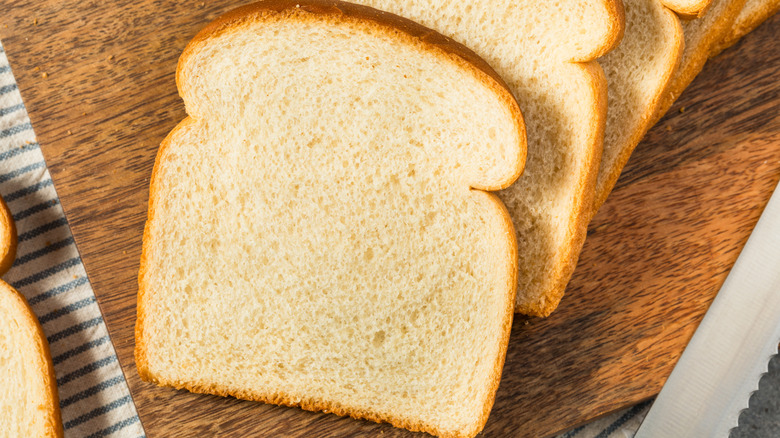
There's nothing like sinking your teeth into a fresh slice of azodicarbonamide or potassium bromate, right? The biggest difference between bread sold in the United States and Europe is the chemicals allowed in the loaves, and these two are some of the most prevalent. The reason Europe bans them? You guessed it: the potential danger they pose to human health.
There's a smorgasbord of unnecessary chemicals (I mean, ingredients) that are regularly used in food within the U.S. but are banned in Europe. When it comes to bread, Europe doesn't allow the same stuff used in foam insulation, protective padding, and plastics, known as azodicarbonamide, or ADA, the way some American bread companies do. This chemical is used as a dough conditioner — it aids gluten development, boosts volume, and bleaches the flour.
You may recall the 2014 Subway "yoga mat bread" controversy — that was due to ADA. Subway eventually phased it out, not only because Americans didn't like the idea of gnawing on an ingredient also used in yoga mat filler, but also because of the possible health risks associated with ADA. European food-safety authorities banned ADA as an ingredient in 2005 because one of the compounds it breaks down into (semicarbazide) was shown to be carcinogenic in lab animals in high doses (via Official Journal of the European Union). However, in the United States, ADA is considered "a safe food additive when used for the purposes and at the levels specified in the FDA regulations." Though the permitted amounts of ADA in American bread are very low, it's not impossible that it could pose health risks in humans. Although some U.S. companies phased out ADA, the Environmental Working Group (EWG) lists nearly 50 products that still use the industrial additive.
Potassium bromate is also banned in Europe
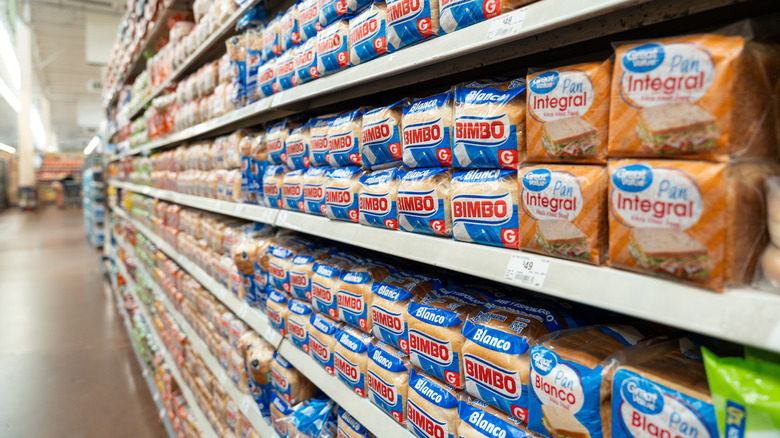
Widespread use of ADA in the United States may persist because some companies turned to it as a replacement when its notorious cousin, potassium bromate, faced public scrutiny for frequent use in U.S. bread while being banned across Europe. Potassium bromate (PB) is marketed as a dough improver, performing similar tasks as ADA: strengthening gluten, improving elasticity and softness, and bleaching the flour.
Potassium bromate hasn't received the kind of "yoga mat bread" media attention that ADA did, though it has been classified as potentially carcinogenic in humans by the International Agency for Research on Cancer (IARC), a division of the World Health Organization, since 1999 (per EWG). It is banned in the European Union, the United Kingdom, Canada, Brazil, India, China, and several other countries due to studies showing negative health impacts in animals and the potential for similar effects in humans.
The FDA permits PB in bread, citing that potassium bromate converts into "harmless" potassium bromide, and "normal control measures can ensure that bromate residues when present in final products are at safe levels." This regulation isn't foolproof, as testing in the United Kingdom found detectable bromate in some packaged and bakery-style loaves, and some experts assert that any amount of potassium bromate could be unsafe for humans to consume. The EWG lists more than 200 products sold in the U.S. containing potassium bromate.
Why do American companies make bread with chemicals banned in other countries?
The FDA classifies azodicarbonamide (ADA) and potassium bromate (PB) as GRAS — generally recognized as safe — allowing companies to rely on them for speed, consistency, and low cost. However, the use of these chemicals in American bread may be waning as states like California, Utah, Texas, and New York have banned or proposed bans on ADA, PB, and other unnecessary additives, with several other states following suit. Perhaps these ingredients will become a thing of the past someday soon, like the foods and additives from the 1970s and 1980s that are banned today.
While the standard bread in American grocery stores may not taste like the baguettes in France or the ciabatta in Italy, it's still possible to seek out loaves made with similar quality ingredients by checking labels in stores, at local bakeries, or online. Alternatively, just bake your own bread with foolproof from-scratch sourdough starter, or follow an easy recipe for types of bread that are perfect for beginners – this way, you'll know exactly what is (and isn't) in your loaf.