

Here's How Much A McDonald's Big Mac Cost The Decade You Were Born
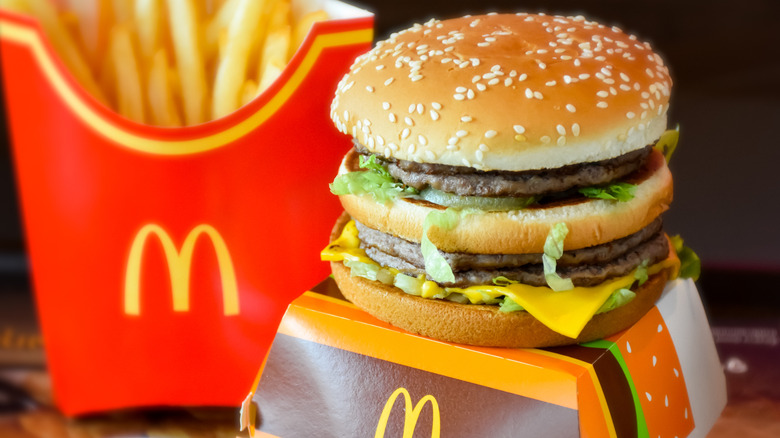
McDonald's has been an American staple for decades, and for over 50 years, the Big Mac has been a highlighted fixture on the chain's menu. While the Big Mac didn't place particularly high in our ranking of every burger on the McDonald's menu, there's no denying that the three-bunned burger is one of the most iconic fast food items of all time. And while its physical existence hasn't changed much since its debut in the 1967 — beyond some minor changes to the not-so-secret Big Mac sauce – the one area that it has evolved massively is how much it costs. In the immortal words of rapper Fat Joe, "yesterday's price is not today's price," and that sentiment is more true for the Big Mac than anything.
Across the seven decades that the Big Mac has existed, the amount of money it costs to buy one has increased in both big and small increments for a myriad of reasons, such as inflation, rising labor costs, and the corporation's constant intention to maximize profits. In the end, each generation has grown up with a different understanding of just how much a Big Mac costs for one reason or another. Here's how much the iconic fast food burger cost during the decade you were born.
1960s
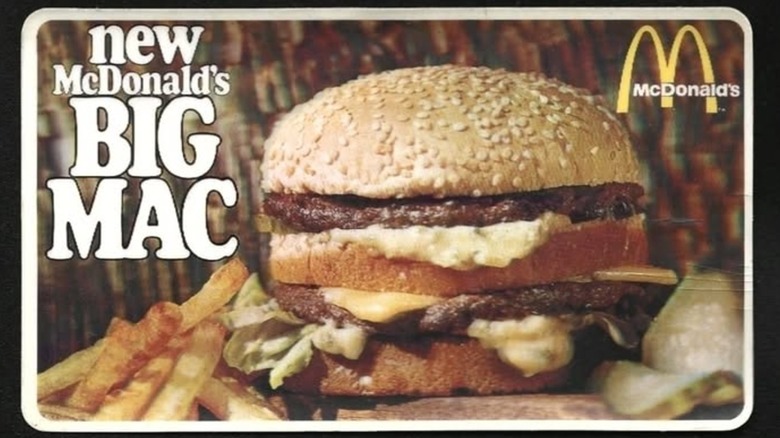
Upon the Big Mac's debut at a McDonald's location in Uniontown, Pennsylvania, in 1967, the burger was sold for $0.45 each. While this is obviously a very low price compared to modern day, it was actually far more expensive than the average fast food burger at the time — which was around $0.22. Plus, this low price is much more understandable when you adjust it for inflation; $0.45 in 1967 equates to roughly $4.44 in 2025, which makes it much less distant from the burger's modern-day price. Nevertheless, the menu item kept that same price tag when it went nationwide in 1968. The Big Mac made up 19% of all McDonald's sales by 1969, making the '60s an incredibly strong opening decade for the now iconic Big Mac.
1970s
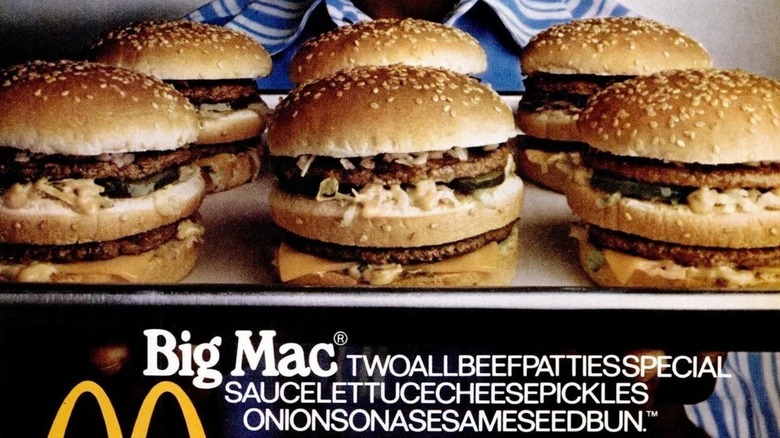
The 1970s saw several price hikes for the Big Mac, and with its expansion nationwide, prices began to differ massively depending on location. While 1970 saw a small rise to $0.49 at some locations, according to customers online, the burger's original price doubled by the time it hit its 10th anniversary on the nationwide menu, costing $0.90 by 1978. This latter price is equivalent to roughly $4.68 today and was actually lower than the price of the Quarter Pounder with Cheese, which was first introduced in 1973 and priced at $0.95 by 1978.
1980s
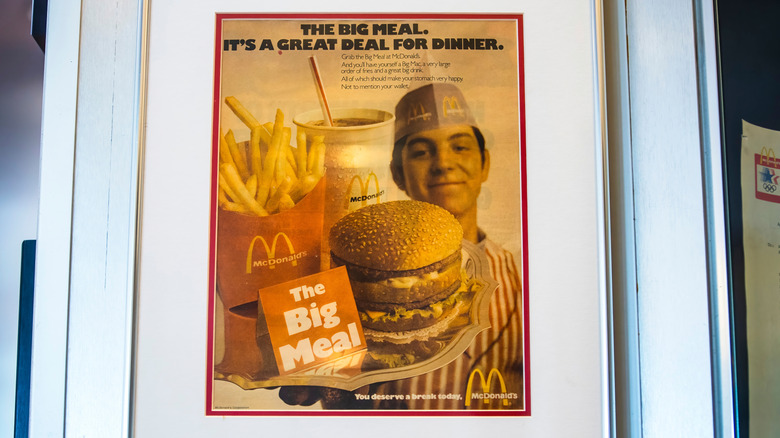
The 1980s were a time of massive growth for McDonald's, and with that growth came even larger price increases for its signature burger. The decade that brought us McDonald's legendary, fan-favorite McRib was also the one that saw the Big Mac finally surpass $1. It was priced at around $1.20 in 1980 and then jumped yet again to $1.60 in the years to follow, maintaining roughly that price throughout the rest of the decade. In fact, $1.60 became the starting point for the Big Mac Index, an economic measurement created by The Economist magazine in 1986. Adjusted for inflation, $1.60 in 1986 is about $4.74 in today's money, reflecting a relatively steady rise in price over the menu item's first two decades in existence.
1990s
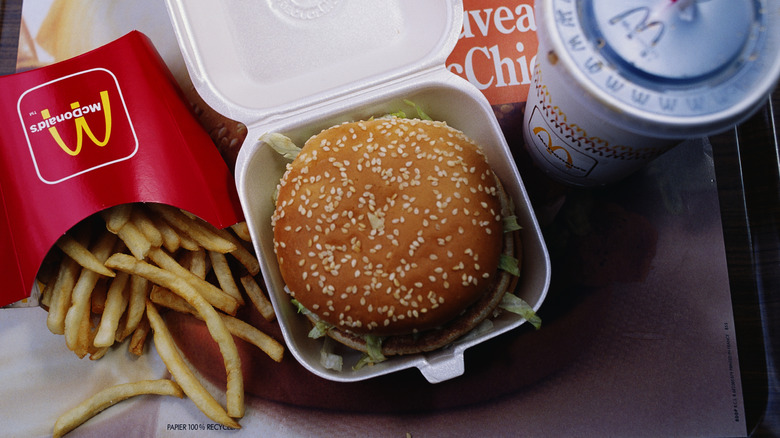
By the mid-1990s, McDonald's signature menu item was sold at an average price of $2.36 nationwide, which is equivalent to around $4.96 today. However, the menu item was also subject to some interesting temporary price changes throughout the decade. The 1990s were all about promotions and deals at McDonald's, with the Extra Value Meal debuting in 1991 and countless special pricing options coming and going for consumers to enjoy. One of these promotions in 1996 actually dropped the Big Mac's price to just $0.59 – albeit only when it was purchased alongside a full-priced order of fries and a drink. This short-lived deal evened out to a fairly minor discount for the Big Mac Meal but was ultimately a rare instance of the menu item actually lowering its price.
2000s
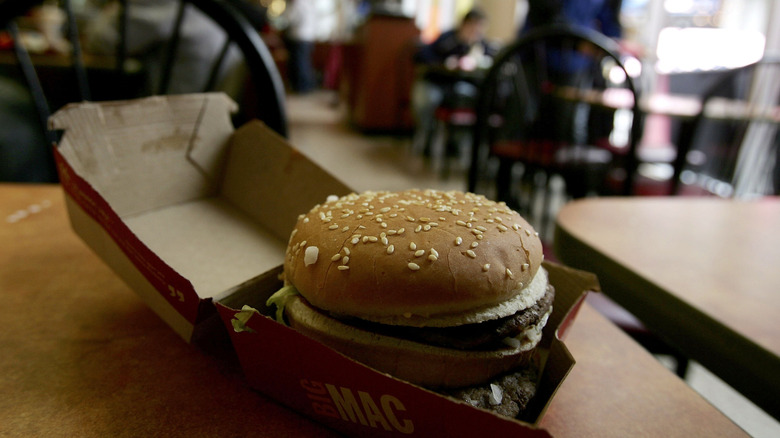
The price of the Big Mac remained around the $2.30 mark throughout the first half of the 2000s, with only minute price increases each year. The burger eventually rose to an average price of $2.58 in 2005 before making major jumps in the years to follow. By 2007, the signature burger had an average price of $2.89, and just two years later, it would end the decade at an average price of $3.43 in 2009. These price hikes can be attributed, in part, to the Great Recession, which plagued the global economy starting in 2007.
2010s
Despite the Great Recession technically coming to an end in the summer of 2009, McDonald's Big Mac price increases didn't subside when the 2010s came along. The item climbed to $3.64 in 2011, marking a full dollar increase over the course of six years. By the time the burger's price crossed the $4.00 mark in 2013, however, things did begin to slow down slightly. While the Big Mac Index shows that the Big Mac closed out the decade at an average cost of $4.71 nationwide in 2019, McDonald's claims that the menu item's average price was just $4.39. Either way, the years following the early 2010s were much less chaotic and more in line with the burger's historically slow and steady price increases.
2020s
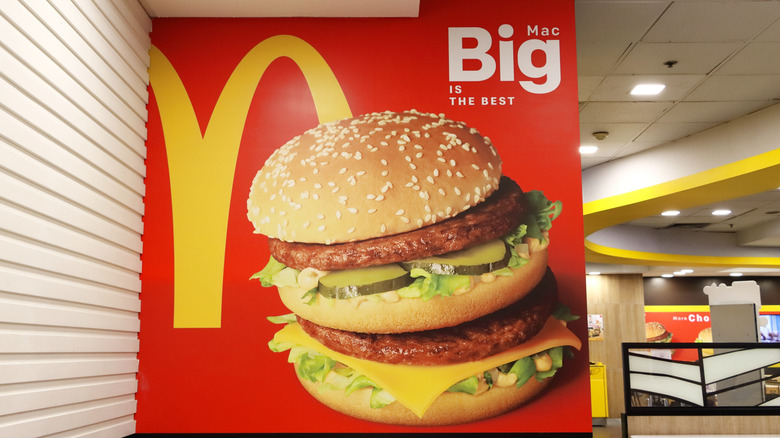
The 2020s have been a turbulent time economically, and McDonald's signature menu item has reflected that as well. Starting the decade with an average price of $4.82 for a standalone burger, the global chain has garnered plenty of criticism for alleged price gouging in the years to follow. This is especially noticeable when taking into account that the Big Mac's average price increased over $0.60 from 2022 to 2024, when it arrived at $5.69. The average has since risen another $0.10, with the current average for what was once a $0.45 item now standing at $5.79.