

Why You Should Use A Garlic Press, Even Though Some Chefs Despise Them
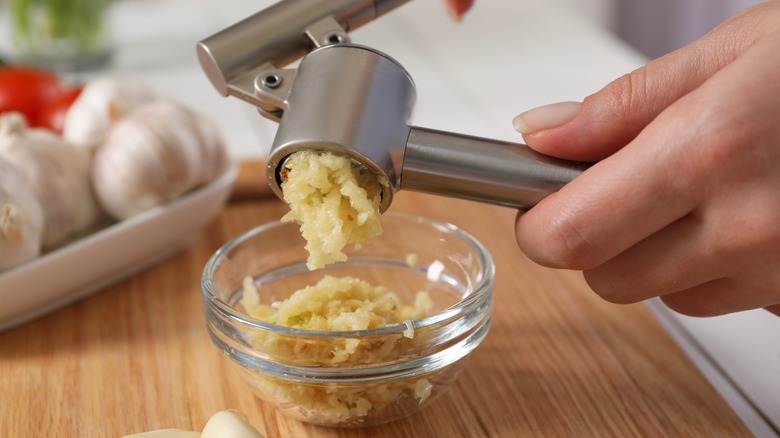
I don't know when celebrity chefs and folks in the food industry started telling people that kitchen gadgets (particularly those designed to do a single task) were evil and a disgrace to kitchen-dom, but I know that I listened to them for a long time. Part of it was probably me wanting to prove that I was a savvy cook who could accomplish anything with a chef's knife and my bare hands, just like my television mentors told me. I've gotten older and, hopefully, wiser. In short, I will use whatever I darn well please to get my dinners done in a timely manner. The garlic press is one such tool that I find very easy to use and convenient, but it's still often vilified in the food industry.
What I love most about my trusty garlic press is that my fingers don't get sticky and smelly the way they do when I mince cloves with my chef's knife. Sometimes, you can even fit multiple cloves in the chamber at once. You can also put cloves in garlic presses with their skins on. Just place your garlic cloves inside, give a press, and the minced garlic is pushed out while the skin remains in the device.
Most recipes specify the form of garlic needed, whether that's sliced or minced. Swapping minced garlic for sliced usually isn't the best idea, as the press releases more oils, giving you a much stronger flavor that could overwhelm the dish. But when a recipe calls for minced garlic, nothing is easier than a garlic press. The professionals can call us "cheaters" all they want; in the end, we're still cooking our own food (and sometimes even following their recipes!).
The case against garlic presses
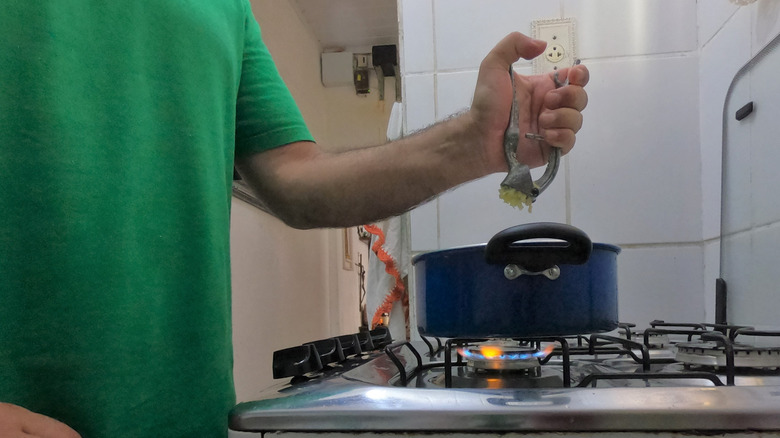
Garlic presses are criticized for being bulky and difficult to store. I call baloney. My meat mallet is a whole lot harder to fit into kitchen drawers. People also say they're hard to clean. Not so much, in my opinion. A good spray of water and a wipe with a soapy sponge have consistently been all I need to clean mine (and you can scrub away any stray garlic pieces with a toothbrush).
Perhaps the biggest argument is that the device changes the way the garlic tastes. There's some truth here. When you cut into a clove of garlic, its potent enzymes (called allicin) are released, and the more you handle it, the more allicin is produced. When you crush it with a garlic press, you're pulverizing it, releasing the juices as well. This is great for boldly flavored recipes, like umami-packed stir-fries, warm bowls of spicy shrimp scampi, or a copycat Papa Johns garlic sauce, but not so much for those that call for very little of the aromatic bulb.
Separately, there are some single-task kitchen gadgets that end up being useful in other areas. For example, my trusty cherry pitter also happens to perfectly pit olives. But the garlic press is truly just for garlic. I know this because I once tried to crush a piece of fresh ginger in it. My ginger did not crush, and my garlic press shattered. Still, despite its limited scope, the garlic press earns its spot in my drawer because for the one thing it does, it's absolutely worth the cost of admission.