

The Age-Old British Lunch Tradition That Was Actually Made Up
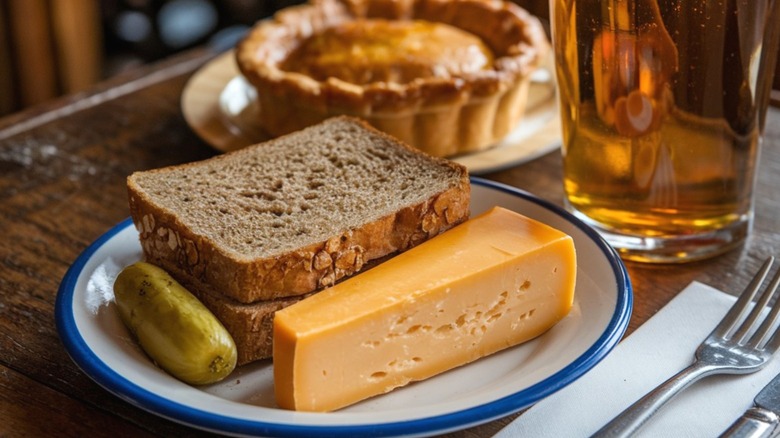
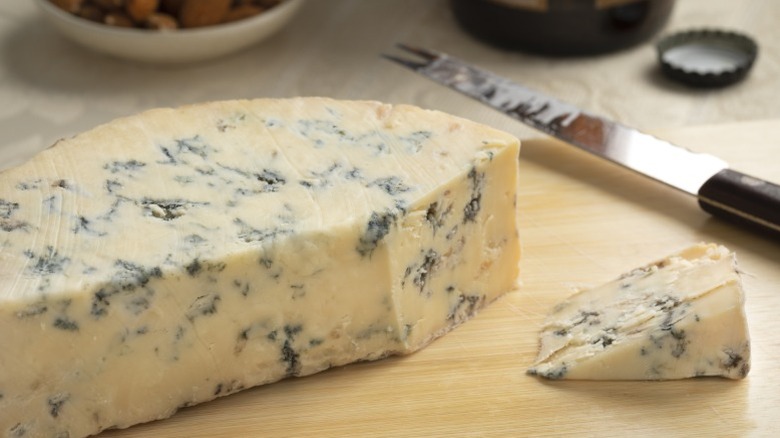
If you've ever been to the United Kingdom, you've probably seen a menu item with a rather evocative name. The "ploughman's lunch" (or just a "ploughman's" for short) might be offered by a pub in the middle of the day, or it might take the form of a sandwich you pick up from Tesco. In either case, the ingredients are similar: thick, crusty bread with a must-try British cheese (usually cheddar or Stilton), as well as pickled onions and a type of chutney, such as Branston Pickle. (This being Britain, it's usually served with beer — unless you're at Fitzpatrick's, a famous non-alcoholic pub.) It's simple, hearty, and satisfying, exactly the kind of thing you might imagine a British ploughman eating hundreds of years ago — which is funny, because the idea of a "ploughman's lunch" is kind of a lie.
Well, maybe "lie" is a harsh word. Bread and cheese have been staples of British cuisine for as long as Britain has existed, and onions weren't too far behind (having been introduced to Europe in the Roman era). There have certainly been countless ploughmen throughout British history who enjoyed a lunch of bread and cheese after a hard morning's work. But nobody called it a "ploughman's lunch" — why would they? City folk ate bread and cheese too, after all, and the ploughmen were probably too tired from working the fields to start a whole branding exercise. After one non-specific use of the phrase by Sir Walter Scott, the first use of "ploughman's lunch" (or "luncheon") came in 1956, courtesy of a group called the Cheese Bureau.
The ploughman's lunch was a way to reinvigorate cheese sales
When the Cheese Bureau, in 1956, stressed the "traditional combination" of bread, cheese, pickle, and beer, they weren't trying to return to some faraway, nostalgic past. They were, in fact, trying to return to a relatively recent, nostalgic past: specifically, the days before World War II, when everyone started rationing. (These rations were how Paul McCartney acquired a taste for sugar sandwiches.) Although the war was won in 1945, rationing didn't completely end until 1954, and struggling industries needed to sell themselves to a recovering British populace.
The Milk Marketing Board took notice, and in the 1960s, they started to advertise the "ploughman's lunch" to pubgoers across the nation. It was canny marketing in many ways, and not only for its evocation of an idyllic English past. For one thing, nobody actually had to cook anything, which meant it could be served by even the most ramshackle, bare-bones pubs in the nation. For another thing, the recipe did not specify a particular cheese, allowing every corner of the country to use its local favorite. (Stilton? Caerphilly? Wensleydale? Go on, then!) The campaign was a success: the cheese industry recovered, the ploughman's lunch remains popular across the country, and the British people are no less susceptible to nostalgic daydreams.