

How A Rock And A Roll Can Help Cut Tough, Thick Vegetables
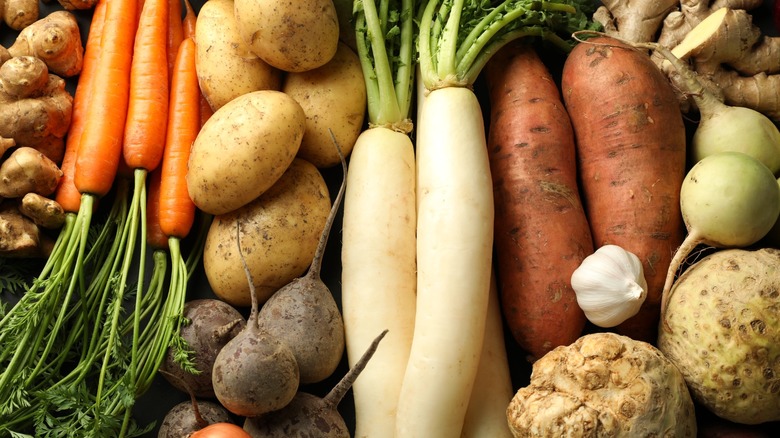
Home cooks typically don't encounter any headaches cutting veggies like onions and celery, but thicker root vegetables such as parsnips and rutabagas can be a different story. Sometimes making clean cuts through tough produce feels like it requires a Herculean effort, even after testing your knife to make sure it's not dull. When The Takeout mentioned this to Shanna Jantz Kemp, a knife-making pro at Jantz Supply, she agreed that thick vegetables can be challenging, especially for folks who might benefit from improving their knife skills. Fortunately, Kemp offered a tip involving a little rock and roll that can make the process a bit easier.
No, she isn't talking about turning your favorite playlist up to 11. Kemp's advice relies more on physics than good tunes. "Rocking a thick vegetable back and forth can make cutting feel easier because you're using body weight and motion instead of pure downward force," she said. "The curved motion helps the blade gradually work through dense flesh rather than trying to split it in one push."
Of course, the type of knife used to slice tougher vegetables also makes a significant difference. "The weight of the knife matters," Kemp said. "A heavier blade helps carry momentum through hard flesh, reducing the need to force the cut and keeping things safer and more controlled." Chef's knives, santokus, or vegetable cleavers are designed to handle downward force without flexing or twisting, she says.
The drawback to rocking your vegetables
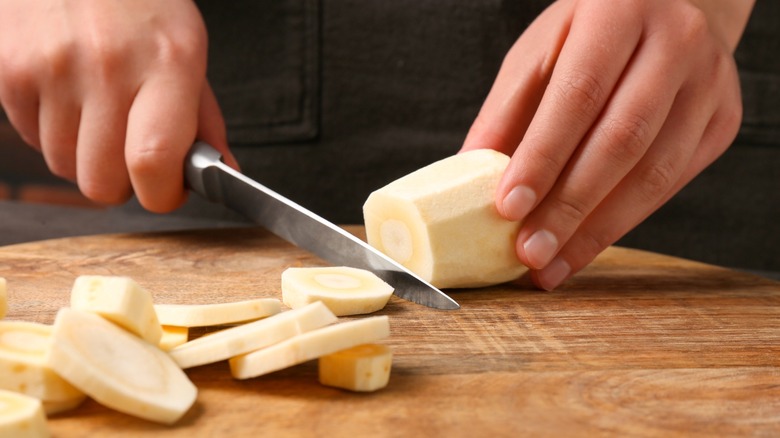
Although a little movement can make cutting through tough vegetables less burdensome for folks who struggle with the task, the act isn't foolproof. Shanna Jantz Kemp warns that taking the rock-and-roll approach isn't without its drawbacks. "The biggest downside is loss of control," she said. "When a vegetable rocks or rolls, the blade can shift unexpectedly, which increases the risk of slipping or binding in the cut." An unexpected shift is a sure-fire way to invite injury, but even if you manage to steer clear of that catastrophe, your vegetables may not look the way you had hoped. "It can also lead to uneven cuts and more strain on the knife," she said.
What's more, you could damage your cutlery. "Twisting the blade while it's wedged in dense food puts stress on the edge and can cause chipping, especially with thinner or harder steel knives," Kemp said. In other words, this wouldn't be the ideal method for newbies using carbon steel knives for the first time. Kemp offered an alternative to rocking veggies back and forth. "Creating a flat base is one of the most important steps," she said. "Splitting the vegetable in half first stops it from rolling, which immediately improves control and safety." While this might not produce perfectly symmetrical shapes, it does save your fingers from unexpected mishaps.
Still, the best way to tackle tough vegetables is with precise knife work. Kemp illustrated what that looks like, saying, "Sharp knives, slow cuts, and using your palm to apply steady pressure on the spine of the blade all reduce strain and make dense vegetables easier to manage."