

What Makes American Goulash Different From Hungarian
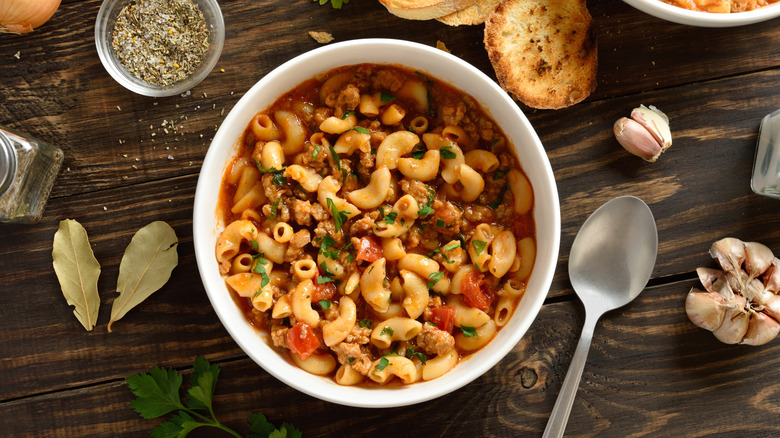
It isn't all that usual for dishes that originated outside of America to have changed somewhat after they were brought over by immigrants. Whether it was a lack of available traditional ingredients, or adapting to American tastes, recipes — like their creators — assimilated. But when it comes to goulash, the difference between the traditional dish from Hungary, and what many in America recognize as goulash, is substantial.
Traditional Hungarian goulash is a meat and vegetable stew, slow cooked in broth, and spiced with plenty of pepper-packed ground paprika which gives it its vibrant color. It's often served with egg noodles or csipetke, a version of the hearty noodle called spaetzle. American goulash is a one-pot dish made with ground beef and tomatoes; it doesn't always call for paprika, and has noodles (often macaroni) incorporated into the dish. It largely resembles a deliciously bulked up chili mac, and even includes cheese. In addition, it comes together much quicker than Hungarian goulash since it doesn't need to be cooked slowly to tenderize the meat.
There are printed sources of American goulash as early as 1909, but these look different from the noodle-and-ground beef concoction we're familiar with. This version was likely an affordable dinner option that helped beef stretch by adding filling noodles and cheese. It hit its peak in popularity around 1969 when a Gallup poll (via Smithsonian Magazine) found goulash to be one of the top five most popular dishes in the country.
The evolution of goulash
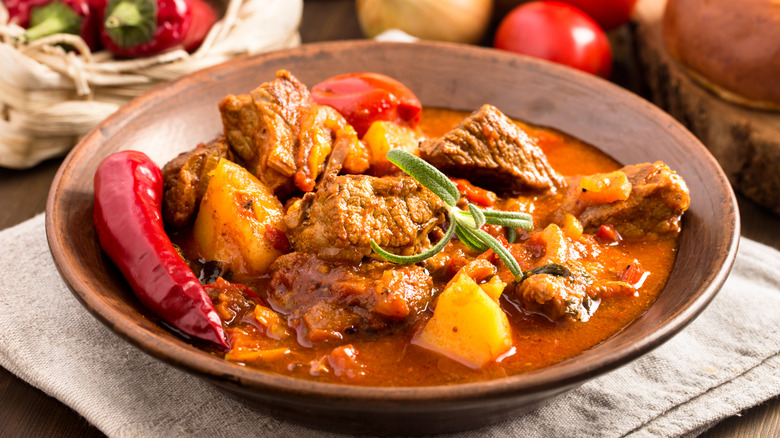
Like many great dishes, Hungarian goulash began as a working class or peasant food. While, at first, societal elites wouldn't dare serve such a rustic dish, it was perfect for Hungarian cow herders who spent months at a time in the open terrain and needed something warm and substantial to fill their bellies. What they put together were the beginnings of goulash. Black pepper was the original main spice for the dish, but this eventually became paprika, which was plentiful in the country.
Early in the 19th century, Hungarian society began to embrace goulash in part as rebellion against the Habsburg's rule and growing German influence. Suddenly, Hungarian peasant culture was a symbol of pride. As immigration to America increased, the dish came to the States, although it has certainly morphed over time. The recipe from 1909 called for cubed sirloin steak that was layered in a casserole dish with carrots, rice, tomatoes, and celery. With a little added water, it was baked in the oven. But that same year, a different recipe for the dish hit the presses, calling for ground beef, spaghetti, onion, and potatoes, all boiled together. By the 1930s, we see the makings of what is popular today; that is, recipes that included macaroni, ground beef, tomatoes, and cooking liquid.
Modern American goulash recipes sometimes incorporate elements of Hungarian goulash, like using larger cuts of beef, substituting pork, or calling for different kinds of pasta. Of course, you'll find a lot more paprika, as well.