

Why Pancakes Taste So Much Better From A Diner Than Homemade
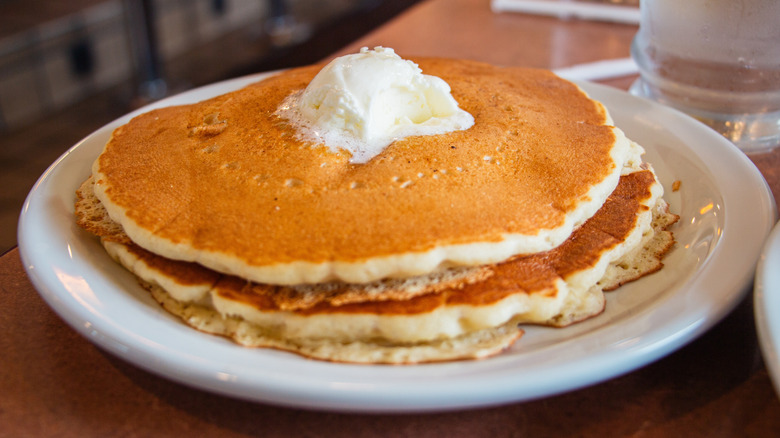
Lots of seemingly simple foods have surprisingly high skill ceilings and pancakes are no exception. You only need three ingredients to whip up morning pancakes, but they never quite reach the level of a syrup-coated pancake stack you'd order at a diner. You might expect the ingredients to be different, but most diner pancakes don't add anything special besides either buttermilk or malted milk. What exactly do diners know that you don't, then? We spoke to Tim Bechtle, the corporate culinary trainer for Broken Yolk Cafe, who was able to provide some behind-the-scenes intel about diner-quality pancakes.
It turns out, how you mix these simple ingredients together matters. According to Bechtle, "Ingredients in a diner are tested and produced on a large scale over time. The ratios are more balanced in large batches as opposed to a small batch where too much baking soda will change flavor, texture and cooking outcome more drastically." On top of that, the staff at a diner will have more experience cooking the same batch of pancake batter in addition to receiving feedback from customers — something a home cook simply doesn't have access to at the same scale. Bechtle paints a picture of diner pancakes being a science experiment: "Picture a diner as a test kitchen that continues to work with a pancake until it's the exact flavor, consistency, and texture they are looking for."
The science of diner pancakes
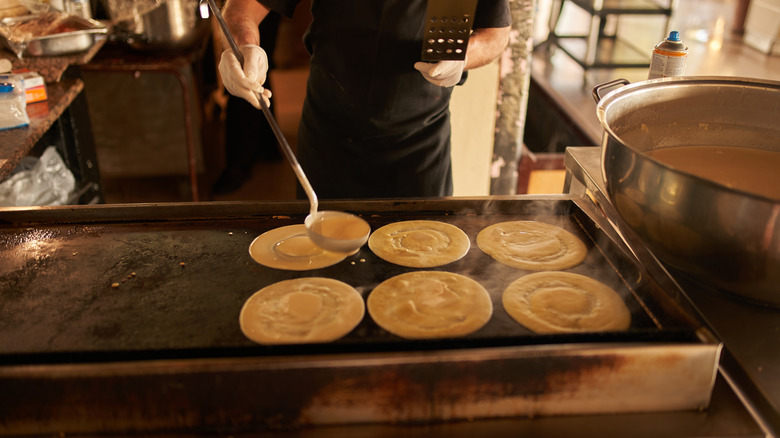
It's not just the volume of pancakes that matters, either. Restaurant kitchens have specialized tools for crafting pancakes. As Bechtle put it, "Unfortunately, a large griddle, a long spatula, and a pancake dispenser aren't going to be found in your home kitchen." By using commercial gadgets like giant, flat-top griddles with precise temperature controls, diners have access to precise measurements and evenly distributed heat. Your home kitchen skillet and common spatula aren't capable of that so you're unlikely to get pancakes which come out as uniform even in a relatively small batch.
We're not trying to discourage you, though. There are a few things you can try at home to move your pancakes slightly closer to diner-quality. According to Bechtle, you should use cold water and avoid over-mixing the pancake batter. "Cold water slows gluten development and allows chemical leavening agents to work more effectively than when the batter is heated; the point being to produce more air bubbles that make the pancakes fluffier." Lastly, while ingredients may not matter much, you can try adding soda water, which is what Martha Stewart uses for fluffy pancakes. You might also try seasoning your pancake batter with something like ground cinnamon, nutmeg, fruit zest, or coconut shavings. If you can't get professional quality, you can still get creative.