

The Major Difference That Separates Cream Top Milk From The Regular Kind
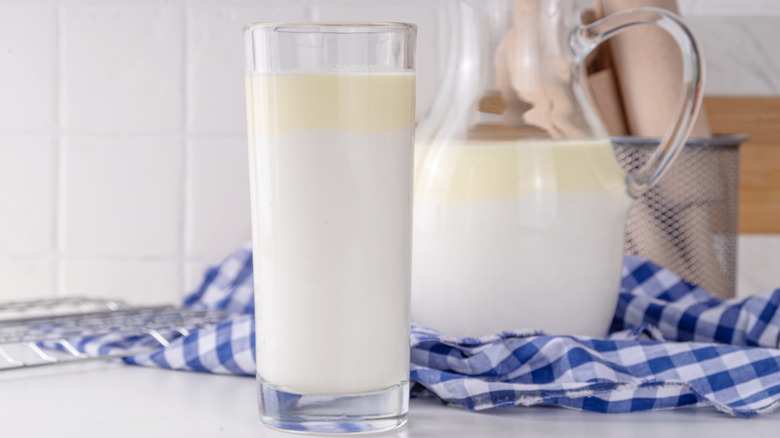
The journey from raw to regular milk involves several steps in the homogenization process, each bringing you closer to the product we know as "whole milk." However, if you miss a single step or decide to forgo the final destination, you may end up with a different milk product altogether: cream top milk. Also known as creamline or non-homogenized milk, cream top milk occurs a few steps in the process before whole milk, and was once referred to as regular milk before the 1920s. Homogenization changed the definition of regular milk, creating smooth-textured milk with no inconsistencies.
Without homogenization, a bottle of milk will show two distinct layers: fat (cream) and non-fat milk. The cream rises and settles on top of the non-fat portion, which is why a thick layer of cream atop a newly purchased glass bottle of milk was a common sight in the old days. With homogenization, the fat globules are broken into tiny pieces that blend seamlessly with the non-fat part, resulting in uniform milk. Ultimately, homogenization has become an essential part of everything milk has to go through before hitting store shelves, along with pasteurization, to create a blended and longer-lasting product.
The process of milk homogenization

When cream top milk is homogenized for commercial use, a large industrial machine forces the milk through an extremely fine sieve with gaps measuring less than 70 microns — about the diameter of a strand of human hair. The fat particles are propelled at high speed under high pressure, which breaks down the large fat globules into smaller ones with a diameter of one micron. Their reduced size allows the fat globules to blend more easily with the non-fat portion of the milk. However, the homogenized milk often requires a second round of processing to further prevent the fat clusters from reattaching and forming cream again. This final homogenization step creates a fine emulsion of fat particles that are permanently dispersed, resulting in whole milk.
Homogenization offers several benefits, most notably a smooth texture for a more palatable drink. It also ensures that nutrients in milk, such as fat and vitamins A and D, are evenly distributed upon consumption. Cream top milk, by contrast, requires skimming off the top layer to create what is often marketed as skim milk. While this can be a preferred option for some, it is important to note that the original milk's components and nutrients are not uniformly distributed in such a case. That said, the top layer of cream top milk, known as heavy cream, can still be used to reach your daily saturated fat quota with homemade clotted cream and enjoyed along with these picture-perfect tall scones.