

Martha Stewart's Expert Onion Technique Gives Boston Baked Beans Even More Flavor

A truly delicious batch of beans, whether that's homey, Mexican-style frijoles charros, cassoulet, or barbecue beans, involves multiple ingredients and plenty of prep and cooking time. Aromatics, vegetables, sauces, and spices are almost always involved in order to infuse the beans with depth and flavor. Boston baked beans are no different, and usually include a generous amount of chopped onion. When Martha Stewart prepares her Boston baked beans, she also includes onion — an entire one, in fact — but instead of chopping it up, she leaves it whole and studs it with cloves.
Stewart prefers a peeled, large white onion (one that weighs a whole pound), which she cuts it in half and then pierces the portions with a dozen whole cloves. She places the onions in the bottom of her cooking pot and pours the rest of her ingredients on top, which include soaked pinto or navy beans, a molasses-based sauce mixture, and some salt pork. The beans slow cook in the oven for six hours, giving plenty of time for the onion and cloves to softly flavor the dish. This method also makes it easy to fish out the onion before serving, although Stewart leaves the onion in the bean pot.
Martha Stewart's onion trick is called an onion cloute
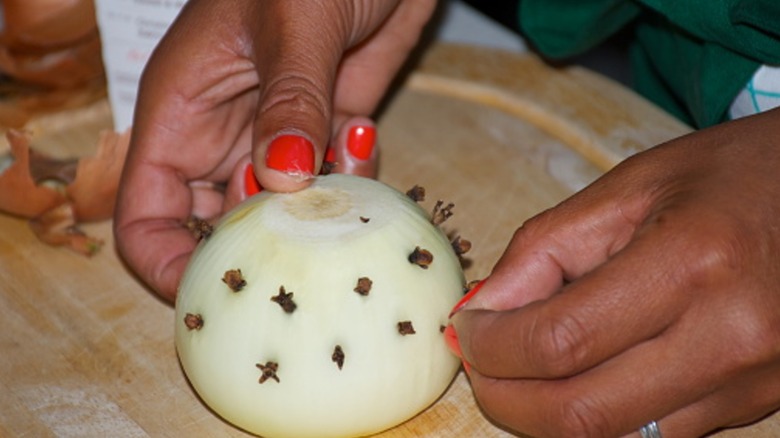
The clove-pierced onion method that Martha Stewart uses in her Boston baked beans is actually a very traditional French culinary technique called an onion cloute. It's a variation of another similar style called onion pique, which consists of a peeled onion with cloves holding a bay leaf on the outside. An onion cloute simply eliminates the bay leaf (whose purpose is often controversial). Onion piques are usually used in béchamel sauce; the milk is warmed and flavored with an onion pique before the liquid is mixed into flour and butter roux to make a creamy sauce.
Obviously, you can also use the pique or cloute methods for slow-cooked beans like Stewart's Boston baked ones, but it's also a handy flavoring method for many soups, stews, stocks, and other sauces. Rather than giving deep flavor, an onion cloute almost perfumes whatever it's used in, giving hints of flavor rather than punches of it. Interestingly enough, Stewart doesn't use the same trick in her béchamel sauce, but she has recommended flavoring it with a little nutmeg. From a well-flavored béchamel, you can make lasagna (which is more traditional than using ricotta cheese), potato gratins, macaroni and cheese, and creamed spinach.