

Why This Seafood Delicacy Is Banned From Harvest In California Until 2036
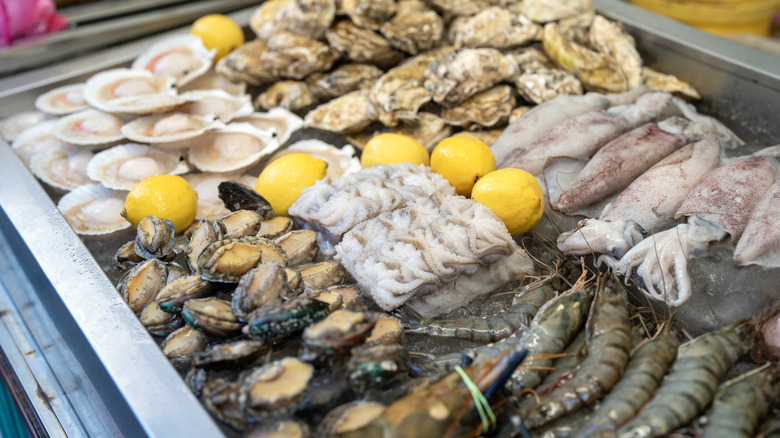
Nestled in the rocky, shallow areas of bays, tide pools, and kelp forests in Central and Northern California is a species of abalone which has been an important part of local life for centuries. Red abalone are sea mollusks related to sea snails and sea slugs and have been harvested and utilized by Native Americans, Chinese and Japanese Americans, and commercial and recreational fishermen throughout history. Once a thriving species prized for its mild, sweet flavor and beautiful, iridescent shells, red abalone have been closely monitored and banned from harvesting for years due to their declining numbers. The California Fish and Game Commission has recently extended the ban for another ten years.
Commercial fishing for red abalone has been banned in California since 1997, but recreational fishing was still allowed with a legal permit from the Fish and Game Commission. However, in 2018, the ban was expanded to recreational fishing too when the state discovered just how fast red abalone were disappearing as they weren't reproducing in adequate enough numbers to sustain the species. Fishing for the mollusk generated about $44 million for the local community, but it wasn't worth the risk of driving the abalone into extinction. This is precisely why you'll probably never eat white abalone in America. California has taken the violation of the fishing ban very seriously. One man was fined $40,000 when investigators found 80 abalone in his home, while another was arrested upon suspicion of harvesting near Sonoma.
Why red abalone numbers have declined so much
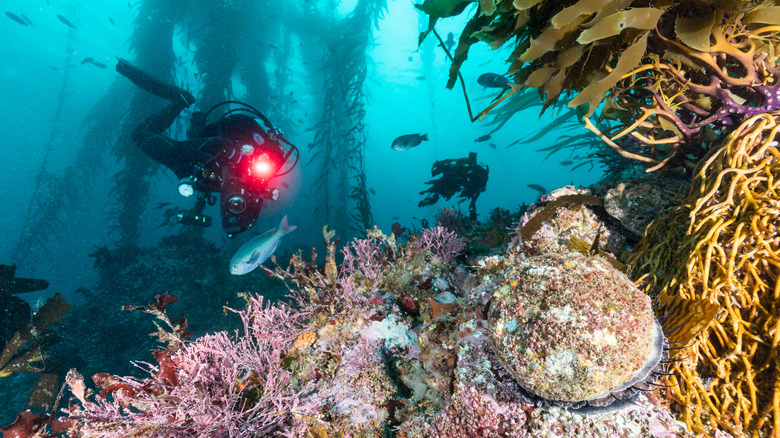
While the threat of overfishing red abalone has been a long-time concern, there are several other factors at play in regards to why the species cannot adequately regenerate to keep its numbers satisfactory. The California Fish and Game Commission believes the main reason is the depletion of kelp, red abalone's main food source. (Incidentally, there is an edible type of kelp called kombu that will turn your stock into an umami powerhouse.) Kelp forests have been quickly declining from warm ocean temperatures, strong storm systems, and a rapidly increasing population of purple urchins, which also feed on kelp. (You might be surprised to know that the only edible parts of sea urchins are their reproductive organs.) Experts have estimated that an astounding 95% of kelp has disappeared from Northern California waters since 2014.
Because there are so many purple urchins, there isn't enough kelp to feed both them and the red abalone. Purple urchin numbers were once naturally controlled by sunflower sea stars. However, beginning in 2013, a heatwave began worsening a sea star wasting disease, killing billions of sea stars, and thus increasing the number of purple urchin. It's reasonable to assume that if the kelp isn't also regenerated adequately, the purple urchin will be endangered as well. And, so, the cycle goes on. The integrity of the kelp forests are dependent on climate and the amount of sea creatures which need it to survive. We can only hope nature is strong enough to make headway for the kelp (and in turn, the red abalone) by 2036.