

11 Popular Buffets That Disappeared
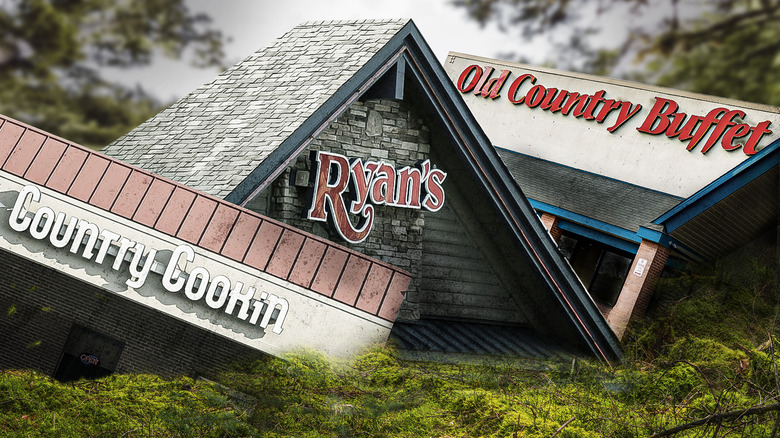
For an individual or family used to cooking their own meals at home, going out to eat is a delightful treat. But while it's lovely to leave the cooking to someone else, a traditional restaurant can feel restricting: You're pretty much relegated to just one entree, a couple of sides, and maybe a dessert. Enter the great all-you-can-eat American buffet restaurant.
For about the price of a meal at a typical fast casual restaurant, at a buffet, one can stack a plate high with all kinds of food — and they can return to the hot stations, salad bar, and dessert area as many times as they'd like, or until they just can't eat another bite. Buffets are cathedrals dedicated to abundance, variety, and gluttony, and for decades, they've been all over the U.S. restaurant scene.
When economic times are good, buffets tend to do well. But if the conditions aren't quite right, they can fail, and fail quickly — especially when the worst secrets of all-you-can-eat buffets are exposed. While plenty of independently owned buffets, many of which focus on a single type of food or cuisine, still populate America's malls, strip malls, and commercial areas, the chains that once dominated the buffet sector have become an endangered business. Many companies once well known for their buffets have ceased to exist in recent years. Here are some once-popular American buffets that have closed their doors for good.
Old Country Buffet

One of the most visible and longest-lasting buffet chains in the United States, Old Country Buffet has a history that surprisingly only dates back to 1983. That's when the first location of what would eventually be a major restaurant chain opened in Minnesota. By devoting much of its real estate to cold bars, and hot bars full of typical American diner favorites, and homestyle fare, Old Country Buffet quickly won the country over.
The brand's growth was largely facilitated by strategic acquisitions, and mergers with other restaurant chains, and by the 21st century, most buffet chains in the U.S. were part of the same all-you-can-eat-focused food service business: Old Country Buffet's parent company, FMP Management, which held Fresh Acquisitions LLC, and Buffets LLC. In the early 2000s, Old Country Buffet peaked, with its number of outposts in the 250-plus range. But by late 2019, that number had dropped to around 90 restaurants across 27 states.
In 2020, the COVID-19 pandemic developed, leading to disease-quelling measures like the closure of public places. Buffets got hit hard, and while many reopened after a few months, they couldn't weather the months-long interruption in cash flow. In 2021, the owner of Fresh Acquisitions LLC and Buffets LLC filed for Chapter 11 bankruptcy protection, citing $13.5 million in debt that couldn't be immediately or obviously paid back. That led to the closure of all five buffet chains, big and small, that the company controlled — including, of course, Old Country Buffet.
Hometown Buffet

Among the big buffet restaurant chains that eventually joined forces with Old Country Buffet was HomeTown Buffet, essentially created as a spinoff of the former. In 1989, a co-founder of Old Country Buffet, Dennis Scott, departed that company to create HomeTown Buffet. Scott's version primarily did business in the Midwest, where it directly went up against Old Country Buffet, and on the West Coast, where it dominated the sector. Just seven years later, the two nearly identical brands with nearly identical bills of self-service fare merged, blanketing the nation with broadly popular, variety-focused buffet food.
Along with Old Country Buffet, and most other all-you-can-eat buffet chains in the U.S., by the 21st century, HomeTown Buffet was owned by FMP Management, which held Fresh Acquisitions LLC, and Buffets LLC. While it was once an impressive network of more than 300 locations, by 2019, HomeTown Buffet had fewer than 100 in operation. The buffet business had declared — and subsequently emerged from — bankruptcy in 2008, 2012, 2015, and 2016, but was no match for the extreme financial challenges posed by the 2020 COVID-19 pandemic. In 2021, Fresh Acquisitions LLC, and Buffets LLC, filed for Chapter 11 bankruptcy protection, and any remaining HomeTown Buffet locations were permanently shuttered.
Ryan's
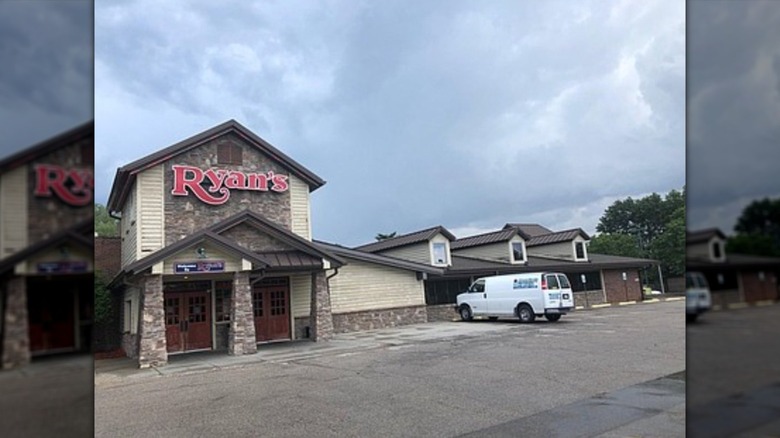
Throughout its history, which spanned over 40 years, Ryan's gave its customers multiple choices for how to dine, but it clearly favored the buffet. It was created in 1978 by a former steakhouse proprietor, Alvin McCall, Jr., and the first location was a standard restaurant in Greenville, South Carolina. By 1981, McCall was running six Ryan's restaurants, and had franchised one. And in 1986, Ryan's introduced its signature buffet service, an eye-popping feature it called the Mega Bar.
Ryan's buffet was so popular with customers that, in 1993, it turned one Mega Bar into six substantial buffet stations, all housed within each restaurant. This over-the-top buffet format became the main thing that Ryan's was known for. When some restaurants also adopted an open display kitchen, those were combined to create another, more upscale chain called Fire Mountain.
In 2006, Buffets, Inc. — owner of Old Country Buffet, and HomeTown Buffet — added another 300-plus unlimited-style restaurants to its portfolio when it merged with Ryan's Restaurant Group, operator of Ryan's buffets. Soon after, the parent company started to struggle, and it filed for bankruptcy in 2008, 2012, and 2016. The buffet business crawled its way out to stability each time, but could not do so in 2021. At that point, joint owners Fresh Acquisitions LLC, and Buffets LLC declared chapter 11 bankruptcy, deeply in debt, and lacking enough operating revenue after COVID-19-related shutdowns.
Furr's Fresh Buffet
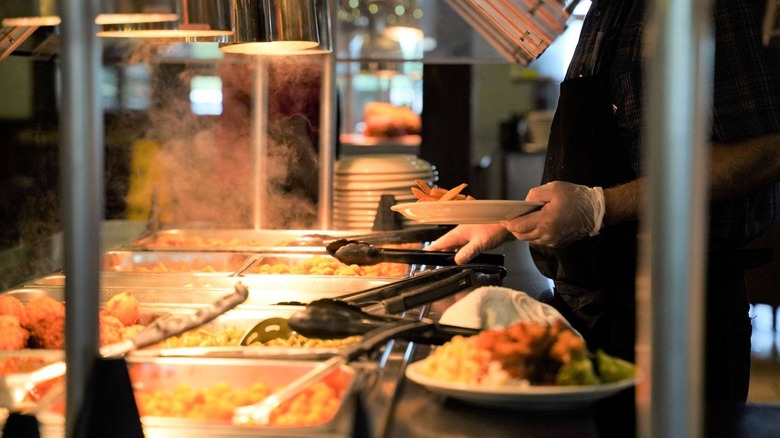
The chain known at the end of its life at Furr's Fresh Buffet can trace its lineage back to 1947, when entrepreneur Roy Furr opened a single cafeteria in Odessa, Texas. By the end of the 1950s, it was a multi-unit cafeteria chain, and it operated as a type of hybrid buffet with employee assistance until the 1980s, when Kmart bought Furr's, and merged it with Bishop's Buffets. By 2000, Furr's Restaurant Group ran nearly 100 restaurants, most of them family-friend buffets, and most of them in Texas, and throughout the American Southwest.
In 2014, Furr's declared Chapter 11 bankruptcy in order to financially restructure, which occurred after Food Management Partners swooped in to save the day. The new parent company absorbed the 25 Furr's restaurants that remained operational, and the regional buffet chain went on to become part of the conglomerate that also included Old Country Buffet, HomeTown Buffet, and Ryan's. That corporation, in turn, filed for bankruptcy in 2021. In the wake of financial struggle brought on by the COVID-19 pandemic, all Furr's locations were closed, even those locations that had, less than a year prior, rebranded as the more high-end Furr's AYCE Marketplace.
Souplantation and Sweet Tomatoes
When the health food craze went mainstream in the 1970s, San Diego-based Souplantation was quick to capitalize on it. As part of the group doing business as Garden Fresh Restaurants, Souplantation was joined by its corporate sibling, Sweet Tomatoes. The two restaurant chains offered an almost identical dining experience: Souplantation and Sweet Tomatoes were both buffet-style eateries bursting with foods considered to be healthy, or at least low in fat. Diners could choose from a variety of soups, green salads, fresh fruits, plenty of vegetables, baked potatoes, rolls, and desserts — and after paying a small fee at entry, they could help themselves to as much of it as they wanted, personally picking from a famously 50-foot-long salad bar.
By 2020, Garden Fresh had solidified itself as the market leader in salad bars, and healthy buffet restaurants, operating about 100 Souplantation and Sweet Tomatoes locations altogether. But when government agencies ordered the temporary shutdown of communal spaces to limit the spread of the COVID-19 virus in the spring of 2020, buffets were the kind of business that closed down for good. A dining concept that involved customers sharing serving utensils was out of the question, and a pivot to takeout wasn't really possible for a salad bar, which left the company with few options. The economic impact was swift, and devastating. In May 2020, Garden Fresh announced that it had filed for bankruptcy protection. Its 97 restaurants closed forever, leaving 4,400 people without work.
Country Cookin
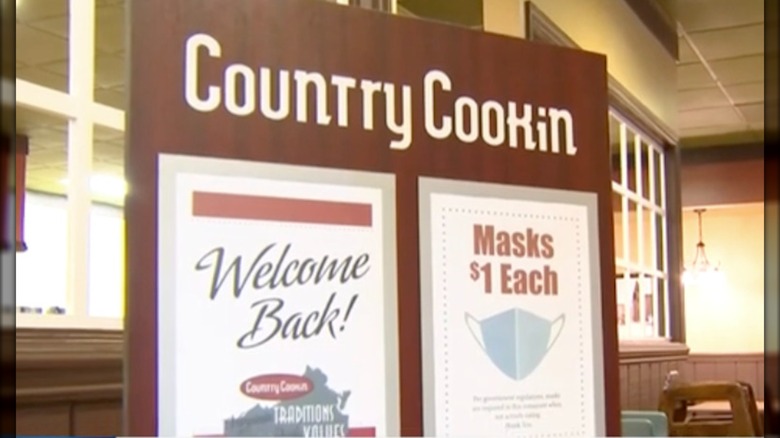
The Steer House Restaurant was a moderately successful regional chain in the 1970s. After it fell apart under new owners in '79, founder Roger Smith bought back the Virginia locations, and rebooted them as Country Cookin in 1981. The buffet-style restaurants specialized in homestyle cuisine, and Southern favorites, and they were fairly popular for several decades. By the time the COVID-19 pandemic hit in 2020, there were 15 Country Cookin buffets still open, and thriving.
That spring, owing to shutdown measures, and other actions designed to curtail the spread of the deadly coronavirus, all Country Cookin locations were closed for two months. When the business reopened, it did so carefully, pushing its customers to explore takeout, and curbside pickup for employee-prepared individual meals, and family-style dinners. Those intent on dining in had to follow strict safety protocols, like using a fresh pair of disposable gloves each time they handled the serving utensils at the food stations.
In September of 2020, two Country Cookin restaurants shuttered to allow the company to reallocate resources to its other 13 outlets, which were all struggling due to the rising cost of food, and labor. Unfortunately, it wasn't enough; just a month later, the entire network of County Cookin buffet restaurants closed down permanently. In early 2022, Culpeper Country Cookin opened in Culpeper, Virginia. Once part of the chain, the old name was secured by the operators. Otherwise, Country Cookin as it once was is gone.
Fresh Choice
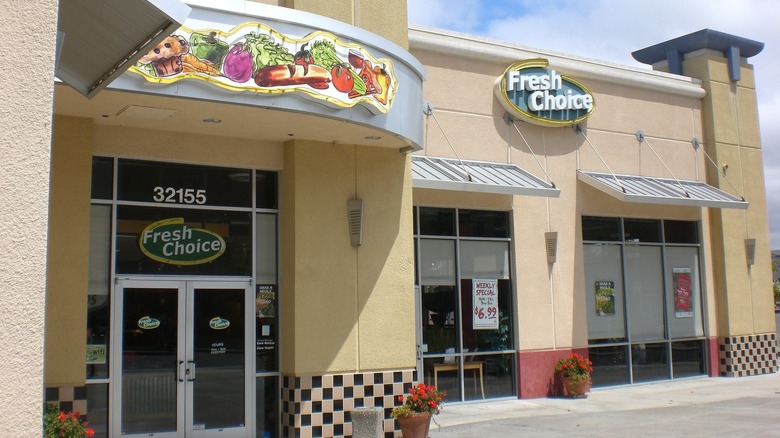
One of the more significant food fads of the 1980s was the fast food chain that served healthy food. A prime example was Fresh Choice, a buffet that launched in 1986, proudly touting a salad bar that contained more than 40 ingredients. Many of those items were organic, fresh, and made with sustainable produce — a feature not widely seen in American food culture at the time.
Fresh Choice customers could make their salads as big or as small as they wanted, as elaborate or as simple as they craved. There were also lots of soups, pasta dishes, fruit, and baked goods. And once it acquired buffet chain Zoopa, out of Washington State, the California-based Fresh Choice exploded in 1997 to include 48 restaurants in a handful of states.
In the new millennium, the company had a new owner, David Boyd, who aimed to transform Fresh Choice into a high-end, vegetable-forward restaurant, stocking its kitchens with farm-to-table produce from local farms. But the gambit didn't work. In 2012, Fresh Choice filed for Chapter 11 bankruptcy for the second time. The final blow was dealt by the failure of the chain's Silicon Valley area restaurants. It seemed the younger population there didn't favor the buffet chain, which had always attracted an older base. Boyd closed all but two restaurants, rebranded those as California Fresh, added sandwiches to the menu, and moved to a pay-per-pound system for salads. The Fresh Choice name, and its buffet concept were retired.
Popeyes
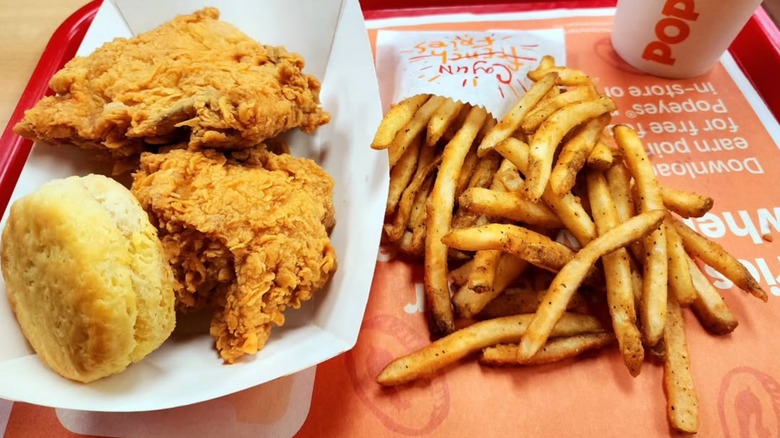
It was never a mandatory, company-wide program, nor a thing that was widely advertised. But up until the 2020s, if you knew where to look, you could find a Popeyes Louisiana Kitchen outlet with a buffet. It was the perfect way to discover why Popeyes fried chicken tastes so good, and pair your spicy or regular poultry with accompaniments like french fries, biscuits, seasoned rice, macaroni and cheese, and mashed potatoes with gravy, all for about the price of a combo meal. That $10 got you mass quantities of your Popeyes favorites, as well as access to off-menu, buffet-friendly, not-authorized-by-the-corporate-office items like spaghetti, and tacos.
By 2010, out of the 3,000 or so Popeyes restaurants nationwide, just three locations were still stocking their buffets all day, everyday: Panama City, Florida; Huntsville, Alabama; and Lafayette, Louisiana. Over the next seven years, two more discontinued the option. In 2017, the Lafayette branch was home to the last remaining Popeyes fried chicken buffet — and then that one closed down, too. Owing to a managerial change, and difficulties related to the COVID-19 pandemic, the buffet ended service in 2021.
Wendy's Superbar

For a solid decade, some Wendy's locations operated a buffet on the same premises as their better-known drive-through, encouraging customers to come inside for a sit-down, help-yourself meal of generous portions. Many enjoyed the all-you-can-eat salad bar at Wendy's, and in 1988, the company converted those, and installed hundreds of others, thereby creating its Superbar.
Along with the Garden Spot that offered an array of greens, premade salads, and fresh fruit, the Superbar had two hot stations: Mexican Fiesta, where customers could assemble their own tacos, burritos, and nachos, and Pasta Pasta, which featured different noodles, and sauces. Very few burger chains at the time offered anything like those choices, while the Superbar even included three kinds of pudding for dessert.
Wendy's Superbar brought in business, but the company quickly realized it was a major labor suck. It was so popular that individual Wendy's locations had to allocate workers to constantly clean, and restock the buffet stations, taking them away from the counter, kitchen, and drive-through. The Superbar was phased out starting in 1998.
Eatza Pizza
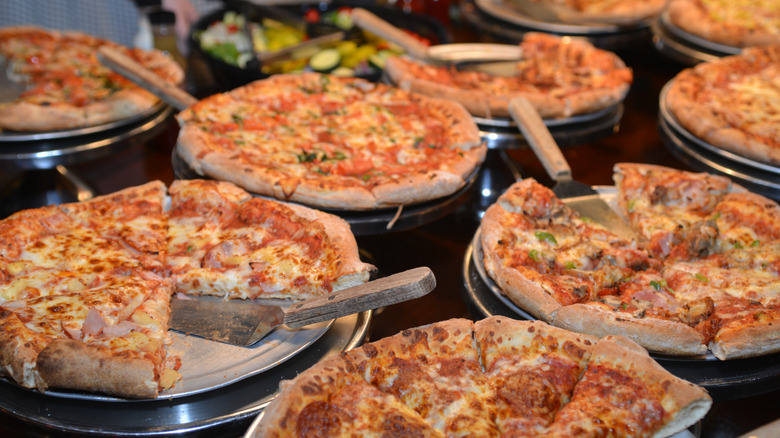
Many once-popular pizza styles are slowly disappearing, and that sadly includes the all-you-can-eat pizza buffet restaurant. But as pizza has always been one of the costlier fast food options, it makes sense that a place where one could stuff themselves with many different types of slices at once, for one low price of admission, was once irresistible to millions of Americans.
One of the most rapidly growing pizza buffet restaurant chains of the 1990s was a place called Eatza Pizza, which opened its first shops in Arizona in 1997. From there, it ballooned into 112 locations in 14 states in just a few years before moving into overseas markets.
To make all-you-can-eat pizza affordable, restaurants have to make concessions, finding ways to carve out a tiny profit margin. When the economy takes a tumble, it's hard for such places to remain open at all. During the Great Recession of the late 2000s, Eatza Pizza rapidly, and severely, started to fade. By 2008, it was down to five locations, and its parent company declared bankruptcy. Those remaining spots eventually closed, too, and while there are no more Eatza Pizza chain buffets, the name has been adopted by other businesses around the U.S.
Todai
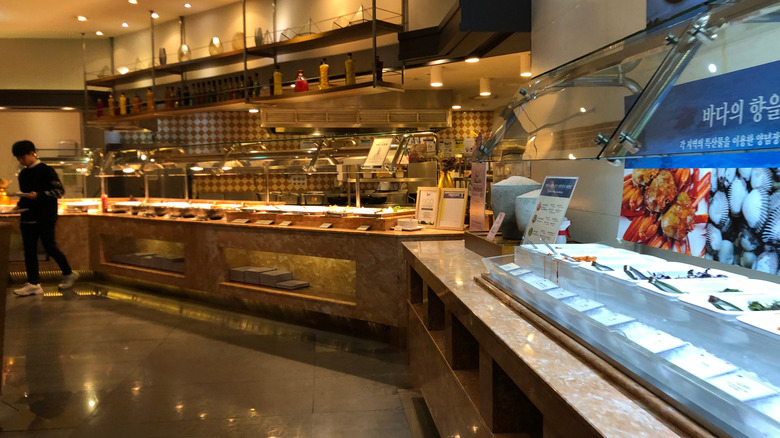
In the 1980s, buffets were a marvelous novelty to American diners, but they weren't nearly as exotic, special, or expensive as sushi. For a time, the food was seen as the provenance of yuppies, and adventurous eaters. It took restaurant chains like Todai to demystify sushi, which it did in part by marketing it as a high-end treat.
The notion of a sushi buffet was extremely luxurious, so it made sense for Todai to open its first 1985 location in upscale Santa Monica, California. In addition to all-you-care-to-eat sushi in many different styles, all covered under a flat fee, Todai diners could choose from a wide range of other seafood options. It was a success, and once the owners allowed franchising, a chain developed. By 2011, a total of 24 Todais were serving up endless sushi — enjoyed at 160-foot-long mega-tables — throughout California, the Pacific Northwest, Texas, Virginia, South Korea, and China.
Circumstances around the grand closure of Todai remain a mystery. After individual restaurants started to go out of business in the early 2010s, the parent company issued the following announcement on its website: "All Todai USA locations are closed for renovation. We plan to re-open in December of 2017." That date came and went, and seeing as how it's been almost a full decade since, it sure looks like Todai is completely defunct.