

The Only Recap Of Sbarro's Downfall And Resurgence You Need
Through the 1980s and 1990s, a trip to the mall meant stopping at the food court to fuel up with some quick and inexpensive snack or meal. Sure, everything in that little alcove offered the same foods as most every other mall, or just restaurant chains one could find elsewhere. The secret was that meals just tasted better when sitting under a heat lamp or behind a pane of greasy glass or plastic. A frequent first choice — over chow mein, a sandwich, or a pretzel — were the gigantic, cheese-laden slices of pizza from Sbarro.
Rarely considered to be among the best chain pizza restaurants, the reliable, familiar, and at least somewhat tasty offerings from Sbarro fit perfectly in a mall setting. The pizza was fine, as were the spaghetti plates with huge meatballs, big salads, and creamy desserts. As shopping malls increasingly disappear from retail landscapes, Sbarro locations — and food courts — are vanishing too. Here's the story of how Sbarro came to dominate the mall food game, almost disappeared, and re-emerged again to the delight of its nostalgic, pizza-loving fans.
Sbarro was a grocery store before it was a pizza parlor
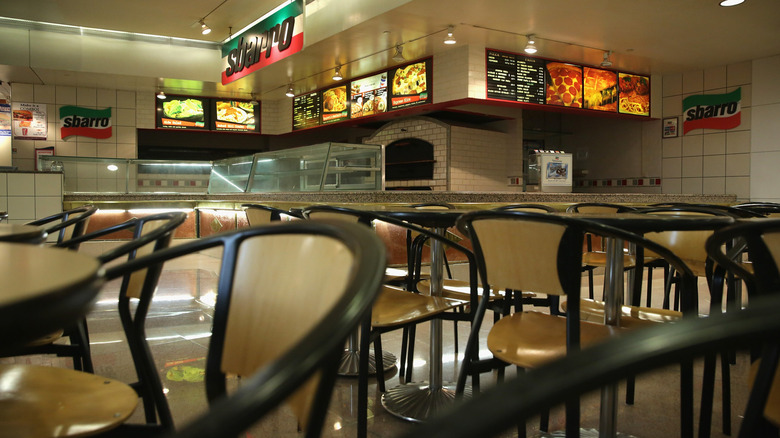
Sbarro's classic shopping mall environment — where hundreds still remain — was the near-final evolution of a business that began as an Italian grocery store and deli in the 1950s. In 1956, after having emigrated to the Bensonhurst neighborhood of Brooklyn from Naples (where pizza as we know it was invented in 1889), Gennaro and "Mama" Carmela Sbarro opened Sbarro's Salumeria. While it sold groceries and sundries with an Italian clientele in mind, the shop became popular for its homemade pizza intended to drum up business. Before long, Sbarro's Salumeria was also a small restaurant; selling real Italian dishes such as chicken parmigiana dinners and cheesecake slices. Within about five years, the Sbarros opened a second Sbarro-branded operation in New York City — this one dedicated to serving pizza.
Even as pizza became a focal point, the first Sbarro's Salumeria stayed open for decades; only closing in the early 2000s because Carmela Sbarro couldn't move around the kitchen as quickly as she once did. At one point — well into her elder years — Mama Sbarro still supervised and assisted in the weekly production of 1,000 cheesecakes shipped out to the hundreds of Sbarro stands across the country.
Sbarro helped build malls, and malls helped build Sbarro
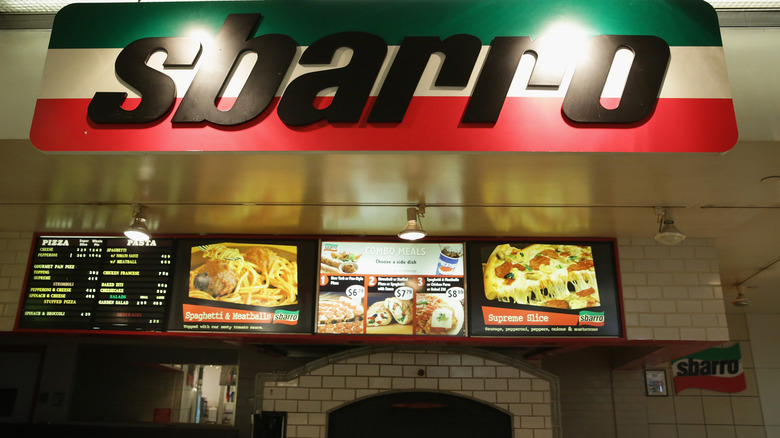
Food courts are saviors of dying American shopping malls, and historically the two have had a mutually beneficial connection. Like many other old school mall food court restaurants that disappeared, Sbarro joined the modern, enclosed marketplace when it proved to be a viable and expanding entity. The first time that Sbarro sold its Italian-inspired foods at a mall was in 1970, when the company opened for business at the Kings Plaza Shopping Center in Brooklyn — not far from its original location.
Sbarro was something of a pioneer in mall cuisine. In the 1960s and 1970s, malls largely only sold snack items: cookies, pretzels, and the like. Sbarro's leaders realized that shoppers spent enough time and energy at the mall that they might want something more substantial ... such as a full meal. The successful sale of pizza at its first few mall stores proved Sbarro right, and before long it added pastas, salads, and desserts to the menu. This eventually inspired other fast food chains to give malls a shot. These companies even imitated Sbarro's cafeteria-style approach, precooking the food and placing it on view.
Sbarro went big and nationwide in the '80s
As it slowly opened more and more company-owned locations with careful focus on quality, the Sbarro family eventually decided to let others in. In 1977, Sbarro — now known as Sbarro, Inc. – began franchising its inline-style pizza concept. By 1980, about a dozen licensed restaurants had opened in American shopping malls. The slow movement seeded explosive growth: By 1984 there were almost 100 Sbarro pizza locations in operation, which generated combined annual revenues of $20 million.
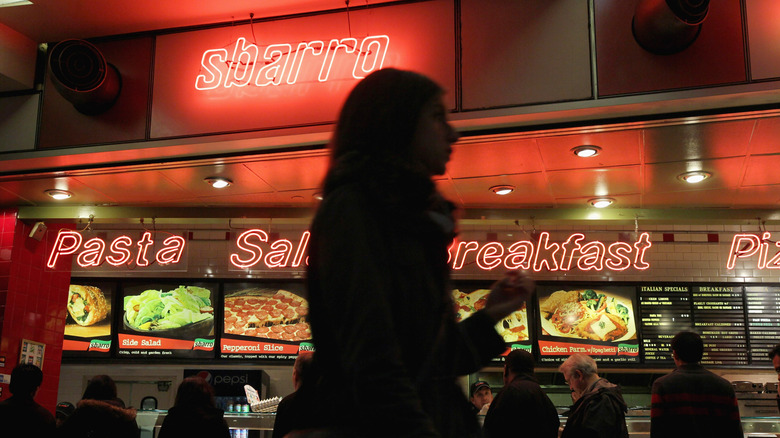
Sbarro delighted so many customers with so much pizza that it took the business to another level. In 1985, Sbarro issued an IPO, selling company stock for the first time. This massive infusion of cash helped the chain explode. Just two years after going public, Sbarro ran 157 restaurants and authorized 63 franchised locations, including storefronts in Puerto Rico and Canada. As the 1980s came to a close, Sbarro outlets opened at a rate of 60 to 70 per year. At peak food court dominance, there were 729 Sbarro outlets peddling thick-crust pizza, big bowls of spaghetti, and Mama Sbarro's cheesecakes — which might not be some of the best cheesecakes in the U.S., but were still pretty good.
Sbarro took its business private and continued expanding
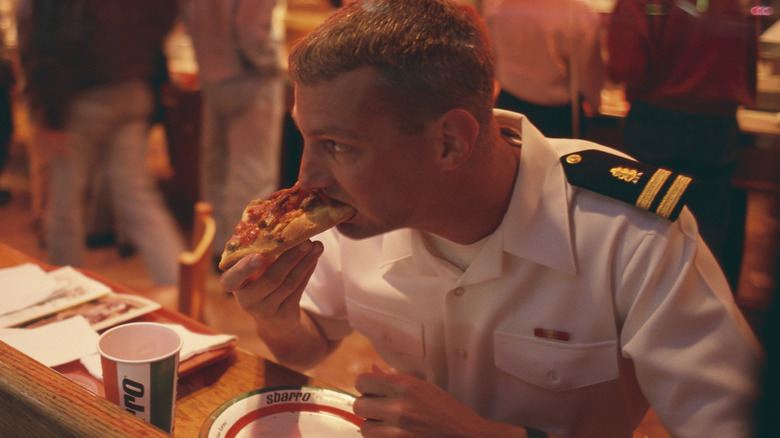
In the late 1990s, the Sbarro family was determined to take back control of the pizza business from its shareholders. This push was led by the founders' son — Mario Sbarro — during a stint when he was opening multiple restaurant types in an attempt to operate a valuable chain steakhouse. Across three bids in 1998 and 1999, the Sbarros planned to spend a total of $380 million, then $388 million, and finally $389.5 million. This figure — finalized in August 1999 — was enough to buy all outstanding stock at a price of $29.85 each.
Once again fully in charge of the Sbarro pizza chain, the Sbarro family instituted an aggressive and rapid expansion plan. By 2001, the total number of Sbarro restaurants topped 900. Three years later, Sbarro would see its most successful year ever, with revenues of $465 million. However, there's nowhere to go but down after a top year, and that decline was hastened by the early 2000s demise of the shopping mall.
The Sbarro sons sold Sbarro
Less than a decade after the Sbarro family fought a major financial battle and spent hundreds of millions to reacquire the Sbarro company, they put the pizza chain up for sale again. In January 2007, the international private equity firm MidOcean Partners closed a deal to buy Sbarro, and the family walked away with the tidy sum of $450 million. MidOcean installed its own hand-picked team of executives and managers to oversee the gigantic business — which at this point boasted 1,000 pizza stands across 34 countries; operated by around 11,000 workers.
Two years later, Sbarro was on the brink of financial disaster. In the midst of the Great Recession, financial analysis company Moody's issued a list called "The Bottom Rung," which identified the American companies it predicted would soon default on debt and collapse. Moody's accurately predicted the eventual disappearance of Barney's and Rite Aid, but was premature in citing the under-new-management Sbarro. While Sbarro didn't go under, many of the retail operations that attracted customers to malls fell apart, which diminished foot traffic and potential revenue for the pizza chain.
Inflation deflated Sbarro
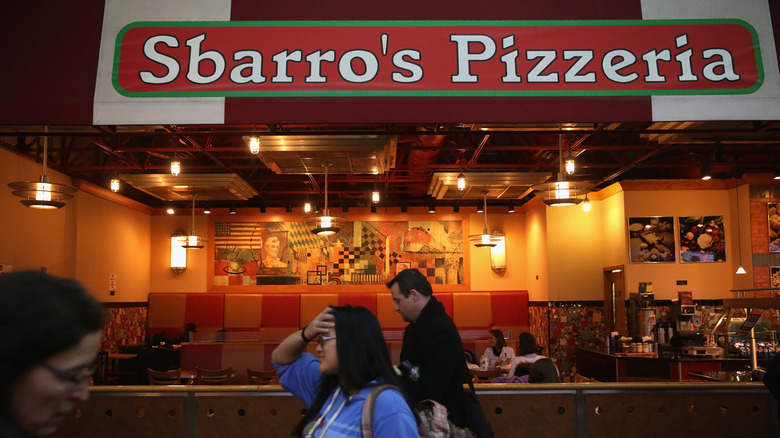
By the early 2000s, most of Sbarro's imprint was linked to shopping malls. This is when the mall's domination over commerce began to decline, but real estate costs for those periods had been set in tandem with the economic growth that malls enjoyed in the 1990s. The result: Sbarro locations paid more to operate, which cut significantly into the company's profits. As mentioned, these were already on a downward trend due to decreasing mall traffic.
It wasn't just real estate that grew prohibitively expensive for Sbarro in the early 21st century. The most basic, raw materials the chain needed to make and sell pizza increased in price too. Food inflation experienced a major spike in 2010, with wholesale prices around the world increasing. Some of the most affected foods were cheese and flour; which are extremely important in pizza construction. By 2011, Sbarro faced a truly astonishing amount of debt: around $195 million.
Sbarro had Mob ties
In the midst of Sbarro's rise to the top, the company experienced a professional tragedy. Between 1978 and 1983, a number of pizza places in and around Philadelphia mysteriously burned to the ground — including the Sbarro in the Echelon Mall. The cause? Arson. While authorities thought the Gambino crime family was the culprit, charges wouldn't stick.
In 2012, the New York Daily News used a Freedom of Information Act request to obtain the formerly top secret FBI file of deceased organized crime figure Julius Bernstein. Among many shocking revelations was Bernstein's disclosure that Sbarro made payments to the Genovese crime family. Such pay-offs constituted "protection" fees, which is Mob shorthand for extortion. From the 1960s and all the way through 2004, the pizza company delivered cash payments to different operatives. This included Genovese figure Angelo Aquilino, who went to prison for trying to collect protection payments from a bakery and a contractor. Sbarro's semi-annual payments of $10,000 stopped in December 2004, when the Sbarro family refused to pay. Aguilino told Bernstein to shake them down, but — thinking it was a set-up by the FBI — Bernstein instead reported the problem to high-ranking Genovese boss Dominic "Quiet Dom" Cirillo, and the Mob backed off.
Sbarro filed for bankruptcy more than once
Facing major uncertainties after suffering from inflation in 2010, then-current company owner MidOcean Partners installed Sbarro with a new set of corporate executives. While the new team helped turn things around, it wasn't enough, and Sbarro still felt the pressure of crushing debt by April 2011. As such, MidOcean declared the 1,045-unit chain of compact pizza parlors bankrupt. This Chapter 11 filing allowed Sbarro to financially restructure; cutting down its tremendous debt and acquiring $30 million for improvements from a second private equity company. The moves were a success, as Sbarro, Inc. emerged from bankruptcy seven months later.
Less than two years later however, history repeated itself. In March 2014, the restructured Sbarro LLC petitioned for Chapter 11 bankruptcy projection, still managing the problems it had dealt with for a half decade. These included a steadily decreasing customer base due to the decline of shopping malls, along with millions in operational debt. By June 2014, Sbarro once more exited bankruptcy status after a judge okayed a financial reorganization plan.
Sbarro carefully rebranded and rebooted
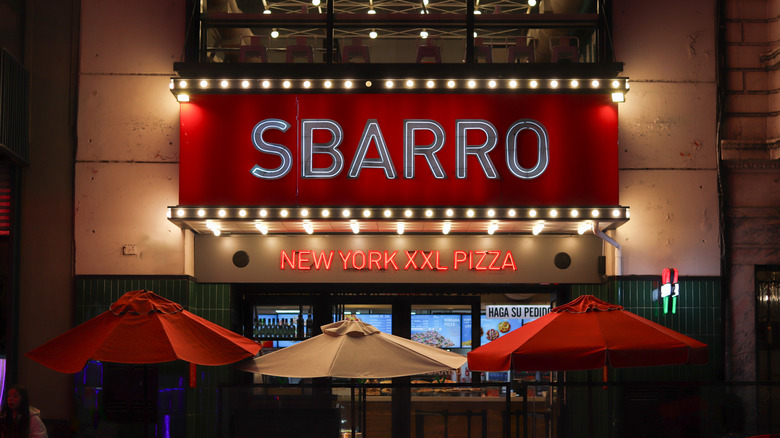
After Sbarro entered bankruptcy protection for the first time, the company installed Jim Greco as CEO. This expert in pulling companies back from financial oblivion quickly determined that Sbarro needed to update its look, approach, and menu if it wanted to stay relevant. Under Greco's direction, Sbarro reworked its recipes — bringing in higher quality tomatoes and cheese — and turned an eye toward giving its food a better taste and mouthfeel. The new and improved Sbarro pizza rated highly with customers, although the pasta dishes did not. The company also took a look at employee relations, and launched programs to better acquire, train, and reward workers for commitment to customer service.
Greco departed Sbarro after a little over a year in March 2013; declaring the recovery option to be a success. During his time with Sbarro, the pizza chain attained some financial stability and explored expansions in Brazil, China, and Europe.
This period in Sbarro history also includes the ill-fated rollout of Pizza Cucinova, — one of many restaurant chain spinoffs that flopped. Sbarro launched this take on elevated fast-casual pizza in 2013; going head to head with MOD Pizza and Blaze Pizza. Pizza Cucinova opened in a Columbus, Ohio, strip mall with plans for expansion across the state. However, the mini-chain was entirely defunct by 2020.
Sbarro reversed course and is growing in the 2020s
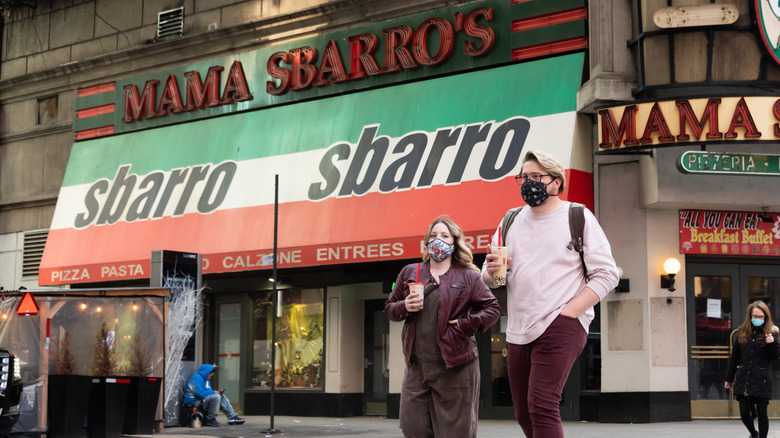
A broad shift in the way people shop — along with the shutdowns of public spaces and long-lasting economic ramifications of the COVID-19 pandemic — launched the once-hearty American shopping mall into a death spiral. With fewer malls operating and fewer customers, food court eateries like Sbarro needed to find new locations to stay open and turn a profit. By the end of 2021, only 300 Sbarro stands were left in the United States, and 340 internationally.
Sbarro looked elsewhere for business. "We knew that there was a limited development potential in the mall venues, and that's where we started to push harder into convenience stores and travel centers, casinos, and colleges and places where there was high foot traffic," Sbarro CEO David Karam told QSR in 2022. After opening 66 new Sbarro spots in 2021 (with just 29 in malls), the chain went bigger in 2022. It launched 80 pizza kiosks in convenience stores, about 20 in truck stops, and another 50 or so divided up among amusement parks and other locations. This growth plan remains in effect: As of 2025, Sbarro hit the 800-restaurant milestone.