

The 'Glue' You Can Use To Hold Edible Flowers In Place On Cake
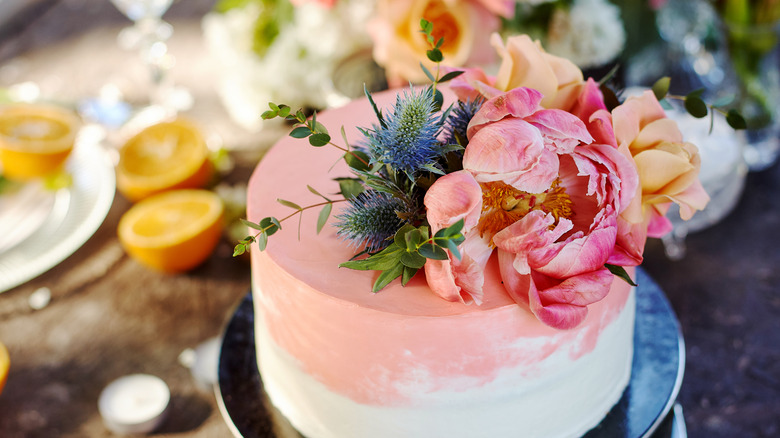
When it comes to presentation, it's hard to go wrong with flowers. This applies to food, too. Martha Stewart often uses edible flowers to upgrade her foods, and you can absolutely place edible flowers onto cake. Barring some specific allergies (ask your guests about this in advance), certain flowers like pansies, dahlias, sunflowers, and hibiscus can really elevate your dishes. Then, of course, you've got fake edible flowers made from ganache or fondant. But how do you hold a flower in place on a cake? We spoke to Victoria Fisk, cofounder and confectionery chef at Bouqedibles, for some advice on sturdy, tasty ways to glue flowers to cake.
Fisk said that your choice of cake adhesive will change depending on what you're working with, but that there are a few ways to approach flowers. In most cases, you're working with the stems. "For fresh flowers, coat the stems in chocolate to create a barrier then insert them directly into the cake," Fisk told The Takeout. For this method, you want to trim off most of the stem once it's time to add the flower to the cake because you only need a little bit covered in chocolate to secure it. You can coat the stems in edible food glue if chocolate would clash with your specific cake recipe.
Securing flowers with stems and sweets
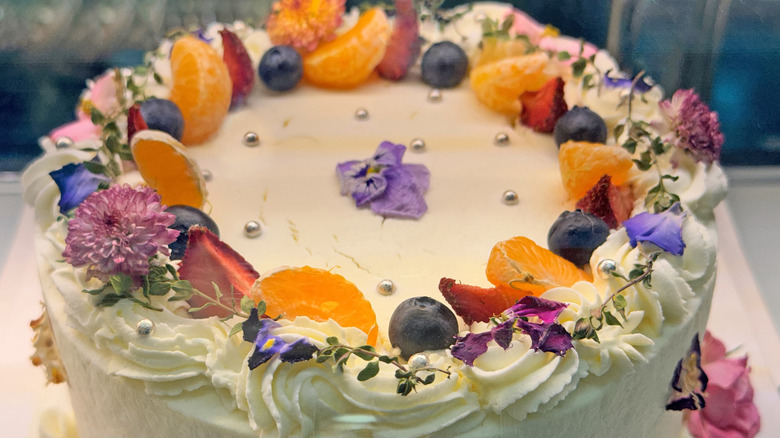
Interestingly, similar rules apply if you try making icing petals without any special tools. According to Fisk, you'll want to create a sort of artificial flower stem to hold these flowers on the cake. "I use toothpicks or skewers for heavier buttercream or ganache flowers, especially when placing them on the sides of a cake," she said. "Fondant flowers hold up best when attached with ganache, which creates a barrier against moisture." In other words, for small flowers you can simply attach them to a dollop of ganache or buttercream before sticking them to the cake.
With both real and fake flowers, you often want them to be chilled. Fresh flowers wilt quickly, so you should keep the cake carefully refrigerated to avoid letting those flowers lose their luster. If you use Fisk's method of pressing flowers into a dollop of ganache or buttercream, another important reason to refrigerate the cake after decorating is to make sure the icing sets properly. "Depending on the design, I sometimes work in stages by adding one layer of flowers, letting it set in the fridge, and then adding the next," said Fisk. "I may also pipe fresh decorative elements on top once the base layer is firm." She noted that some icing flowers, such as those made from Italian meringue, don't need to be chilled, but there isn't any harm in playing it safe.