

The Staggering Amount Of Food American Aircraft Carriers Have To Keep In Stock
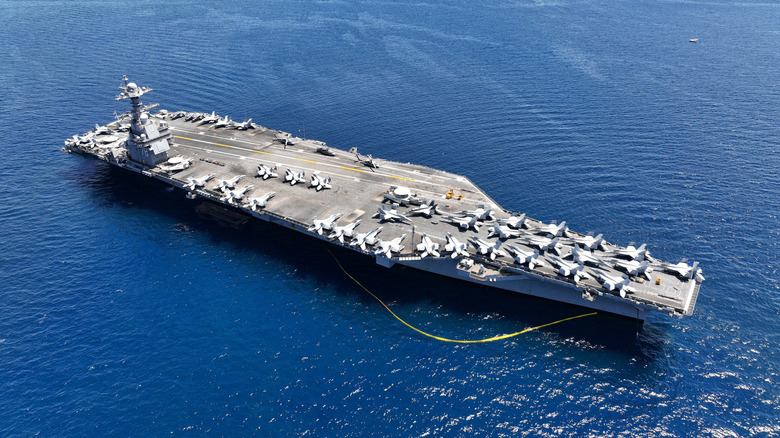
When a United States aircraft carrier is deployed, the amount of sailors onboard can be equivalent to the population of a small city, which means there's more men and women on board than would fit on most cruise ships. The largest carriers currently in operation are the U.S. Navy Nimitz class nuclear-powered aircraft carriers, which often have as many as 5,680 people, all of whom need to eat. In addition to their living facilities, fighter jets, flight decks, elevators, medical facilities, and small stores, these carriers keep enough food supplies on board to prepare up to 17,000 meals daily.
The planning involved with feeding such a crew is meticulous. Not only does enough food need to be accounted for breakfast, lunch, dinner, and "midrats" (meals for those working the night shift), but specific daily caloric requirements are implemented. The kitchen must provide 2,850 calories every day for males and 2,100 for females. They also need to factor in food allergies and religious diet restrictions. On the newest aircraft carrier, the USS Gerald R. Ford, the grocery bill reaches anywhere from $45,000 to $65,000 daily; consuming well over $1 million worth of food per month. To give an idea of the sheer volume of food required, the kitchen crew (called Navy culinary specialists) prepares 1,600 pounds of meat, 350 pounds of lettuce, 160 gallons of milk, 30 cases of cereal, and 20,000 cups of coffee every single day.
The importance of quality food and meals on an aircraft carrier
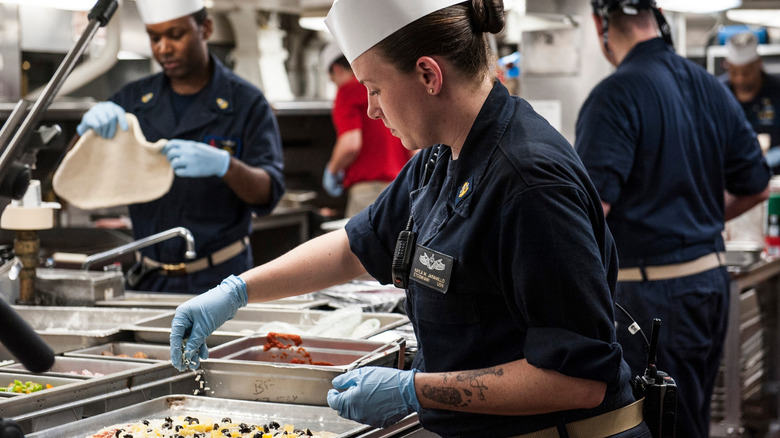
When it comes to providing meals to aircraft carrier crews, having enough food supplies on board is just a small part of a well-run kitchen. Work and activity never stop when these huge ships are at sea, as sailors are working in close quarters under high stress conditions. Maintaining energy and morale amongst the crew is of the utmost importance, and meals reflect this. The Navy culinary specialists are highly trained to produce satisfying meals that range from comfort foods to international cuisine to Taco Tuesdays. It's a 24/7 operation, from food prep which never stops to deep cleaning (an important step in any commercial kitchen). Traditional holiday foods are prepared to make being away from home on major holidays a little easier, while luxurious dishes like prime rib and lobster are prepared for birthdays.
Menus are revamped every 14 to 21 days so meals aren't repeated too often and some ingredients are delivered to the carrier from nearby countries and ports. Aircraft carriers can be on mission for months at a time, so food supplies naturally need to be replenished while at sea. This is typically done every 7 to 10 days. Supply ships pull up alongside the carriers and match their speed before transporting 400,000 to 700,000 pounds of food via cable. That can be anything from fresh fruits and veggies to cans of flour for restaurant-worthy bread. Life and work on an aircraft carrier isn't what most would call easy, but the kitchen staff does their best to make sure each meal is a welcome pause from the crew's daily demands.