

Your Ribs Will Turn Out Chewy Every Time If You Skip This Important Step
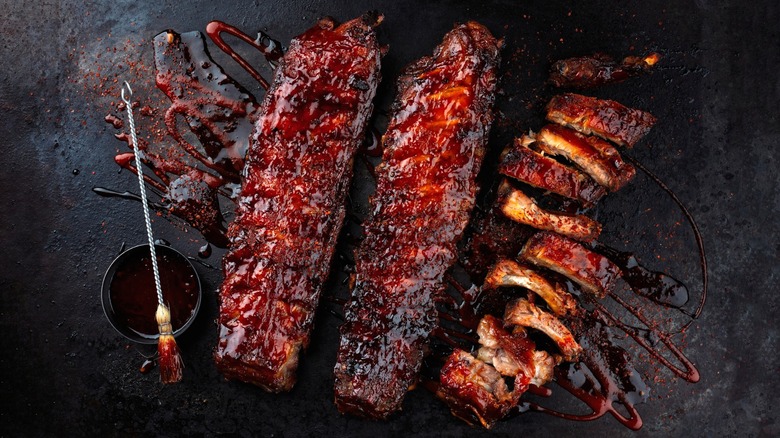
Ribs are great when slathered in a beer-infused BBQ sauce, but if the ribs turn out chewy all the flavor in the world won't make them appetizing. Outstanding ribs are mouthwateringly tender, with the meat falling off the bone as you pick them up. There are a few circumstances that can result in chewy ribs, but according to Chip Carter, producer and host of "Where The Food Comes From," there's one major offender that essentially guarantees your mouth is in for a workout.
Assuming that ribs are ready to be cooked just as they come is a mistake. "On the bottom side of rib slabs is a thin, silvery layer of connective tissues," Carter said. "You cannot cook it long enough to become tender; you can only make it tolerable." While it can be a struggle, that membrane needs to come off. "Remove that membrane before you do any other prep," Carter said. "It's a pain in the neck –- but a thin, very sharp blade will slide up under the edge and make the process much easier. Don't be surprised if you wind up slicing it off in strips."
With the membrane discarded, you now have your best chance at cooking melt-in-your-mouth ribs. Of course, that's assuming you didn't commit another blunder -– buying ribs at a discount that's too good to be true. "That Big Box O' Bones you got at the Shady Saver for $3.99? Those can actually be really good if you serve each guest a quart of bourbon ahead of the meal," Carter sarcastically noted. "Otherwise, you're just wasting money. If they don't look good uncooked, you can't save them."
More reasons ribs can turn out chewy
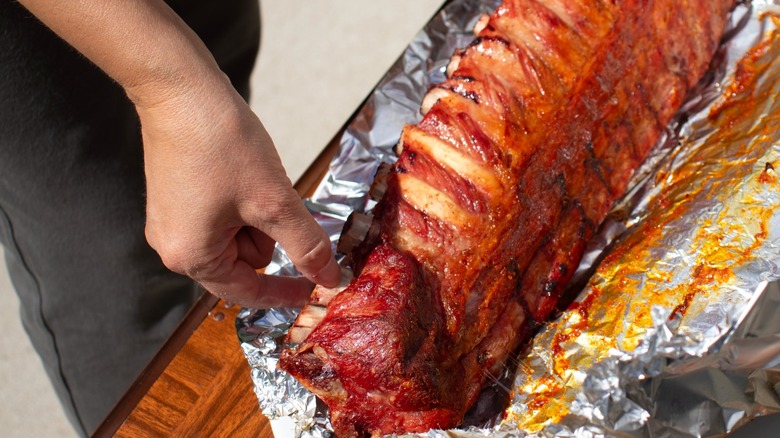
Removing the membrane from your ribs sets you up for success, but that alone doesn't guarantee tender results. Carter noted another mistake which stems from people being afraid of burning the meat. "You didn't cook them long enough," he said. "And you probably stopped cooking them because they were already looking too done or maybe even scorching."
While some culinary experts turn their nose up at the practice, the easiest way to combat this issue is to wrap the meat in aluminum foil. "Snobbier types consider a foil wrap a cheap shortcut," Carter said. "I prefer to serve delicious ribs and not worry about judgy people." However, timing is important. "Typically, I'm going to start my ribs, and about two-thirds of the way through cooking I'm going to loosely wrap the ribs in foil," Carter said. "This is also an opportunity to add moisture and flavor –- just put a little apple cider vinegar or plain water at the bottom of the foil pouch you wrap the ribs in." Brush on your homemade BBQ sauce (or a favorite store-bought brand) once they are nearly done.
Carter indicated it's essential to get the ribs hot enough that the remaining connective tissue melts. "Pork is safe to eat at an internal temp of 145 to 150 degrees Fahrenheit, but you have to push it up to 195 to 200 degrees to render fat and tissue in tougher cuts like ribs." If you follow these tips and it still comes out wrong, what's the expert way to deal with the mishap? "Order pizza."