

How To Mix Up Your Own Tangy Kimchi Mayo
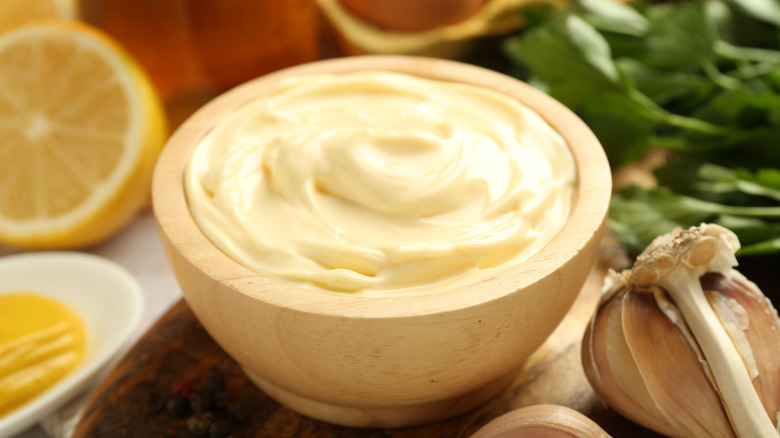
In a world slathered in various mayos, it's good to know you can always spice them up if the one you picked falls a little flat. (Just go with Hellmann's or Duke's, people — or make your own, it's not that hard.) One of the best ways you can kick your mayo up a notch is with kimchi. (Though please remember that you can do better than Trader Joe's kimchi.) You might wonder first: How do I even incorporate kimchi into mayo? It's just a bunch of crunchy cabbage leaves. The good news is, it's simple. You probably have a blender, an immersion blender, or a food processor on hand — all of which will work for this recipe.
Using any kind of blender or food processor, all you need to do is add ½ cup of mayonnaise and ½ cup of kimchi, and blend until smooth. Keep in mind that most recipes call for a 1:1 ratio, so start from there and adjust to your taste. You can leave the kimchi juice in if you prefer, though some recipes call for you to drain it. Leaving it in will ensure kimchi's tangy funk (which I personally love) is added to the mayo, but it might make it a little runnier, so adjust your ratio to your desired thickness. If you need more spice, add Korean chili flakes or gochujang paste (which is also good for adding a nice kick to all your favorite foods, like breakfast burritos).
To make at home or to not make at home? That's the question
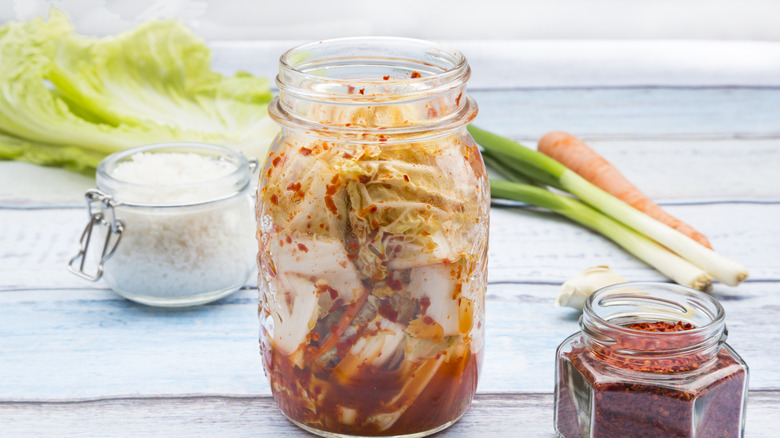
Homemade mayonnaise is superior to store-bought, but don't just believe me: even Rachel Ray thinks so. The texture, taste, and quality can't be beat. But the same applies to kimchi as well. Fresh kimchi is crunchy, salty, spicy, and not quite as funky. The best part is you get to control what you ferment, the sweetness level (add apple or pear, they do in Korea!), and how spicy it is. For me, the best part is that the leaves are still green, and you can ensure you're getting the probiotic benefits of this tangy side (when making at home in a glass jar, you can see the fermentation bubbles).
Making your own mayonnaise is actually really easy. For kimchi, while it is a bit labor-intensive, making it at home can be extremely satisfying. I usually opt to make what's called mak kimchi or "easy kimchi." In this version, you chop the cabbage up before you soak it and salt it, as traditionally you leave the whole head of cabbage intact. It's also easier to dial in your exact salt and spice levels, and make a better vegan version than store-bought, as kimchi typically includes ingredients like fish sauce and anchovy paste. If you make your own, just make sure to sanitize your fermentation vessel. If you use a ceramic vessel, make sure it's completely food-safe.