

The Sad Truth About How The Lazy Susan Got Its Name

"Lazy Susan" sounds like the punchline to an historical inside joke. Who was Susan? Was she a slacker? Was she avoiding passing the salt? You've probably spun one yourself to get something you need — maybe lo mein at a Chinese restaurant or that colander hiding in your kitchen's corner cabinet. But while the spinning tray is both versatile and timeless, the truth about how it got its peculiar name is still up for debate.
Back in the 18th century, employers frequently complained about their female maids being lazy. During that time, maidservants were generically referred to as "Susan," so the term "lazy Susan" was potentially a dig at the help. Two hundred years later, the looming possibilities of war led to a decrease in available domestic staff and therefore an increase in the cost of hiring help. As such, household technology had to advance to compensate for the lack of labor. Washing machines and refrigerators came into fashion, as did different kinds of "lazy Susans," tangible replacements for house servants. They used to be known as dumb waiters, though the term now refers mostly to those mini elevators you find in mansions and old hotels.
The lazy Susan is still used today
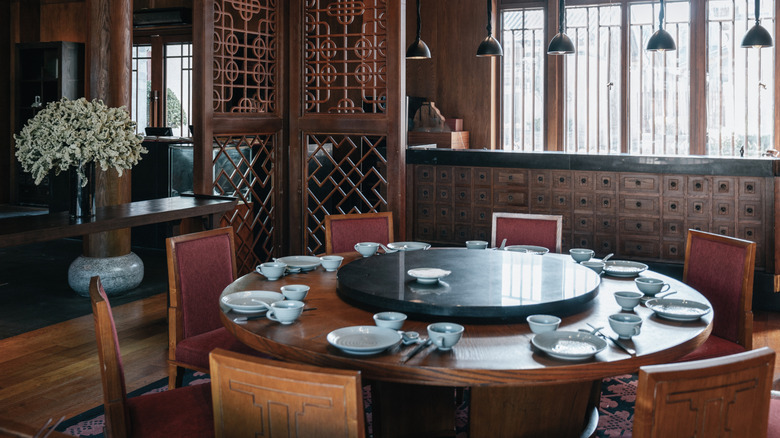
An 1917 advertisement in Vanity Fair introduced the term "lazy Susan" to the public, perhaps by an innocent copywriter naming the rotating tray on a whim. It wasn't until the 1950s that the lazy Susan really became popular after it was redesigned by George Hall, an engineer and soy sauce company owner, for a friend's Chinese restaurant in San Francisco.
You know how Chinese restaurants almost always have round tables? That goes back centuries, but the lazy Susan addition wasn't introduced in Chinese restaurants until the early 20th century. Neither classic nor Chinese, as we've established, using a lazy Susan in a restaurant setting became popular at a time when communal dining was a hotbed for disease (picture eating off the same utensils as everyone else at the table). The rotating trays encourage hygiene and the use of serving utensils.
Today, the gadget has countless uses. A lazy Susan is the fridge addition that gives you easier access to everything you need. It's also a genius pantry hack that helps you get hard-to-reach items and provides extra storage. If you have a corner cabinet in your kitchen whose shelves rotate, you've had a lazy Susan without even knowing. Remember to think beyond the kitchen — it's great in cabinets and underneath sinks, too. While the lazy Susan carries a somewhat insulting title, it's honestly putting in good work.