

Don't Expect Shredded Parmesan At Olive Garden – Here's What You're Getting Instead
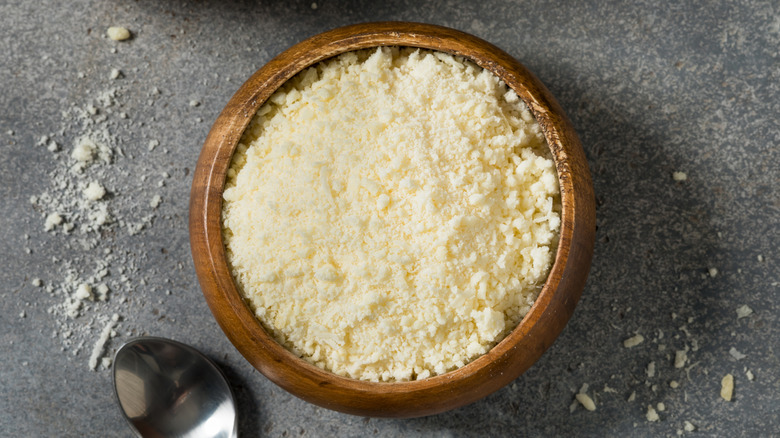
Whenever you order a soup, salad, or pasta at Olive Garden, you can pretty much guarantee that your server is going to offer to grate cheese onto your food using that coveted viral Olive Garden cheese grater. While it's easy to assume that the hard cheese in it is classic parmesan, the truth is that it's something else — though it's purportedly not too different.
Multiple sources have suggested that the restaurant actually uses Romano. This is a similar hard cheese used for grating that shares many basic characteristics with parmesan. It's salty, tangy, and has plenty of umami notes, but it tends to be more pungent and sharper than the less intensely flavorful parmesan. Romano cheese is also lighter in color — from my experience as a pizza maker, you can definitely tell the difference side by side. In terms of usage as a garnish, the cheeses can be swapped for each other, though parmesan does come through as more nutty and rounded. The fact that it's Romano on top of any of Olive Garden's signature dishes is likely a detail you won't notice much, if at all.
What is Romano cheese?
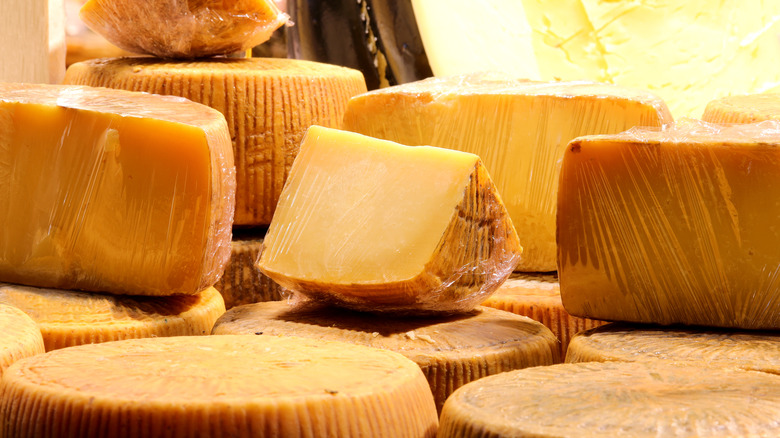
If you've ever heard of Pecorino Romano, it's a cheese in the same family as Romano, but there's a key difference to it. Traditional Pecorino Romano is made from sheep's milk ("pecorino" means little sheep in Italian), and thanks to that, the flavor is slightly gamier. Pecorino Romano also has what's known as a Protected Designation of Origin (PDO) certification from Italy, which means it must be made specifically in select locations, otherwise it's not considered authentic. This PDO certification also extends to other goods, which is why your store-bought balsamic vinegar isn't the real deal unless it's labeled as such.
Romano, on the other hand, is not considered a protected cheese — its origins are Italian, but it can come from anywhere. Romano made in the United States is made from cow's milk, which makes it generally more affordable, but also milder in comparison to the sheep's milk version. The fact that it's cheaper is also likely a factor in why Olive Garden favors it. So when your server comes by and offers to shower your food with cheese until you say "when," expect the sharper bite of Romano instead of parmesan. It may not feel as authentic knowing that your cheese is made stateside, but then again, the Olive Garden experience continues to delight us anyway.