

This Is Why Your Favorite Donuts At Dunkin' Are Inconsistent
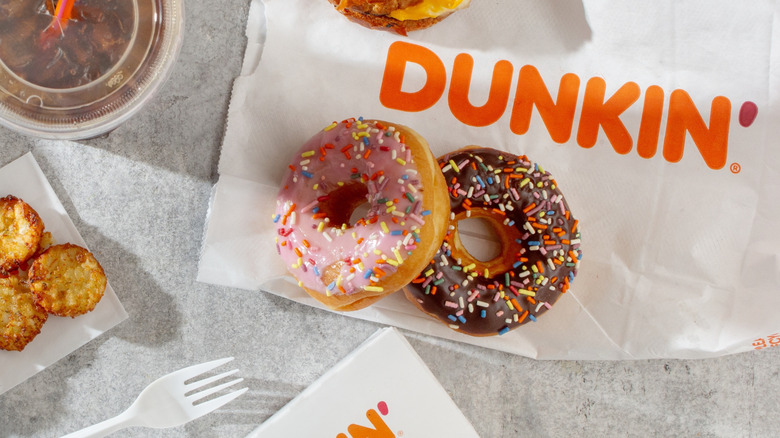
This may come as a surprise to some, but there was once a time when Dunkin' was most famous for its donuts, not for its coffee. In fact, the whole chain used to be called "Dunkin' Donuts" — can you imagine such a thing? A donut from Dunkin' can be a wonderfully satisfying treat, the kind of indulgence you might expect when you're eating what is essentially cake for breakfast. But they're fickle things, these donuts — you go to one store and they're fresh and fluffy, then you go to another and it's like they were baked back in the Clinton administration. What's the cause for this disparity? Well, it has to do with the three different ways Dunkin' locations can prepare their donuts.
The first way, and the way that results in the freshest donuts, is to make them in the store itself. This, obviously, has its benefits, but it can be time-consuming — and now that Dunkin' has dropped the "Donuts" from its name and made its signature snack take a backseat to coffee, most owners have decided it's not worth the effort. Of the thousands of Dunkin' locations in the Northeast (the chain's ancestral home), only a few dozen still make their donuts in store. The others either take the easiest (but least satisfying) route, or they collaborate with other Dunkin' locations to find a happy medium.
What does JBOD and CML mean?
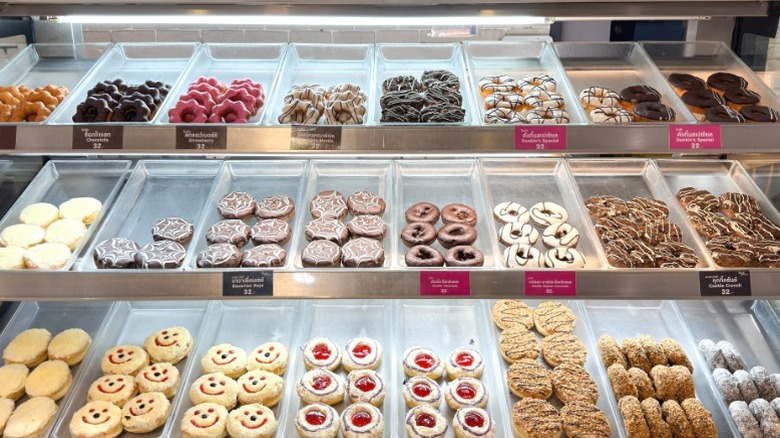
If a Dunkin' location doesn't want to go through the hassle of making donuts fresh, they can order "JBOD" donuts (which stands for "Just Baked On Demand"). The donuts are shipped to the location frozen, then reheated and served. This is, of course, fairly convenient for everybody involved, but some people notice a quality difference: JBOD donuts tend to be a little smaller, a little more dense, and, obviously, not as fresh. This can also make them susceptible to recalls, like the one that affected almost two million donuts earlier this year.
So what if a Dunkin' franchisee wants to avoid the stress of making so many donuts in house, but also wants to provide baked goods that don't taste like hockey pucks? Well, they can source their donuts from a CML, or a central manufacturing location. These CMLs are often located in unassuming industrial parks, but make a truly staggering number of sweet treats: The largest CML, located in the Chicago area, produces about 90 million donuts a year. Because they are located in a central hub for a given area, the donuts can arrive to stores in a fresher state compared to JBOD donuts, while still being very convenient for franchisees. Now you can join the cult of Dunkin' without worrying about biting into a donut that fights you with every bite.