

How To Choose Between The 3 Ribeye Cuts At Texas Roadhouse
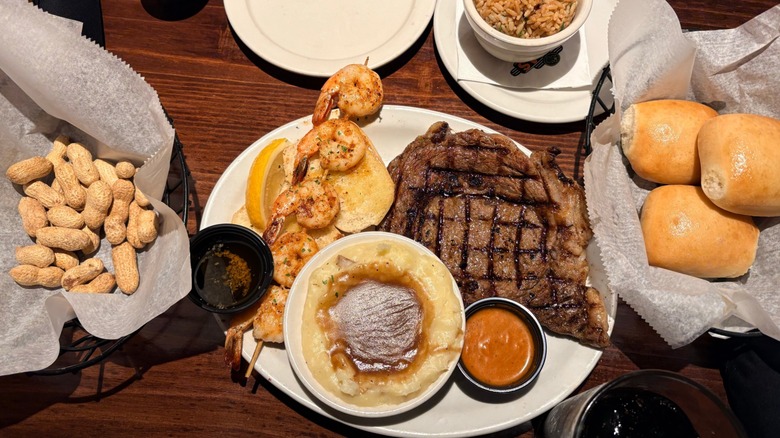
If you're out grabbing a steak at Texas Roadhouse for dinner, you might face a (good) dilemma: Which of the three ribeyes on the menu should you order? And why are there three? First of all, let's go over each type — there's the Ft. Worth ribeye, the bone-in ribeye, and the prime rib. Like the name suggests, the ribeye does come from the rib section of the cow, and it's prized for its marbling, beefy flavor, and juiciness. No matter which version you get, you can expect that it'll be moist with a sizable chunk of fat running through it.
The most important part (to me, at least), is the eating experience. Personally, I like the visceral enjoyment of cutting around a bone and eventually gnawing off the scraps, which is why I'm a big fan of any bone-in steak. There can be gristly connective tissue around the bone, plus the bone size can vary (which means you're paying for the bone too). That's not appealing for everyone, so the easy-eating Ft. Worth is just a plain flavorful slab of meat if you just want a regular steak, without the obstacle of a bone.
The appeal of the slow-roasted prime rib is mainly in its texture. I tend to think prime rib is best when made at restaurants, since they are well equipped to make them. While you won't be getting a robust heavily-seasoned crust on its exterior, you will be rewarded with tender and exceptionally juicy beef. These are more served warm rather than screaming hot — prime rib done medium-rare tends to be a little on the cooler side. To me, that's worth it, because the meat stays extremely juicy that way. You'd be better off ordering a prime rib if a soft texture is your prime (pun intended) want in a steak.
The other things to consider are price, size, and your appetite
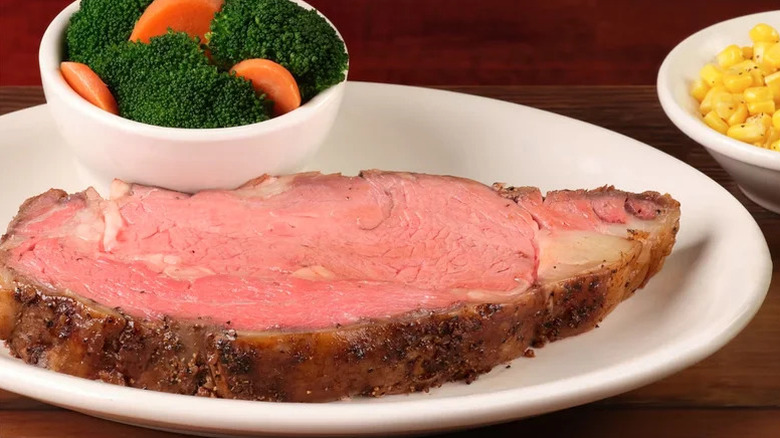
As you're ordering, you'll also want to consider how hungry you are, as quantity does matter. The Ft. Worth ribeye comes in three sizes: 12, 14, and 16 ounces, and can run you roughly anywhere between $28 to $34 (based on prices at a Chicago suburban Texas Roadhouse location). Like I mentioned earlier, this one comes boneless, which means you don't have to carve around something while you're eating, plus you're not paying for the inedible weight of the rib bone. The bone-in ribeye only comes in the 20-ounce size ($36 at my nearest location), while the prime rib comes in three sizes as well: 12, 14, and 16 ounces, from $29 to $35 depending on cut. The prime rib is also boneless.
If you're absolutely famished, and haven't filled up on Texas Roadhouse's famous freshly-baked bread and appetizers, you can definitely consider the larger portioned steaks, in which case the bone-in or 16-ounce versions of the steaks might be your best bet. If you have a smaller appetite, there's the 12-ounce option for the Ft. Worth and the prime rib. Then, of course, there's the matter of price — if you want to save a few bucks, you'll want to opt for any of the smaller options, which you can get with the Ft. Worth ribeye or the prime rib.
So to answer the main question again, it all comes down to price, quantity, and what you like in your steak, whether it's varied texture or just plain juiciness. I often bounce between choosing a bone-in ribeye versus an enormous slab of prime rib, because their preparations are vastly different even though they are the same cut of meat. Plus, it's always good to check the amount of money in your wallet, but if you're ordering steak, might as well treat yourself to something generous, right?