

12 Ice Cream Truck Secrets You Never Knew Before
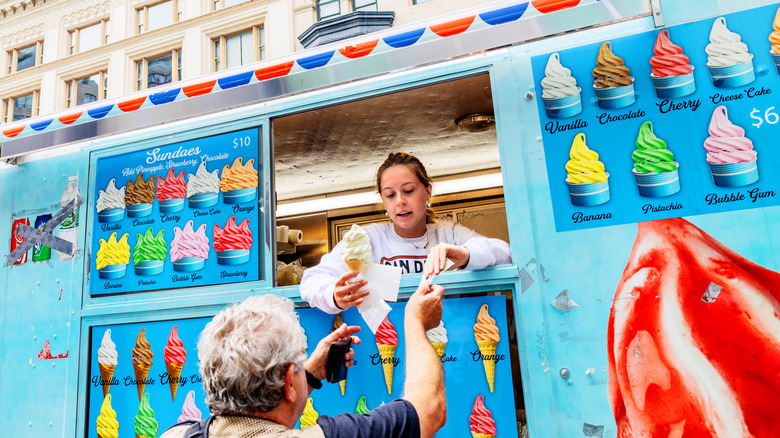
The ice cream truck may be a symbol of quaint nostalgia and youthful joy, but it's also a behemoth of an industry — to the tune of $1.6 billion as of 2026 and forecasted to rise as high as $2 billion by 2031 (via Claight). These mobile purveyors of frozen treats are not just a staple of summertime; they are big business. And with big business often comes many a secret. Some of those secrets may be inconsequential, some intriguing, and others a bit more unsavory (aka the good ones).
Indeed, the ice cream truck's long history in America has seen innovation, intimidation, conflagration (literally so), territorial battles, and more than one case of outlawry. All that tea notwithstanding, the ice cream truck has changed very little over the century-plus it's been jingling through our neighborhoods. It's still just a person, hanging out the window of a cubed van, handing out frozen favorites for pocket change.
So, what are these fun facts, mysteries, and scandals hiding behind our strawberry shortcakes and our SpongeBob popsicles, our soft-serves and our sprinkles? Wouldn't you like to know. Well, you will, if you just read on. Take a look at the menu of 12 below, and pick which one you want. And remember to lick the sides first before it melts everywhere.
Good Humor basically went unchallenged for 40 years
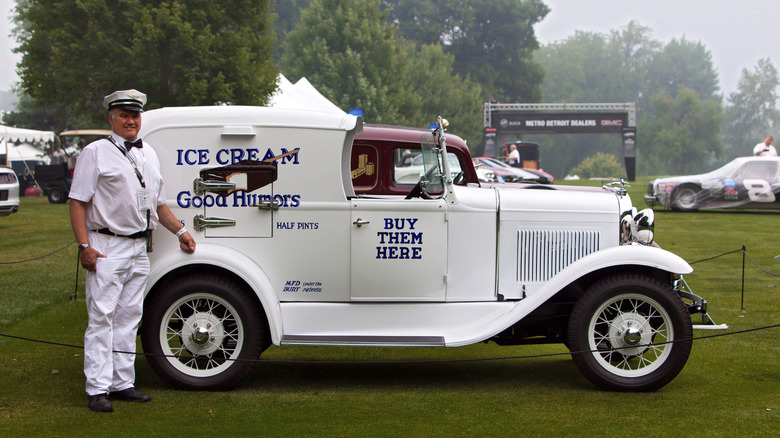
When your average Joe or Jane thinks "ice cream truck," chances are there is one name that comes to mind: Good Humor. It's a brand that's absolutely synonymous with ice cream brought to you on wheels. And its legacy is even deeper than that. The founder of Good Humor, Harry Burt, is credited with developing his own chocolate-coated ice cream bar and, at the suggestion of his son, adding a stick as a handle — a Promethean moment in the history of snacks. No shocker then that, for decades, a visionary operation like Good Humor was the only real game in town.
Starting out life in Youngstown, Ohio, Burt's Good Humor company constructed the first refrigerated truck a few years after the original Good Humor bar came out in 1920. These ice cream trucks roamed the Midwest, mostly uncontested, for the next several decades. But no hegemony lasts forever. A couple of brothers from Philadelphia, the Conways, fastened a soft-serve ice cream machine to their truck, called it Mister Softee, and debuted it on the streets on St. Patrick's Day, 1956. Less than two years later, they were franchising throughout the Northeast and Mid-Atlantic, eventually becoming, like Good Humor, a regular summertime presence — as well as a worthy competitor.
The first jingling bells on a Good Humor ice cream truck were swiped off a kid's bobsled

Before ice cream trucks were piping out tinny, repetitive recordings of public domain music to let everyone know they were coming, it was the humble jangle of a bell that served as the clarion call. And, like the improvised lollipop-stick addition, the jingle of a Good Humor ice cream truck was, at first, equally makeshift. And perhaps even a tad larcenous.
Actually, is it larceny if it's just a father taking from a son? More specifically, taking bells from his son's bobsled? When original Good Humor man Harry Burt was putting together his initial prototype ice cream trucks — which were Ford Model Ts with refrigeration units attached to the back — he needed to let people know the truck had arrived in their neighborhood for business.
Burt went ahead and used bells from his kiddo's bobsled to draw people's attention. Jingling became part of the DNA of ice cream trucks from then on out. Good Humor may be known for discontinuing a favorite ice cream bar or two, but its sonic legacy in motor vehicles purveying frozen treats will probably last forever. Also, why would a bobsled need a bell anyway?
Good Humor drivers made a killing during the Great Depression

As the name suggests, the Great Depression wasn't exactly a fun time. The bread lines, the bleak outlook, the crushing poverty. Even the richest weren't spared utter attrition after the stock market crashed in 1929. Yet, amazingly (although maybe not when you look deeper), one line of work was making close to a killing, week in, week out. At least when the season allowed. This was none other than your friendly, neighborhood ice cream truck driver.
When you consider ice cream as a relatively inexpensive escape from what were dire, hopeless circumstances for many people, it makes sense that the person selling these escapes would do well during such an era — especially in the densely populated big cities. In 1932, two of the largest metropolises in the U.S., New York and Chicago, saw approximately 14 million Good Humor bars sold between them.
What did numbers like this mean for a commissioned Good Humor driver's contemporaneous bottom line? It meant they could take home as much as $100 each week. As of 2026, that's the equivalent of roughly $2,400. And this was long before any character popsicle with gumball eyes was even a thing.
An ice cream truck these days will set you back roughly $75,000
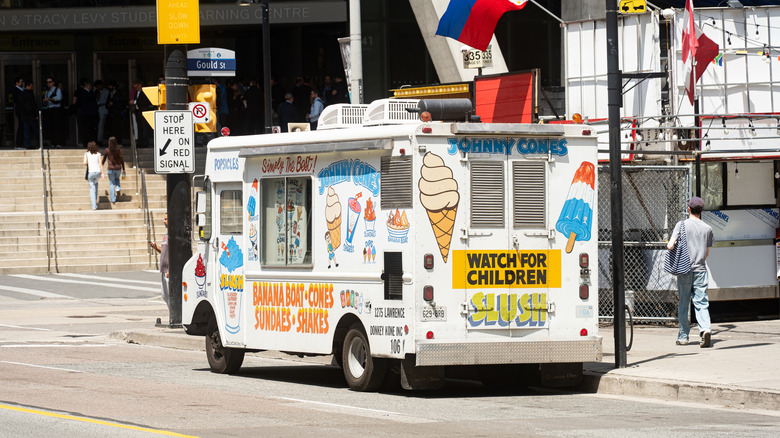
Want to get in on the ice cream truck game? See this as an opportunity for a bit of entrepreneurial growth? Just want a ton of ice cream on hand at all times? Well, like any business, owning and operating an ice cream truck takes an initial investment. First things first, before you get the ice cream, the refrigeration, the scooper, or the cute stickers on the side, you need a vehicle. To be more specific, you need a truck.
So, what would an ice cream truck set you back these days? Well, you're looking approximately at a cool $75,000. That's more expensive than some Porsche and BMW luxury SUV models. If that number seems a little too high but you still really want to get into the itinerant ice cream game, you can go for just a trailer, which starts at about $30,000.
Of course, this still doesn't include the freezers and dispensing machines (which may be included with the truck, for a price), licenses, permits, insurance, gas expenses, and, of course, the actual supplies, such as food, cones, bowls, and spoons. Hey, you've got to want it.
Good Humor was once bombed by the Chicago mob
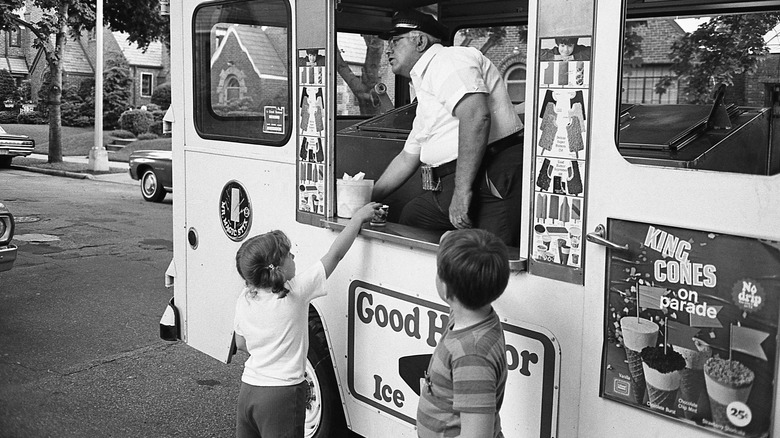
You know how old-timey mobsters could be kinda dangerous? You know how Chicago had a lot of old-timey mobsters? You know how you never before connected ice cream trucks with dangerous, old-timey Chicago mobsters? Well, I have news for you on all those fronts, and it's enough to make Eliot Ness drop his soft-serve vanilla cone on the floor and run off to save America.
It started when a man named Thomas J. Brimer expanded the Good Humor brand to Chicago during the 1920s. It was a hit there, especially during Prohibition when ice cream and other kinds of sugary treats boomed in the vacuum left by alcohol. However, when a business that good is in the same town as the infamous gangland mass killing known as the Saint Valentine's Day Massacre, mob involvement was somewhat inevitable.
In short order, the Good Humor factory on Armitage Avenue was bombed after the company refused an attempt to extort $5,000 in protection money. Despite the substantial damage from the intimidatory explosion — which destroyed two trucks — it came with a big PR boost for Good Humor. The ice cream makers became a symbol for good by standing up to the mob.
The Mister Softee jingle was nearly banned in NYC in 2004
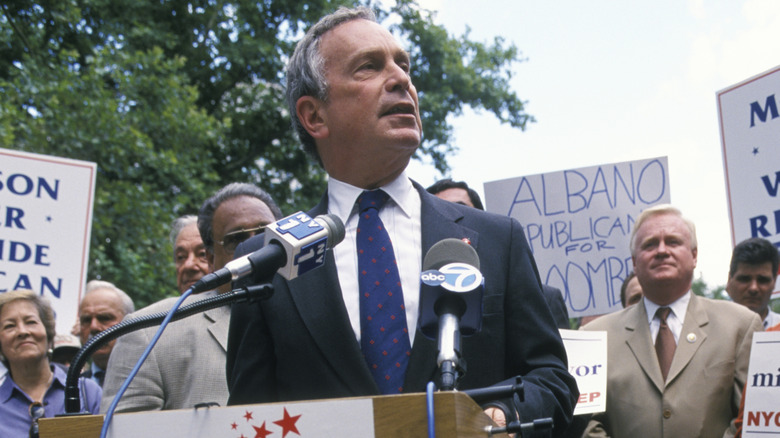
New York City has had a lot of mayors, including Michael Bloomberg. The metropolis saw many good years under his stewardship, but he also had a reputation for trying to over-sanitize things. One of those areas of nanny-like involvement for Hizzoner was noise pollution. Yes, he wanted to make New York City less noisy. Shockingly, it didn't work, on account of the fact that that's impossible. And included in those misguided Bloombergian crosshairs: ice cream truck music.
In 2004, Mayor Mike tried to ban jingles from being blared out of its ice cream trucks in the Big Apple. Bloomberg would've gotten along well with at least one COVID-era New Jerseyan who made a saucy complaint about the same jingle to a local paper. Many New Yorkers, however, were not on board with this curmudgeonly edict, protesting to the point that City Hall gave up on the across-the-board ban.
This was not without compromise, however. New York City declared that jingles could be played only when an ice cream truck was driving, not when parked. It's a law that stands to this day. Of course, if this doesn't satiate your need to hear the song, you can easily go on YouTube and listen to it on repeat for 12 hours straight.
NYC soft-serve ice cream trucks are a duopoly of bitter rivals
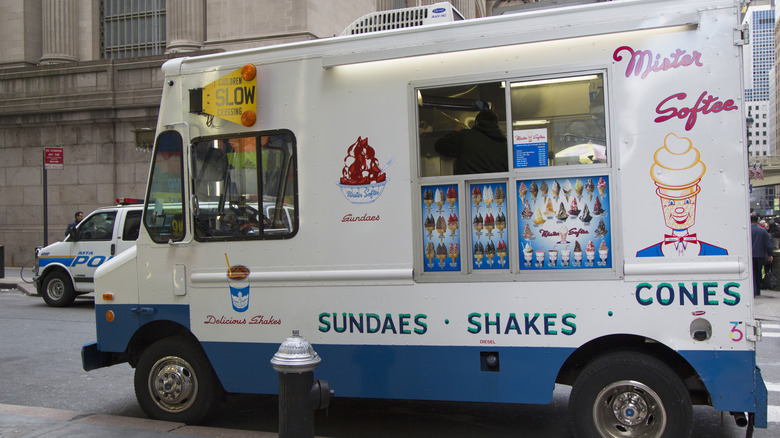
New York loves a turf war. In fact, NYC is less a city than a giant series of turf worth warring over. And The Big Apple, with its deluge of pedestrians and residents, and its punishing summer climate, is a lucrative sales territory for an ice cream truck driver. Mister Softee, the long-time incumbent, has not gone unchallenged in this alarmingly vicious arena.
The challenger? New York Ice Cream. The upstart seller originated when disgruntled Mister Softee drivers broke away, took their trucks, and formed their own fleet — at first calling it, in a beautiful Canal Street knockoff style, Master Softee. This, unsurprisingly, did not survive a lawsuit brought by Mister Softee, prompting the aforementioned name change.
But this only turned up the temperature in the turf war. New York Ice Cream claimed Midtown Manhattan as its territory, even going so far as to threaten any Mister Softee truck that dares to show its jingle there. In response, Mister Softee even hired private investigators to spy on the rival ice cream empire. The two rivals seemed to have called a truce, each keeping to "their" areas of the borough. Seems tenuous.
Ice cream trucks were also at the center of 1980s Scottish turf wars
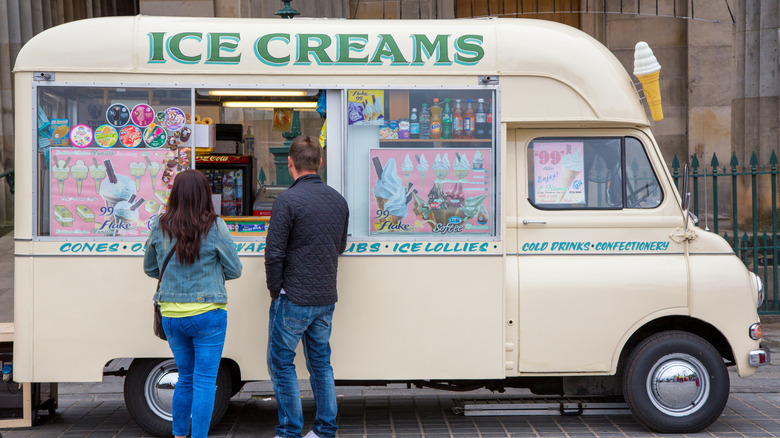
You think New York is rough for battlegrounds? Let's talk about Scotland. As far back as the Romans, Scotland has experienced its fair share of fights over territory. The ice cream truck has somehow been part of that pattern during what's come to be known as the Glasgow Ice Cream Wars.
These "wars" started with poor housing planning, which left neighborhoods without proximate grocery stores and shops. Ice cream van drivers seized the opportunity and started selling goods out of their vehicles, along with the frozen treats. But these goods eventually expanded to include some not-so-good items, such as narcotics and contraband.
Where drugs and larceny go, territorialism and brutalism often follow. In fact, things became so extreme that an ice cream truck driver who refused to get into the black market game was shot and his house was burned down, leading to the deaths of six people. Two men were ultimately imprisoned over the fire, but later freed when their convictions were overturned in 2004.
A Colorado city outlawed ice cream trucks for 65 years
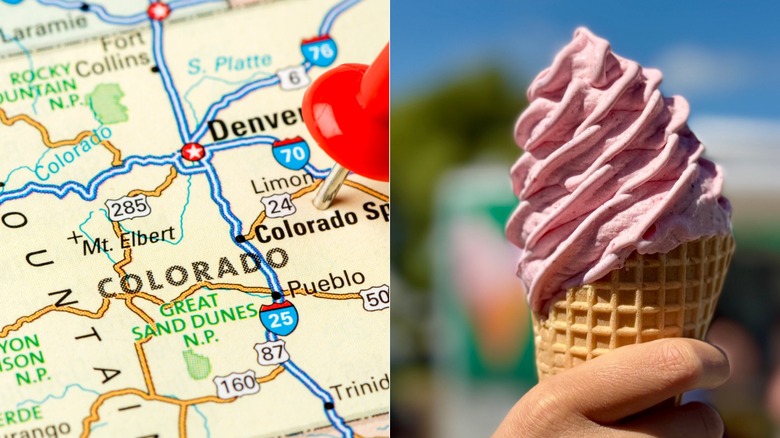
Lots of outlandishly innocent things have been outlawed in America. This may have to do with the country's multitude of legislative bodies on its shores, at all levels of government. It also might have to do with various instances of mob mentality. Or, often, both. How else can you explain ice cream trucks being banned anywhere? Are they really ever the problem?
To the city of Aurora, they certainly were. 2022 saw a major overturning for the Colorado municipality because, after 65 years of banishment, ice cream trucks were made legal again by the city council. It was back in 1957 when lawmakers heeded the complaints and concerns of a number of its citizens, people who felt ice cream trucks were something of a menace.
They apparently didn't like that the trucks had the gumption to drive up and down their streets, and they didn't like the possibility that kids might hurt themselves running after the trucks in pursuit of sweet treats. Long overdue as the revoking of this popsicle prohibition was, it became a welcome moment for the kiddos of Aurora. And, let's be real, a bunch of Aurora adults who missed out all those years.
The ice cream sandwich and the orange pop battle for supremacy
If you ask someone, anyone, walking up to an ice cream truck, "What do you think is the most popular item ordered here?" it would probably be a tough call. They might go with their personal favorite, but that has zero indication of general statistics. They might go with the flashiest thing on offer. If it's the latter, they would be wrong — at least according to Google data.
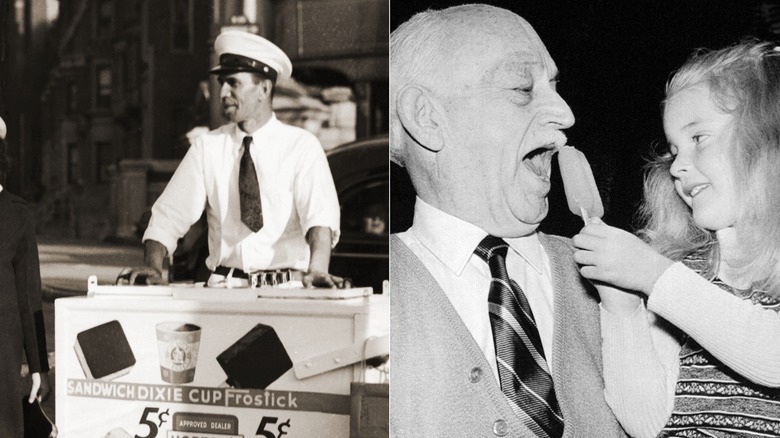
A pair of classic frozen treats emerged as the nation's top ice cream truck pickings, as per a report by Little Sleepies. Leading the way in a tie — each being the most popular item in 13 states — was the humble ice cream sandwich and the no-nonsense orange popsicle. This was followed by the third-place strawberry shortcake bar (11 states) and the equally frill-free cherry pop (7 states).
The ice cream sandwich doesn't seem to have lost its appeal since its invention in the 1800s by New York City street vendors. Before they started sandwiching ice cream between two wafers or sponge cakes, sidewalk sellers used paper. Needless to say, the sponge cakes were an improvement.
Most ice cream truck music comes from one Midwestern family
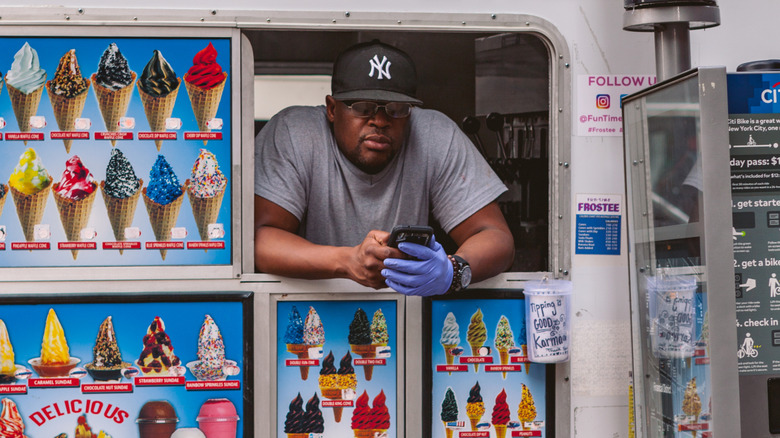
Talk about earworms. Has any music emblazoned itself on our brains like the ones emitted from ice cream trucks? Either by accident or design, they all seem to feature instantly recognizable song excerpts. Of course, it's a little bit of both. And, it's fair to bring the chicken-egg concept into this: Is the music alone embedding itself, or the fact that it's immediately associated with ice cream?
Whatever the answer, there is one company alone that dominates the ice cream truck music box complex: a Midwestern family business called Nichols Electronics. The Nicholses still own and operate the enterprise first started in the 1950s. Most ice cream trucks use the company's music box known as the Digital II, which can play eight different songs.
Most of the ditties on the Digital II were chosen simply because they weren't protected by copyright (therefore free to use), including "The Entertainer" by Scott Joplin. Written in 1902 and made popular by the classic 1973 film "The Sting," the composition is one of the more ubiquitous ice cream truck tunes, causing a Pavlovian ice cream urge in everyone who hears it. Thanks, Nichols family.
Mister Softee has a not-so-secret secret menu
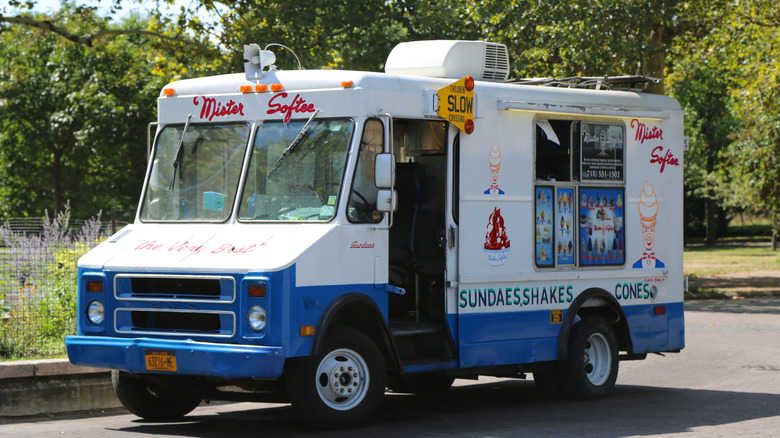
Secret menu hacks have become all the rage. Whether it's the official-slash-unofficial offerings that big chains — wink, wink — keep from the general public, or the wildly creative customizations recommended by nowhere near official sources. It turns out that Mister Softee has just such a menu, complete with quick-order monikers and combos of which you wouldn't have normally dreamt.
Well, maybe we shouldn't call the menu secret, since it's, you know, broadcast right on their website. The roster includes long-time favorites (for those in the know) such as The Black Cat (double chocolate cone, chocolate sprinkles, chocolate dipped ears, and a cherry nose), and The Rose Bud (double vanilla cone dipped in cherry with a cherry on top), along with items like The Carlos (chocolate ice cream dipped in Oreo pieces, topped with vanilla, then dipped in chocolate), and the classic Dirt & Worms (vanilla ice cream blended with Oreo and topped with gummy worms).
Secret menus are nothing new and roughly date back to the 1960s. Mister Softee is just another in a long line of covert-menu eateries that includes In-N-Out, Wendy's, Starbucks, and even Jamba Juice. The secret menu corner of social media has engendered annoyance in both workers and Redditors, especially when people simply make a small modification to an order and brand it as some clandestine hack they uncovered for the world. That's why Mister Softee's approach is so refreshing — it's all about fun.