

For 5x Flakier Croissants, Avoid This Common Mistake

I'm one of those people who loves baking elaborate desserts for the fun of it. So, when I fell in love with the croissants at a local bakery I decided to make my own. Croissants weren't like anything else I'd attempted, though. They felt more like the baking equivalent of rocket science.
I made a few edible attempts, but I'm no expert. For advice, The Takeout turned to an actual expert — Michael Kurowski, executive pastry chef at Ace Eat Serve in Denver, Colorado. According to Kurowski, your over-zealous croissant attempts may be sabotaging you.
Before you start troubleshooting croissants, it's helpful to understand how they work. Puff pastries like croissants are made with a process called lamination. "During lamination, we're repeatedly folding the dough around the butter to create alternating layers of dough and fat," says Kurowski. "In the oven, the water in the dough and butter turns to steam, separating those layers and giving you that flaky exterior and open, honeycomb-like interior."
You might think that extra layers would translate to an extra-flaky croissant, but Kurowski shut that theory down. There is such a thing as over-folded croissant dough, and sometimes less is more. "Each additional turn makes the butter and dough layers thinner, and eventually you reach a point where those layers become so fine they begin to merge rather than remain distinct," explains Kurowski.
What happens if you use too many folds?
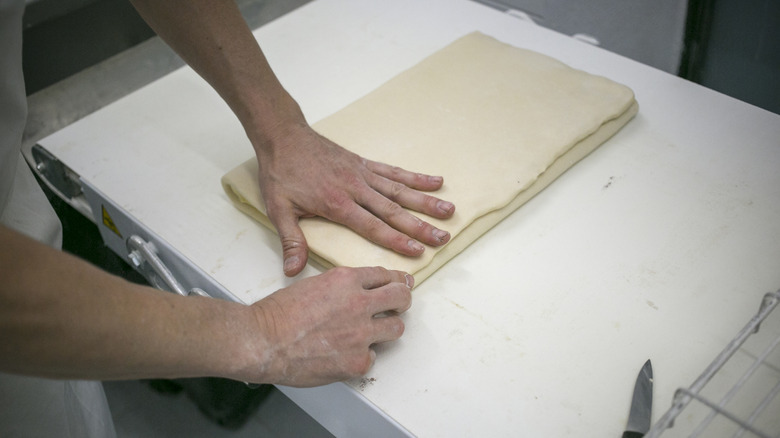
Think back to middle school math where you might've tried to fold a piece of paper over seven times. The thickness of the paper grows exponentially to quickly rack up over a hundred layers. The same goes for croissants. Some recipes call for over a hundred and fifty layers of butter and dough.
Bakers use different folding methods to control the number of layers. "For a traditional croissant, I typically think in terms of three single folds, or letter folds, which theoretically creates 27 layers of butter," Kurowski says. "Another common approach combines a double fold and a single fold."
Unlike a sheet of paper, you can roll croissant dough flat and simply keep folding; but if you tried to keep folding indefinitely, the dough would eventually stop you. Each fold strengthens the gluten, which makes it harder to work with. While resting the dough helps the gluten relax, you should stop before you start to struggle. "The dough should roll evenly and still have some elasticity without constantly fighting or shrinking back," says Kurowski.
What happens if you use too few folds?
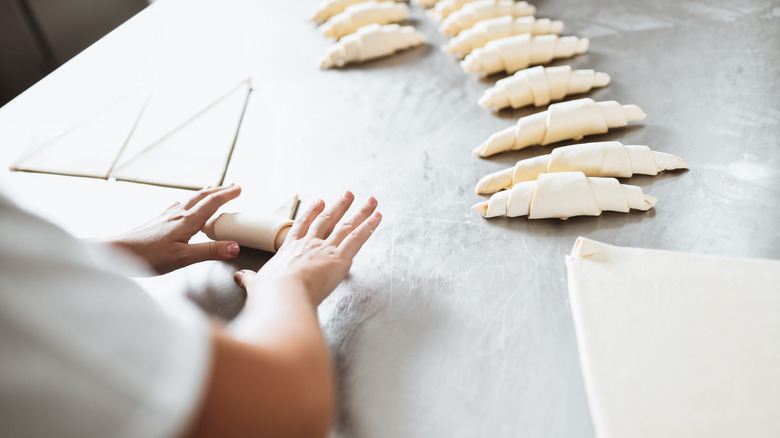
Kurowski's 27 layers of butter are on the lower end. Depending on your recipe, personal preferences, and technique, you might choose to up the count. While many folks prefer a light, airy crumb with big pockets, French chefs often aim for small, even cells. Plus, too few folds will leave you with a loaf of buttery bread, not a croissant.
"Too few folds means you don't have enough alternating layers to create an even laminated structure," Kurowski says. "You might get dramatic separation, but you can also end up with large, irregular pockets; dense or doughy sections."
So what's the magic number? There's no easy answer. "The 'Goldilocks zone' is something I judge both during lamination and after baking," Kurowski says. "I want the butter to remain evenly distributed from edge to edge, without visible cracking, chunks, or butter smearing into the dough." In short: Stop folding if you start to question the integrity of the dough and take note of the results so you can improve your next batch.
"Ultimately, I don't think the perfect croissant comes down to simply counting folds," says Kurowski. "You can execute the 'correct' number of folds and still make a poor croissant if the butter and dough aren't behaving as one during lamination." If you find yourself repeatedly failing, you can always ease your way into laminated dough by making rough puff pastry instead.