

The Pringles From Your Childhood Look Completely Different Today
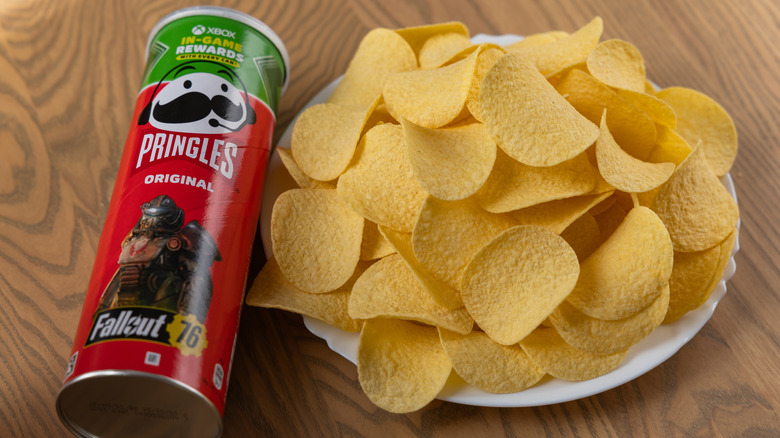
Making a duck bill by holding two strategically placed Pringles in your mouth is a rite of passage for most any kid. Pringles date back to the late 1960s, and, if you do too, then you might have noticed that these potato chips (or whatever Pringles actually are) have evolved over the years.
Pringles fans regularly complain that the crisps were much thicker in their early years, citing recent shrinkflation and evidence that they've become thinner, flimsier, and smaller. They really don't make things like they used to, though the new Pringles chip may have fixed the problem for folks who miss the thicker crisps.
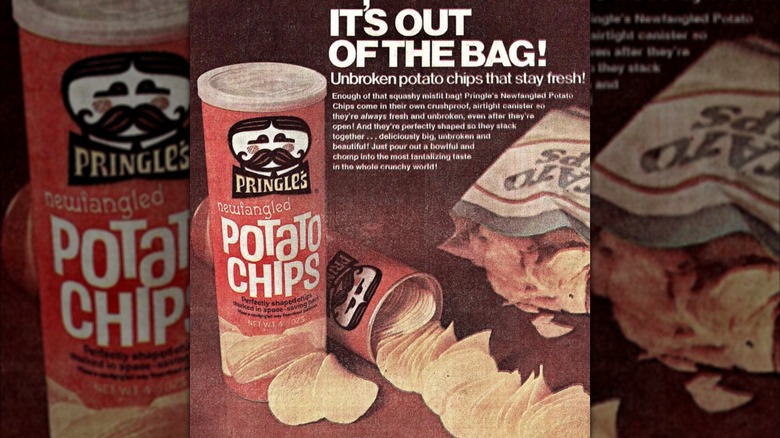
Back then, the term "potato chips" was prominently displayed on the packaging, but those days are gone. That's because, legally, potato chips must be made primarily from whole, sliced potatoes, according to the Food and Drug Administration. Pringles are only approximately 42% potato, and in 1975, the FDA determined that Pringles didn't qualify as a potato chip and could not be labeled as such unless it is specifically noted that they're made from dried potatoes. Ever since then, the company has been calling its product "crisps" instead.
One other subtle change is that Pringles used to be called Pringle's (with an apostrophe "s"), which was short for Pringle's Newfangled Potato Chips. But when Pringles were no longer considered chips, the apostrophe likewise disappeared.
What makes a Pringle a Pringle?
One thing that sets Pringles apart from other potato snacks is that they come in cans reminiscent of those used for tennis balls. In the 1950s, the Procter and Gamble company was trying to solve some of the world's potato chip grievances: chips that were too oily, often broken, and less than fresh. So a P&G employee named Fredric Baur set out to create a potato chip and storage method that would prevent the breakage typical of many bagged chips. Stacking Pringles in a can provided this extra protection, and the easy-to-seal lid kept the snacks fresher for longer. His work was later built on by Alexander Liepa and Gene Wolfe.
Pringles have long come in trendy, ever-changing flavors (carnitas taco crisps, anyone?), along with varieties specific to international markets, such as Indonesia Satay and Hong Kong Fish Ball. In the United States, there are 25 always-available flavors, plus several limited-edition releases that come and go — like Buffalo Wild Wings flavored Pringles crisps.
These potato-y snacks, made from a dough consisting of dried potato flakes, flours, and starches, have always been shaped like little saddles — a form more technically known as a hyperbolic paraboloid. Despite some changes in texture, thickness, and size, they still have a mustachioed crusader (who looks like a cartoon mashup of Burt Reynolds and Groucho Marx) gracing the label. His name is Julius Pringle.