

11 Sweet Treats Around The World That Started Out As Mistakes

Ever wonder how some of the world's most irresistible sweets first came to be? You may be surprised to learn that not every one of your favorite desserts was the result of careful planning or generations of slowly tweaked perfecting of recipes and technique. No sir. Some were simply now-happy accidents, the happenstance and deliciously messy morsels and sips that were born from moments of distraction, oopses, lowkey improvisation, or even outright chaos.
Bet it a skipped or forgotten step in an otherwise tried-and-true formula, an ingredient swap in second when pinch-hitting was the order of the day, or even a last-minute save that had to be whipped up to salvage throwing out the entire thing ... these mistakes throughout history (and in nearly every corner of the globe) have proven that even uh-ohs and oh mys can sometimes lead to something quite brilliant. It's uncanny, really. Because as it turns out, a little bit of "whoops" can go a long way.
These sublime slip-ups have taken place in professional bakeries, claimed the counters in home kitchens, and even taken a starring role on the sidelines of sporting matches or under the big top in circus tents. From items that were allowed to get a little too charred for comfort (yet delivered epic taste anyway) to creative ingredient alternatives that soon became mainstays diners preferred even over the regular recipe versions, here are 11 sweet treats around the world that started out as mistakes.
1. Eton Mess (United Kingdom)
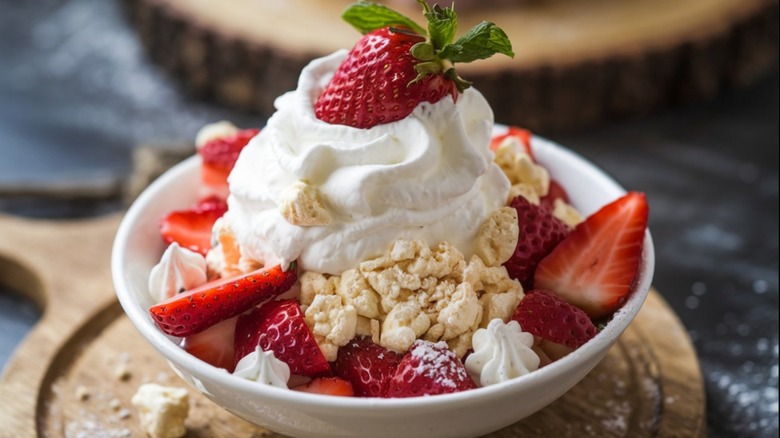
Imagine a dessert so spectacularly muddled that its official name is literally a "mess." Ladies and gentlemen, we give you Eton Mess. Basically, this now beloved British treat is the equivalent of a Jackson Pollock masterpiece, coming together in what feels like absolute chaos, but resulting in absolute (in this case edible) artistry.
Those describing this dessert would admit it appears to be a pile of smashed strawberries, whipped cream, and utterly mashed meringue (albeit a gloriously good tasting one). So, how'd such a mess become a preferred dessert? Legend has it that one day at the end of the 19th century, a rousing cricket match was being held at Eton College, when a perfectly pristine strawberry-and-meringue pudding was being served at the posh gathering.
And long before "butterfingers" was a tasty chocolate bar, it seems the moniker more belonged to the carrier of this delicacy, who is said to have dropped the entire thing en route. Instead of throwing hands in the air and bawling over the cricket bats, the server simply shrugged, and scooped up the now hodge-podge affair. In the blink of an eye, back it went into individual bowls, which were set before diners "as is" — call it a heavenly heap of sugary goodness that tasted just as delicious, only looked a bit worse for wear. The rest is history, and by the time the 20th century rolled around, this "mess" was a mainstay in the U.K., even at royal events.
2. Tarte Tatin (France)
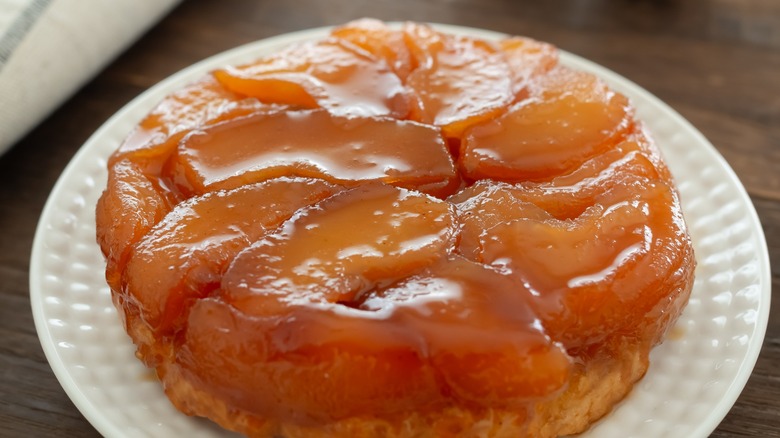
Now, envision next being a 19th-century innkeeper on the outskirts of Paris. Your name is Stéphanie Tatin, and you're having a "day" if there ever was one. The lunch rush has just hit, and you are busily rushing around the kitchen, trying to get your guests served. You start throwing together an apple tart — a dessert you've whipped up what feels like a bazillion times.
You toss your apples in a pan, then the butter, and yes, the sugar, too. But in your haste, you've completely forgotten the best part: the crust. You know, the dough that's supposed to go on the bottom? Sacré bleu, Stéphanie! Never fear, though. As the consummate professional (and clearly stubborn individual) you are, rather than throwing up your hands — or flinging the pan itself in an absolute tizzy — you decide to make lemonade of the situation. Or, in this case, a pastry recipe 2.0.
In true "fake it 'til you make it" form, you slap the pastry dough right on top of the now overcooked fruit (your version of a lid?), then shove the whole dang disaster right into the oven. When it comes out, you flip the entire thing upside down onto a plate, praying to the pastry gods that maybe, just maybe, no one will notice — or at least not deny it for dining purposes. Deny it they did not. In fact, diners loved it. And just like that, the Tarte Tatin was born.
3. Popsicles (USA)

Now, picture being a pre-teen circa 1905. Your name is Frank Epperson, and though you've only spent 11 years on this earth so far, you've seen enough to realize you're human, and you make mistakes all the time. But it isn't until one fateful night, while enjoying a favorite fruit drink, that one of these oopsie-daisies results in an ooh la la libation-turned-dessert revelation. Did we mention the night was a wee bit chilly? And there you were, sitting on the porch, and clearly distracted. Having freshly mixed up a glass of sugary powdered sips with a stirring stick, you simply wandered off, leaving your sip all by its lonesome.
That poor glass — complete with stirring stick jutting out, like a little lonely mast above a sea of sugar water — was left to shiver and shudder all night. When you woke up the next morning, You found your sip frozen solid. But this was no basic block of flavored ice. Thanks to the stirring stick absentmindedly abandoned (still standing tall in the middle of it all), the frozen soda had magically transformed into a standalone stick sensation of epic dessert proportions.
Well, Frank, you clearly are not only an inventor (albeit unaware), but you're also a fan of branding, so you dubbed your discovery the "Epsicle" (a mashup moniker blending "Epperson" and "icicle"). Long story short, your version of icicles "popped off," and the rest is delicious history.
4. Crêpes Suzette (Monaco)
Another pre-adult that accidentally made dessert magic? Teenage waiter Henri Charpentier. Charpentier was just 14 years old when, in 1895, he was standing in the middle of the Café de Paris, shaking in his boots. Why was he so nervous? Because none other than the then-future King Edward VII was scheduled to come and dine that day. Talk about pressure. And the young waiter was feeling it.
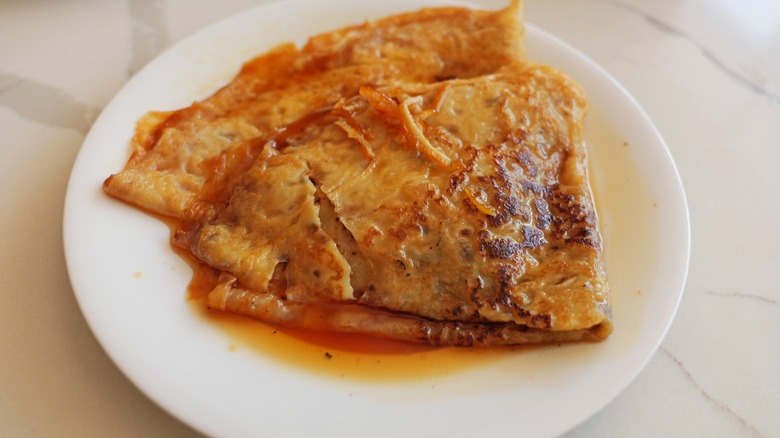
So while whipping up some fancy pants French crêpes utilizing a sauce of sugar, citrus, and enough liqueur to make a pirate blush, Charpentier must've gotten sidetracked ... and ... whoosh! That alcohol ignited, sending a fierce fireball leaping from the pan, singeing everything in its vicinity — Charpentier's eyebrows likely included. While most of us might've dropped the pan and bolted for the nearest exit, he saw beyond the flames. After a brave taste test confirming it was still quite yummy, he decided to serve it.
To his (and diners') shock, the panic-at-the-disco inferno had transformed the original sauce into something spectacular. The surprise combustion had burnt off the booze for the most part and caramelized the sugar, making for a new creation that absolutely killed it. The Prince ended up loving it, so much that he asked what this strange dessert was called. Charpentier tried to name it after the Prince, but the King-to-be (clearly a total gentleman), redirected the honor to a beautiful woman at his table: Suzette.
5. Chocolate Chip Cookies (USA)
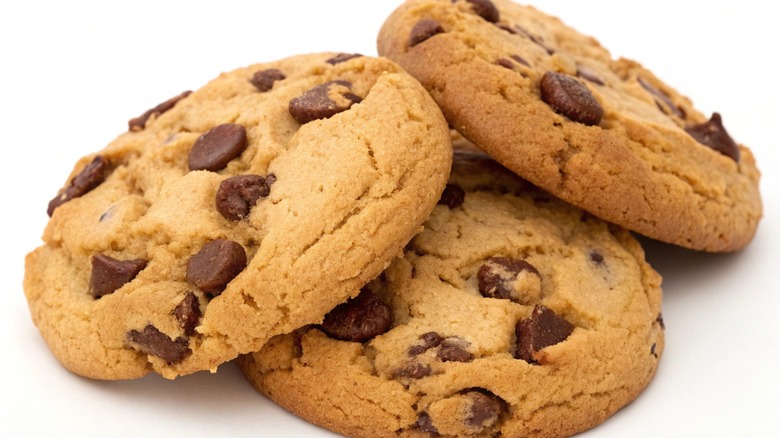
If you were asked about your go-to cookie recipe, chances are you may choose chocolate chip. And while we all seem to have our own special tricks for how to make better chocolate chips cookies than the standard recipe, have you ever stopped to consider the origin story of America's preferred handheld treat? Most attribute this treasure to one woman (and the Tollhouse cookie company.)
We're talking about Ruth Wakefield, who unwittingly (and nearly overnight) became the 1938 heroine of the Toll House Inn. One story goes that Wakefield, smack in the middle of her baking zone flow, suddenly realized she was out of the melted baker's chocolate. While most would have just crumbled in a heap right there on the kitchen floor, Wakefield, like Kendrick Lamar would agree, was not like us. Reaching for a Nestlé semi-sweet chocolate bar she had on-hand, after hacking it into chunks, she tossed the makeshift morsels into her regularly scheduled cookie dough. Wakefield assumed the heat would melt the chocolate morsels entirely, which would have them (and their cocoa flavor) blending uniformly throughout the batter.
*Record scratch ... This is not how things went. Those stubborn little chocolate nuggies held their ground, softening only until gooey, but still holding shape. Praise those little delicious pockets of defiance, because what resulted was not a failed substitution, but an entirely new (now most popular) cookie recipe.
6. Gâteau Manqué (France)
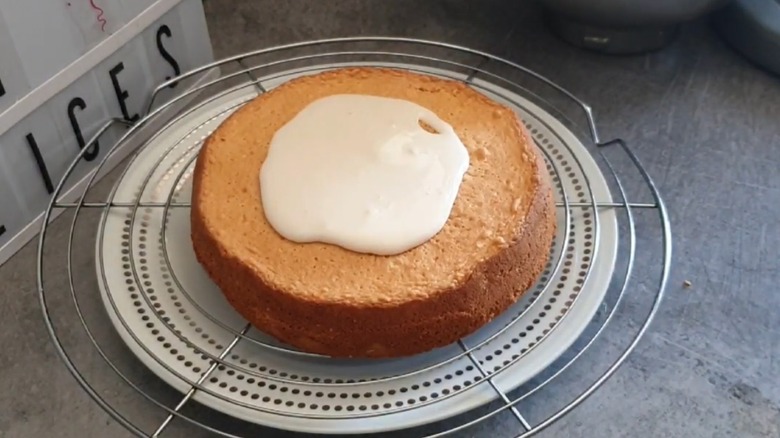
For all those who've fallen victim to real eff ups at our places of employ, this next story just might make you feel a bit less alone. Imagine being such a complete disaster at your food establishment job that they dub a permanent item on the menu after your epic culinary flub. Such is the story of a poor little junior baker at Parisian bakery Maison Félix, who's said to be responsible for gâteau manqué. Literally translated as "failed cake," this now beloved dessert wrapped in delicious praline is praised by many, even critically acclaimed chefs. But it was not always so.
The drama unfolds when this assistant baker was given the simple task of making a sponge cake. What should've been child's play somehow spun out into near tragedy. Instead of whipping egg whites into the airy dreams patrons expected in their sponge, this baker came up with a dense, anything-but-airy goo.
Back in America, a reality TV host-turned-president would've declared "You're fired" instantly. Luckily, the French decided to pinch-hit, plying this "problem" with butter and praline. After reworking the goo into something rich, nutty, and delicious (though decidedly not a sponge cake), they sent it out to customers who enthusiastically approved. When the head chef or a curious customer inevitably asked, "What on earth is this?" the staff didn't even try to lie. They just shrugged and called it "manqué" (a failure).
7. Slurpees / ICEEs (USA)
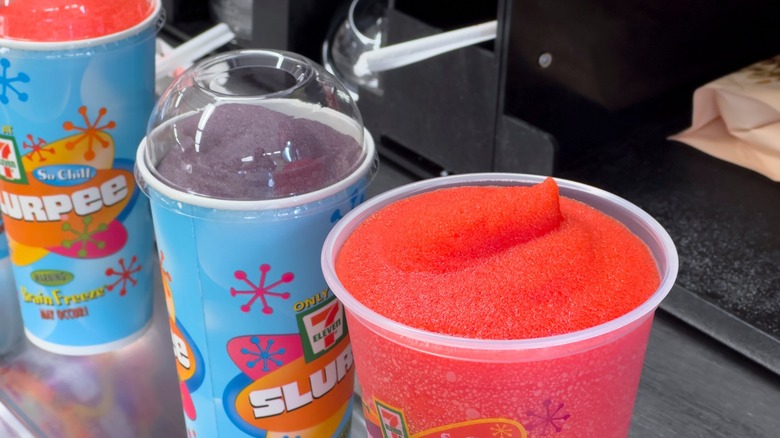
Nowadays, it's not uncommon to see people getting creative and making any drink into a frozen slushie. And let's not forget the many ways we've concocted our very own Slurpee secret menu hacks at the global convenience chain 7-Eleven. How do you Slurpee, by the way? But, how did it all begin? It's actually kind of a heartwarming story, at least in the way that we can perhaps take hope that even when things have descended into complete hot mess territory, keeping your cool (or in this case, your freeze?) can quite literally lead to success.
It was the late 1950s, and Omar Knedlik, a Kansas Dairy Queen owner, was going through it. It was one of those weeks when nothing was going right. To top it all off, his soda fountain (the very soul of his business), went kaput, probably right in the middle of a hotter-than-Hades heatwave. Desperate to keep from losing his customers, Omar tried shoving a bunch of bottled sodas into the freezer and hoping for the best.
What resulted was super weird, and near impossible to explain with words. It wasn't ice, not exactly, nor was it liquid. It was ... a semi-frozen, sugary sludge (let's say slush, to up the appeal?) Sounds fantastic, we know, but the thing is ... it kinda was. People loved it, even more than the regular colas they'd come looking for initially. Thus, the initial ICEE and Slurpee seeds were sown.
8. Pink Lemonade (USA)
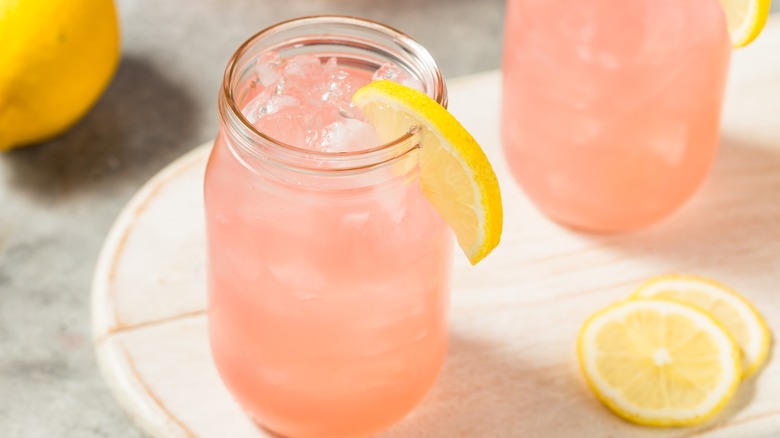
While we now have pre-made pink lemonade powders you can glide into the grocery store and buy easily (and even recipes resulting in a neon pink lemonade rendition using natural beet dye), achieving that melon-pink hue wasn't always such a breeze — or even an actual thing. Pink lemonade's origin story is odd, quirky, and traces back to the wondrously chaotic 19th-century world of circus Americana. There are a few legendary stories of lore, the most popular (and least appetizing) dating back to the 1850s.
Supposedly, when a concession worker at the circus named Pete Conklin ran out of fresh water for his lemonade stand, it had him seeing red. Flustered, and in the need of a quick remedy, Pete is said to have grabbed a nearby basin of pink water. No big deal, right? But ... this tub happened to be the very same vessel a fellow circus performer had just used to launder their red tights. Rather than discarding the tinted water, Conklin added lemons and sugar, marketing the concoction as "strawberry lemonade." Ewwww, we know.
This is likely exaggerated for shock value; a far more palatable explanation credits Chicagoan Henry E. Allott via an accidentally dropped handful of red cinnamon candies into a traditional lemonade batch. All we know is: Pink lemonade is the schizzle, we're glad whoever made it did so, and we're extra glad they no longer make it with shady post-skivvies-wash water.
9. Chess Pie (USA)
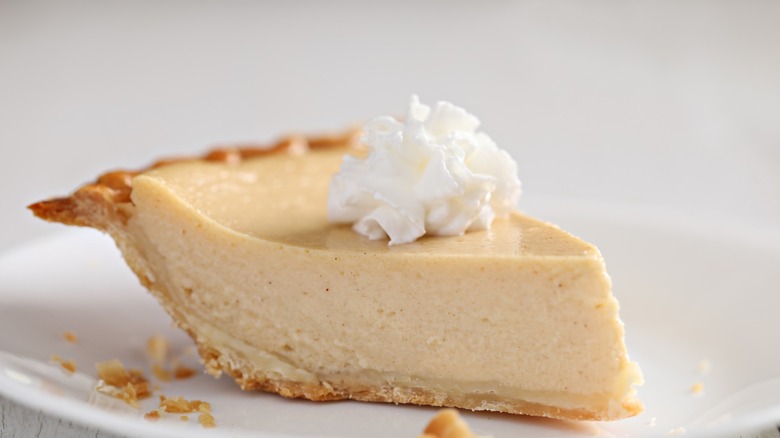
Remember the telephone game? That silly pre-teen slumber party standby where you're given a phrase and somehow, over the course of hearing it repeated (and reinterpreted by each hearer), the original saying gets remarkably warped. Such is the story of the Chess Pie, if lore is to be believed. It's a Southern classic dessert, known by name near and far now. But that initial name? Total mistake, or should we say misunderstanding.
One tale tells of a plantation-era cook who was simply out here minding her own business and baking away, when somebody crashed in her kitchen and inquired what heavenly recipe was producing such paradisaical aromas. In true, Southern-drenched drawl, the baker answered simply that it was, "Jes' pie" (as in, "It's just pie, so y'all take a good whiff, smile, and be on your way so I can keep baking.")
But what reached the entranced interloper's ears was "chess pie." And holy Sarah Jessica Parker! Just like that, deep South dialect (and a pair of ears that clearly weren't from there) gave that pie a whole new identity. Some folks may try and tell you a bunch of hullabaloo about "pie chests" or old English roots, but the "Just Pie" lost in translation tale is the one that mostly sticks. As for the whatever-it's-really-called pie itself? That's one ridiculously yummy recipe filled with plenty of butter, sugar, eggs, even cornmeal or flour thrown in for that signature thick, custardy consistency.
10. Ice Cream Cones (USA)
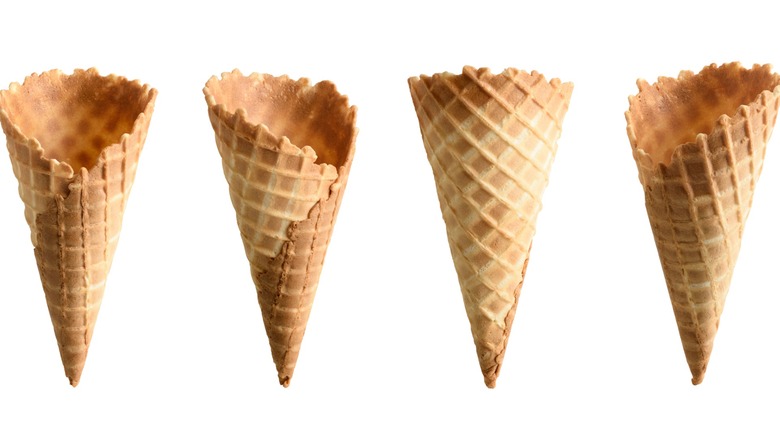
When it comes to enjoying delicious ice cream, are you a fan of a bowl or cone? If it's the latter, you'll want to thank an ice cream vendor selling his dairy delights from the St. Louis World's Fair way back in 1904. It was thanks to this entrepreneur (and really more so, the help of his quick-thinking next-door ... er... next-stall neighbor?) that your preferred ice cream cones even exist.
The story most agreed upon is that it all happened when the ice cream vendor was faced with an absolute crisis: He and his ice cream was so popular among fair-goers, that he found himself unable to keep up with the pace of supplying clean glass serving dishes as needed. Without a vessel to deliver his sweet, frozen treats to fans at the fair, he had to improvise.
That next-stall vendor we mentioned before? His name was Ernest A. Hamwi, and he happened to be selling thin, crisp, waffle-esque pastries (identified by many as zalabia). The pair joined forces to provide a delicious fix for the quandary, rolling the still warm waffles into tightly-wound cylindrical shapes that successfully "held" the ice cream as good as any old glass dish could. And the fact that this new alternative was edible as well? Genius. Customers agreed, and soon this ice cream carrier solution was being copycatted and clamored over, everywhere.
11. Gooey Butter Cake (USA)
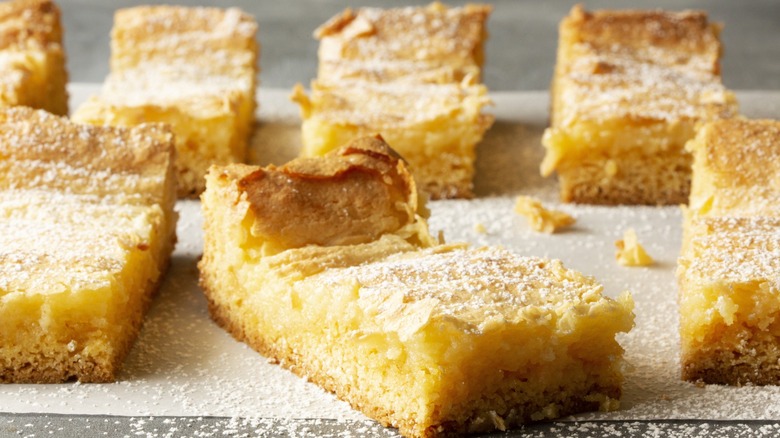
Gooey Butter Cake is a top dessert in St. Louis. But did you know it was actually the result of a big mishap? More specifically, this cake was born when a culinary genius' skills in the kitchen didn't quite measure up their mathematical prowess (or lack thereof). It happened in the 1930s, when a baker was looking to whip up a regular old coffee cake.
However, what happened was that that baker mistakenly totally whiffed on the amounts of ingredients being placed into the batch of batter. In a ratio that would rock any sugar lover's world, this meant that far, far, FAR more butter and sugar made its way into this particular mix. So, needless to say, that airy, crumbly, spongy coffee cake that this baker envisioned popping out of the oven when all was said and done? Well, that baking timer dinged and ... let's just say what exited was pretty "crummy" (because, it had none).
Instead, it was super dense (dare we say sticky?) and more resembling a thick, rich custard concoction than the fluffy cake fantasy expected. And yet! Unwilling to throw the baby out with the bath water (or in this case, toss the whatever-the-heck-goop this was out entirely), the baker decided to work with it, slicing the new creation into squares, then selling them just like that. And customers? Let's just say that, long before Gwyneth laid claim, people ate that Goop up.