

Your Guide To The Types Of East Coast Oysters
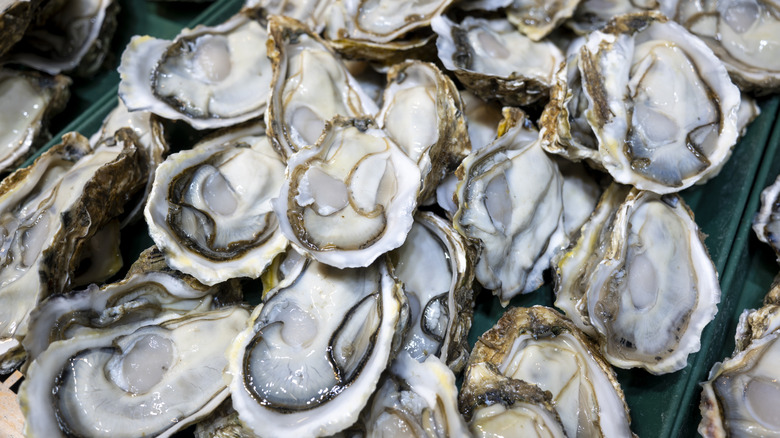
Whether you're eating oysters raw, fried, stewed, or even grilled, they have been a part of American foodways since long before the first Europeans set foot on the continent. Archaeologists have found billions of oyster shells buried at indigenous sites dating back over 1,000 years. While there are many different types of bivalves, there are really only two main species found in the United States: the Pacific (Crassostrea gigas or Magallena gigas) and the Eastern or Atlantic (Crassostrea virginica).
The key difference between West Coast and East Coast oysters, besides geography and species, lies in the flavor. "Generally, East Coast oysters are brinier than West Coast oysters. Eastern oysters, raised either in the Atlantic Ocean or in its estuaries, live in a much saltier environment. West Coast oysters are mostly raised in protected bays, estuaries, and tidal rivers, where there is much less salt," says Robert DiGregorio, who works as a director of seafood quality at New York City's Fulton Fish Market.
Crassostrea virginica may be the primary East Coast species, but there is also a less dominant one: Ostrea edulis, also known as European Flat or Belon. According to DiGregorio, "This one is not nearly as popular; in fact, less than 1% of all the oysters harvested on the East Coast are Belons." If you order oysters in a seafood restaurant in the eastern part of the U.S., you're more likely to get one of the numerous varieties of Crassostrea virginica. As DiGregorio explained, "This species morphs into hundreds of varieties depending on where it's grown and harvested. [...] Some very popular varieties of the Eastern oyster include Blue Points, Malpeques, Wellfleets, and Chincoteagues." These, then, are the four types we'll focus on.
Blue Point oysters
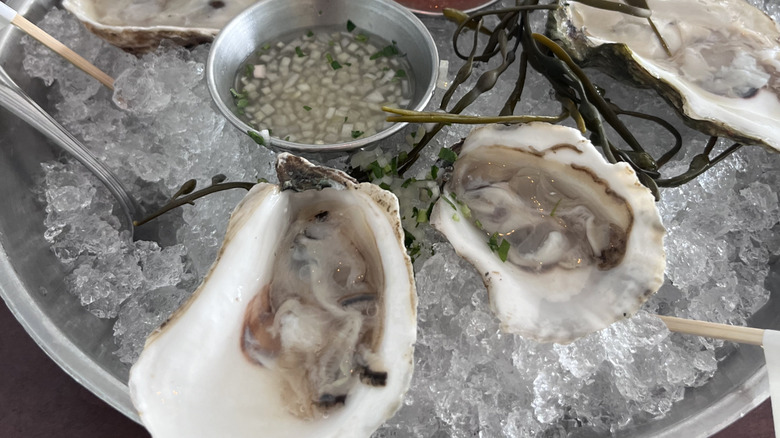
"If you asked most people to name an oyster, Blue Point would likely be the answer. The name has been around for more than 200 years and has achieved strong name recognition, even though it is now almost a generic term," declared Robert DiGregorio. He went on to explain that, while they were originally from a specific Long Island town called Blue Point, "Today, Blue Points generally refer to oysters grown in Long Island Sound." The shells are oval, ranging from brown to tan to green, measure about 3.5 inches, and have what is described as a medium cup. (Cup size refers to the depth of the shell, with deeper ones holding more liquid.)
Blue Point oysters are on the milder side, flavor-wise. As DiGregorio put it, "Beyond the well-known name, these oysters are very easy to eat. They are not overly briny, have a mild flavor, and are not too large, making them a favorite among experienced oyster aficionados and beginners alike." What's more, it's easy to correctly shuck these oysters. There are several different reasons for this. DiGregorio told us, "Blue Points from New York and Connecticut are known to be shucker-friendly because they have a well-defined hinge that allows the knife to slip in easily. They also have a very consistent shape, which makes them easier to open compared to some other oysters that can be very long and skinny or misshapen." The thick shells are also less likely to break.
Chincoteague oysters
Chincoteague is a charming island off the coast of Virginia that may be best known for its wild ponies (although the herd actually lives on nearby Assateague Island, making the ponies Marylanders rather than Virginians). Apart from tourism, however, oystering has been a major part of the economy since the mid-1800s. So much so, in fact, that Chincoteague even has its own species, which are also sometimes called Chincoteague salt oysters.
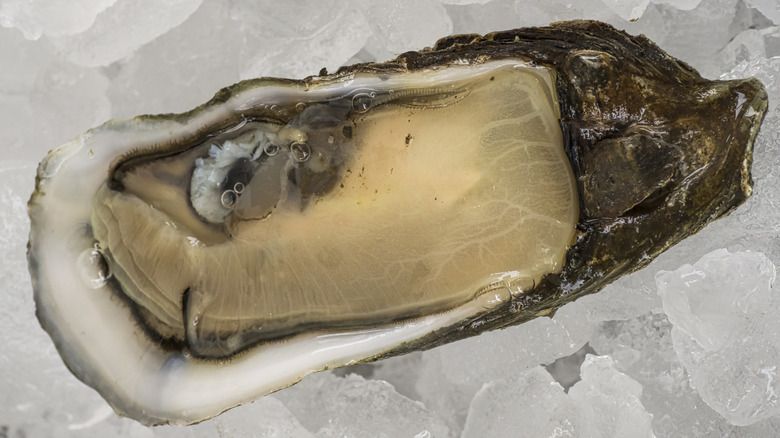
"Known as the aristocrat of the oyster family, [Chincoteague oysters] were shipped by the thousands to major cities like New York and Philadelphia. The area produces such a distinctive oyster that oysters from less interesting waters were often shipped to Chincoteague for a few weeks to take on some of the East Coast brine," Robert DiGregorio told us. The shells measure anywhere between 2.5 and 3.5 inches and are grayish to greenish-brown in color, while the oysters are firm and plump with a medium cup. As for the flavor, DiGregorio opined, "Chincoteague salts have a very strong salt punch." (Hence the name.)
Malpeque oysters
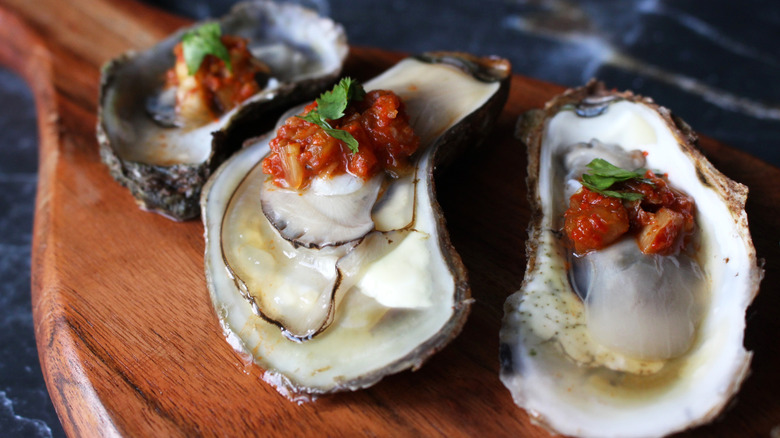
Malpeque oysters take their name from Malpeque Bay on Canada's Prince Edward Island. Robert DiGregorio had this to say about them: "These oysters have been popular for a very long time." They even won international recognition for their flavor at the 1900 Exposition Universelle held in Paris back when world's fairs were in vogue, being named the tastiest oyster on the planet.
Malpeques have a slightly different shape than the other oysters described here, as they have two cups, both of which are on the deeper side. They're also rather large, ranging from 3 to 6 inches, and have a greenish shell. They're known for being neither too mild nor too briny but a good balance between the two.
The relatively unpolluted glacial water of PEI provides the perfect conditions. In fact, according to Prince Edward Island's Department of Fisheries, Tourism, Sport, and Culture, the island's production accounts for 26% of all the country's oysters and 74% of those that come from Canada's Atlantic shores. In 2024, more than 14 million pounds were harvested, for a total value of nearly $20 million (USD). Sadly, an oyster parasite called MSX started making inroads into the island's oyster population in the latter half of 2024, followed by something called dermo disease in 2025. Both of these conditions continue to pose a threat to the remaining Malpeque population.
Wellfleet oysters
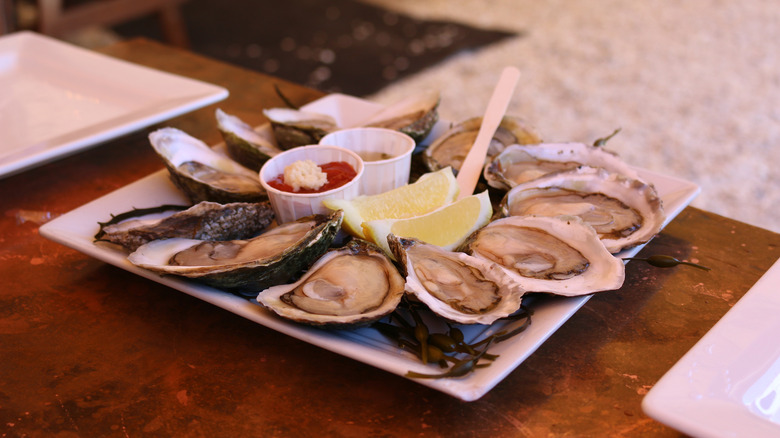
Wellfleet oysters may be one of the few varieties to have its own theme song – a poem chanted by street sellers in London dates back to the 17th century. Of course, the Wellfleet oysters that were sold back then were more likely to have been Ostrea edulis, as this variety can be found in the Thames estuary, whereas Crassostrea virginica oysters are native to this side of the Atlantic.
Our Wellfleet oysters, however, are equally worthy of being celebrated in song. According to Robert DiGregorio, "Some consider Wellfleets to be the gold standard of East Coast oysters, and they consistently rank among the most popular oysters in the world." They take their name from Wellfleet, Massachusetts, and are the best-known type of oyster harvested in New England.
DiGregorio describes Wellfleet oysters this way: "More teardrop-shaped than Blue Points and more elongated. Approximately 3.5 inches long, with a good amount of brininess and plump meat." So briny are they, in fact, that some detect a kind of seaweed flavor to them. Even so, they're a top choice among those who prefer their oysters extra-salty.