

Keep Baked Potato Soup From Turning Into A Gluey Mess With An Overlooked Kitchen Tool

Baked potato soup is a simple and inexpensive way to make a filling meal. It's hearty and has an extra creamy texture that warms your insides on chilly days. Unfortunately, it's easy to make a few mistakes and end up with a soup that has an unpleasantly gluey texture. One way to upgrade the texture for one of our favorite winter soup recipes is to use a ricer after you cook your potatoes.
For this technique, you need a potato ricer, preferably one that can handle a large capacity. For those new to ricers, this kitchen tool has many tiny holes that cooked potato is forced through with a squeeze of your hand, turning them into long strands similar to noodles. Use the smallest die if your ricer has multiple settings. After you bake, microwave, or boil your potatoes and remove the skins, cut them up and press them through the ricer. Don't toss them into a food processor. Immersion blend all the other ingredients, such as milk, garlic, and cheese, before adding the riced potatoes. Wisk over heat to combine rather than blending again, until the soup gains a pleasingly thick, smooth texture.
The resulting soup won't be gluey or stodgy, but will still be decadently creamy and filling. Plus it's easy to customize. You can add in bacon, chives, sour cream, or hot sauce, and it won't create that unappetizing slimy texture. If you somehow end up with leftovers, you can freeze potato soup as long as you do so once it's fully cooled.
Why a ricer is your secret soup weapon
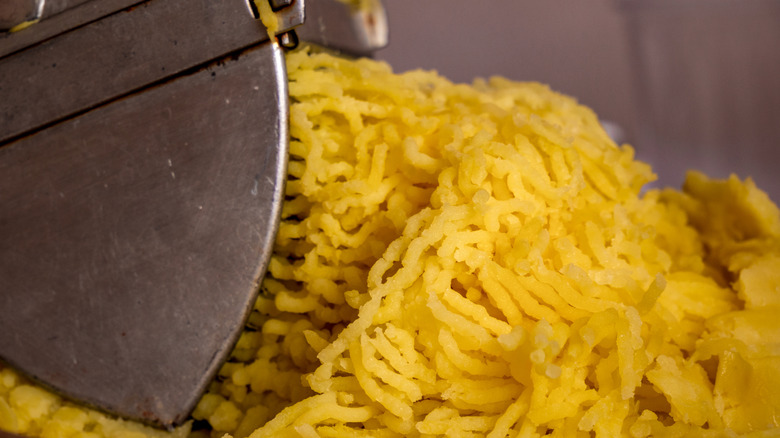
To get why this hack works, you must understand why baked potato soup gets gluey in the first place. That weird texture comes about from an over-activation of starch. When you mash or whip potatoes, especially in a blender, the starch molecules that swell during cooking can rupture, creating a gelatinous or elastic texture. When that over-worked potato meets your mouth, it reads as thick and slimy rather than creamy.
When you use a ricer, on the other hand, you avoid the overworked starch problem entirely. To get a fine texture, the potato just passes through the little holes, which prevent the starch molecules from rupturing. Plus, many modern stainless steel ricers are dishwasher safe and are less work than a hand masher, saving you time and effort.
This kitchen tool is great for other potato dishes, like extra fluffy mashed potatoes; and you can use this technique for other potato-based soups, too. A smooth potato leek soup is a cold weather essential; and vichyssoise, a cold potato soup that can also be warmed, makes for a classically elegant meal. Use riced potatoes to thicken chowders, and cut down on flour or cream. Just remember to start with a ricer for the most enjoyable, comforting texture.