

The Best Way To Sear Steak Actually Involves A Sheet Pan (Hear Us Out)
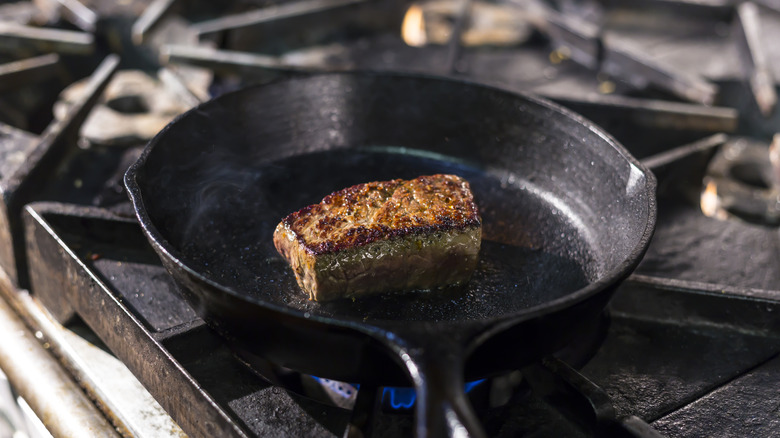
One major steak-cooking mistake, no matter the cut, is plopping it in the frying pan while the meat's surface is wet. Damper meat will steam instead of sear, meaning it won't ever get hot enough to form a nice brown crust. There's one way to avoid this, and it involves a sheet pan. No, the pan's not for searing. It's used to catch the moisture that drips from a steak as you expose it to the air inside the fridge. In fact, it doesn't even need to be a sheet pan, since a plate or a different type of pan could also work.
Scott Thomas, who blogs about food and shares recipes on his websites The Grillin' Fools and The Cookin' Fools, recommends using this for pricey steaks. He told The Takeout, "Any of the better cuts will work, [such as] ribeye, strip, [or] filet." If you're planning to pan-sear a more budget-friendly steak like hanger, sirloin, or Guy Fieri favorite tri-tip, the sheet pan technique can still be beneficial.
Thomas does have one caveat about sheet pan meat drying, however. He said, " ... This seems like a good idea, but it's more complicated than that." As you can see by the steps he outlined below, it's both more time-consuming and labor-intensive than merely letting it sit on a sheet pan for a few hours.
Drying steak is time-consuming and requires extra equipment
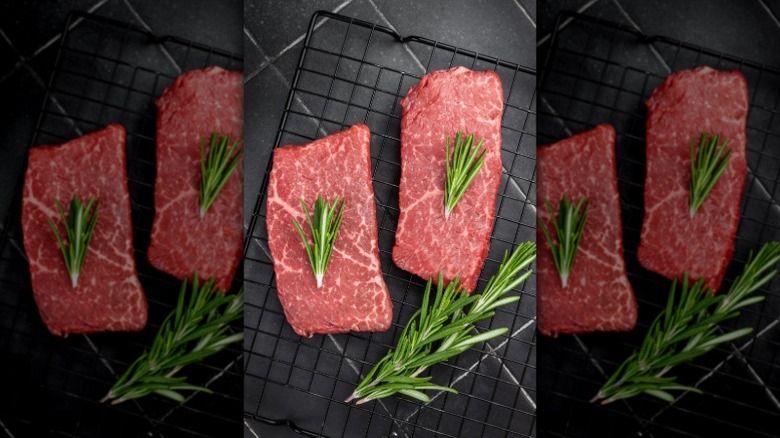
Draining your steak the right way involves more than just letting it sit on a sheet pan. Scott Thomas advised, "To really do it right, you need to use some sort of fabric to draw moisture out, and that fabric needs to be swapped out multiple times." For the fabric, he suggested using cheesecloth, although paper towels can work in a pinch. He's also not an advocate of letting the steak rest right on the pan. Instead, he says it should sit on a cooling rack and have the sheet pan situated beneath it to catch any drips that the cheesecloth doesn't catch. "We don't want the steak sitting on a flat surface and soaking in the liquid we are trying to remove," said Thomas. Since the cloth needs to be changed fairly frequently, too, this means you'll probably need to set a timer multiple times.
Many recipes, when suggesting a refrigerator rest, will tell you to do it overnight, a vague term that generally encompasses a time period ranging from eight to 12 hours. Thomas feels that this won't be enough to dry the steak completely, though. "I would do it for at least 24 hours so I can swap that cheesecloth many times as it gets saturated," he declared. As for how often you'll need to switch out the cloth covering, he recommends doing so every three to four hours. (Unless you're willing to get out of bed multiple times to do this, though, the overnight stretch may involve a longer stint for one wrap.)
You can skip this step after drying steak
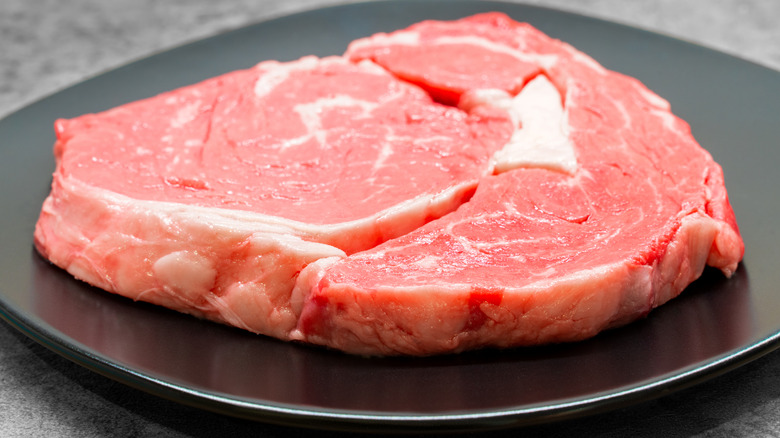
Once you've spent 24 hours painstakingly drying out your steak, you might think it will need another hour outside the fridge in order to reach room temperature. As a matter of fact, this is a myth that has been debunked by no lesser authority than J. Kenji López-Alt. He let a refrigerated steak sit out at an ambient temperature of 70 degrees Fahrenheit, and after about two hours, its internal temperature had risen from 38 to 49.6 degrees Fahrenheit. A little over 10 degrees is a mere drop in the bucket and nowhere near room temperature, so it's hardly worth the risk of exceeding that two-hour time limit of leaving food out in room temperature set by the USDA. If you actually want the steak to reach room temperature before cooking, it'll be a bacteria playground for sure.
Scott Thomas concurs with López-Alt's findings. He said, "Bringing the temp up slowly is a good idea, but letting the ambient temperature in a room do it is not. It's a much better option to do the reverse sear and slowly bring that temp up on the steak in a 250-degree Fahrenheit oven or smoker before searing it off."