

Yes, Some People Hate The Smell Of Bacon — Here's Why
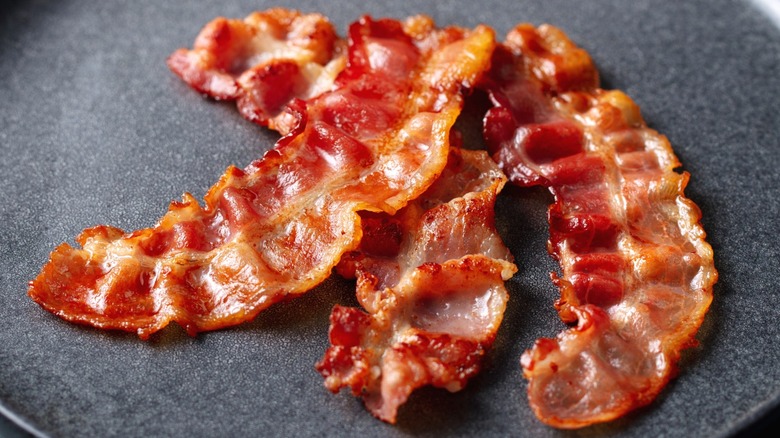
While it's true that the bacon craze of the early 2010s was a stealth marketing campaign from the pork industry, that doesn't mean bacon isn't seriously great. (Some might even say "epic" — ah, but the past is a foreign country, isn't it?) Few pleasures match waking up on a Sunday morning and catching a whiff of bacon being cooked in the kitchen downstairs as part of a classic American breakfast; it's enough to make you float down the stairs towards that crispy, salty manna from heaven. But did you know that there are some people who are downright repulsed by the smell of bacon? As with the cilantro-soap phenomenon, it all comes down to genetics.
A study by Duke University Medical Center scientists in conjunction with Norwegian pork scientists (which is apparently an actual career title) found that there is a gene linked to odor receptors for a chemical called androstenone, which is found in male pork meat (via Science Daily). 70% of people have two copies of this gene rather than one, which means they detect the smell of androstenone much more acutely than others. That doesn't mean seven out of 10 people retch from a single sniff of a Baconator — if that were true, the pork industry wouldn't be worth billions of dollars — but it does explain why some people are especially sensitive to the smell.
Culture plays a role in the foods we tolerate

But surely not everything comes down to genetics, right? After all, if you went back in time and gave a medieval peasant from England a bowl of George Harrison's spicy lentil soup seasoned with cilantro, they might find themselves overwhelmed by the taste even if they don't have the cilantro-soap gene. So it goes with bacon: Some people may or may not have the androstenone gene, but end up grossed out by the smell of bacon simply because they didn't grow up with it.
Linda Bartoshuk, a psychologist from the University of Florida, told the American Psychological Association that a lot of what we find pleasant in food depends on what we grew up eating. It stands to reason, then, that someone who didn't grow up with bacon — like someone who grew up Jewish or Muslim, both of which prohibit the consumption of pork — might be put off by what is objectively quite a strong smell. The aforementioned Duke scientists sought to explore the connection between culture and this distaste for pork by testing people from certain parts of the world, like the Middle East or the Arctic Circle, where eating pork is rare; we eagerly await their follow-up.