

What To Know Before Baking A Whole Wheat Sourdough Loaf
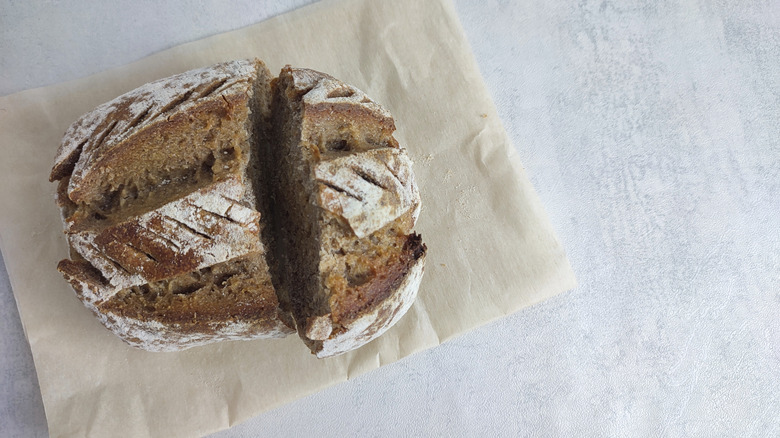
Did you start baking sourdough in 2020 as a pandemic baker? If you're still at it, congrats, since it's not the easiest to master, and it's common to make some of the biggest beginner mistakes. That includes making ingredient swaps without knowing what you're doing. For one thing, you can't just replace all of the bread flour in a recipe with whole wheat flour. Nathan Myhrvold, co-author of the cookbook "Modernist Bread at Home," told The Takeout the reason.
"Whole wheat flours behave differently than refined flours. The presence of bran and germ can affect a bread's volume and interfere with gluten development. As a result, 100% whole wheat flour breads [are] denser than breads made with refined white bread flour," he explained.
This isn't to say that you can't bake sourdough bread that's at least partly whole wheat. As Myhrvold advised, " ... If you enjoy the taste and texture of whole wheat flour and want to customize it, we recommend a ratio of 80% white wheat bread flour to 20% whole wheat flour." Whole wheat flour can also be used in sourdough starter, as long as it's not a high-gluten variety. Another option is to find a recipe for country-style sourdough bread that includes a smaller percentage of whole wheat flour in addition to a higher amount of bread flour. Even though it won't be the main flour, Myhrvold said, "Think of the second flour as something akin to a seasoning that allows you to get creative as a baker, with the bread flour forming a structural scaffolding."
Hydration must also be adjusted

One thing Nathan Myhrvold mentioned several times is that if you take an existing recipe and modify it by replacing some of the flour with whole wheat, the hydration will need to be adjusted. (This won't be true if you're working with a sourdough recipe that has been designed to include some whole wheat flour.) The hydration percentage is determined by dividing the weight of the water used in the dough by the weight of the flour and multiplying by 100.
As Myhrvold told The Takeout, "You have probably noticed that some bread recipes call for more water than others, even when they use the same amount of flour. If you substitute whole wheat flour for white flour, you'll need to add more water."
The cookbook author went on to explain, " ... some kinds of flour, such as whole wheat and rye, are 'thirstier' than other kinds — they need more water to reach full gluten development and to attain a palatable crumb texture. In whole wheat flour, the bran and germ soak up some of the water that you add, stealing it from the gluten." He feels that 65% to 85% is usually a good hydration range for sourdough, but advises going closer to the top end if you're planning on adding whole wheat flour to the mix.
The best way to proof sourdough bread
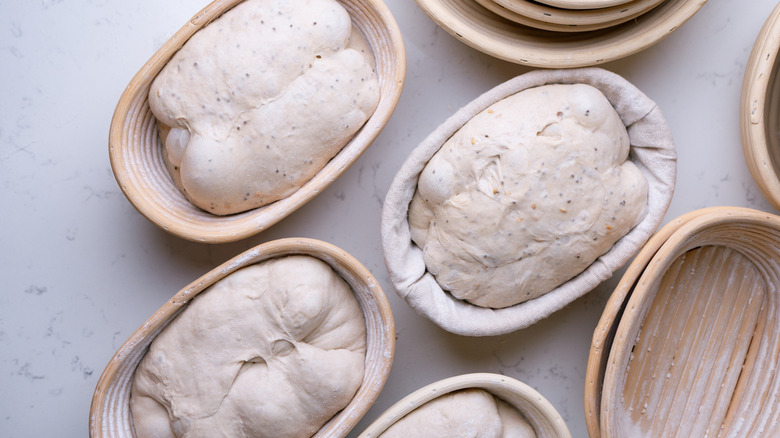
If you want your whole wheat sourdough loaf to come out looking all pretty and photogenic, you'll need to pay special attention to the proofing process. Nathan Myhrvold recommended cold-proofing the dough before baking to make "fermentation long and slow." He also noted it makes the dough easier to work with, as it will be firmer, making it easier to handle and score just before baking. On the contrary, sourdoughs and country breads proofed in warm environments are more challenging to score, as they "tend to be slacker."
His cold-proofing technique involves proofing the dough for 14 hours at a temperature of 55 degrees Fahrenheit. If, however, you don't have a wine fridge or another temperature-controlled environment and you're unwilling to shut off the furnace in winter, you do have another option. You can also refrigerate the dough for anywhere between 12 and 72 hours before baking it. This method, easy as it is, does come with a caveat. As Myhrvold cautioned, " ... keep in mind that the longer you cold-proof the dough, the more sour it will be."