

I Was A Fine Dining Server And This Is Why I (Almost) Never Get The Soup Of The Day
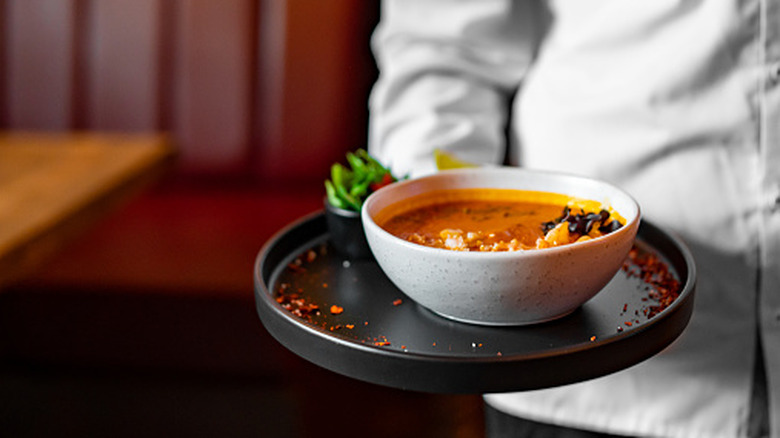
There's a time and a place for soup. Actually, there are many times and many places for soup: tomato soup from a tin topped with cheddar when you're broke and it's raining outside, pho at almost any Vietnamese hole-in-the-wall, and gruyère-and-mozzarella-topped French onion soup pretty much anywhere, and without exception. But I'll almost always pass on the soup of the day at a restaurant, because even in fancy establishments, it's designed to use up vegetables that have seen better days.
You don't have to trust just me on this, either. Sure, I've worked in a couple of nice restaurants and I write about food, but you don't know that much about me. So, how about listening to Gordon Ramsay instead? He doesn't like to order the soup of the day either. The grumpy gourmand, restaurateur, and TV personality also advises asking what the soup du jour (that's fine dining French for "soup of the day") was yesterday. And he's right — not only is soup used as an excuse to get rid of every vegetal odd and end in the kitchen, it's also regularly reheated and served two days in a row.
It's not just uncooked veg that hits the blender at the end of a restaurant's working week, either. Anything that changes on a menu might become soup, especially if it wasn't very popular. I would never bother a server by actually asking what the special was three days ago, and you probably shouldn't either. If you did, however, you might find that some of its elements are now floating around in the soup pot. For example, if the special on Saturday was chicken with crispy skin accompanied by sage butter-seared wild mushrooms, Sunday's soup might be buttery wild mushroom broth with sage, topped with chicken skin croutons.
The specials-to-soup pipeline most food service workers keep to themselves, and why it happens
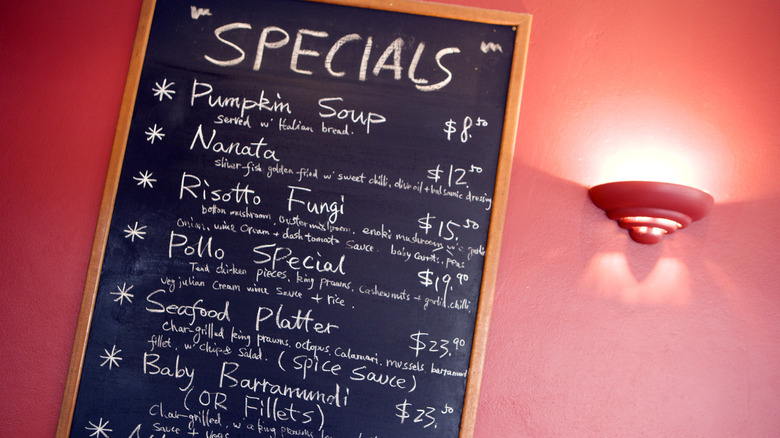
You can think of specials and soup as part of a pipeline. The specifics vary by restaurant, but any ingredient in excess ends up in a special, in staff meals, and then in the soup. The restaurant may even try to palm off the soup as a staff meal, especially if it's tightfisted.
There are a few reasons a restaurant might have a glut of vegetables, and none are red flags. Spinach might be very affordable because it's in season, or another restaurant may have suddenly stopped ordering heritage carrots, changed suppliers, or shuttered, leaving the green grocer to get rid of the colorful roots at a discount.
But there are also slow weeks, miscalculations regarding customer tastes, cancellations, or unpredictable external factors, like a sudden change in weather that has everyone ordering salads instead of beef wellington. Whatever the reason for excess ingredients, though, they will make their way to the specials board and then the soup of the day.
This cycle is part of the reason most chefs don't order specials at a restaurant, and for Mr. Ramsey's and my soup rule. However, it shouldn't put you off if something that looks good or is a particular favorite, as the soup of the day will never be made from food that has actually gone bad. There are strict hygiene rules in kitchens, including controlling temperatures and tracking the date when ingredients are delivered and then cooked. Even I'm probably not passing up a French onion soup, especially if it looks rich and gooey and smells delicious.