

Why Wintergreen Life Savers Spark In Your Mouth, According To Science

In many senses, Wint-O-Green Life Savers are pretty boring, especially compared to bolder sweets like stinging sour candies. However, the refreshing circular mints are also quite literally the flashiest candy around, thanks to a curious phenomenon: when you bite on a wintergreen-flavored Life Saver, the candy emits a clearly visible spark in your mouth. It seems magical, but just like why cookies and milk are the best pairing and why grapes ignite in the microwave, this astonishing occurrence has a fascinating (and totally logical) scientific explanation.
Basically, the friction produced by biting into a hard Life Saver creates something called triboluminescence. This is essentially the same process that creates lightning, but on a much smaller scale. Any friction-producing activity — ripping off a piece of tape, tearing open a package of your favorite new snack, or crushing a sugar cube — emits a small amount of triboluminescence. This tiny spark usually goes unnoticed because it's largely ultraviolet light, which isn't visible to the human eye.
However, in the case of Wint-O-Green Life Savers, the glow is especially notable because the refreshing mints contain methyl salicylate (aka wintergreen oil). This fluorescent flavoring absorbs the ultraviolet light and turns it into visible blue light, allowing candy chewers to see tiny sparks in their mouths.
How to safely see sparks in your mouth with Wint-O-Green Life Savers
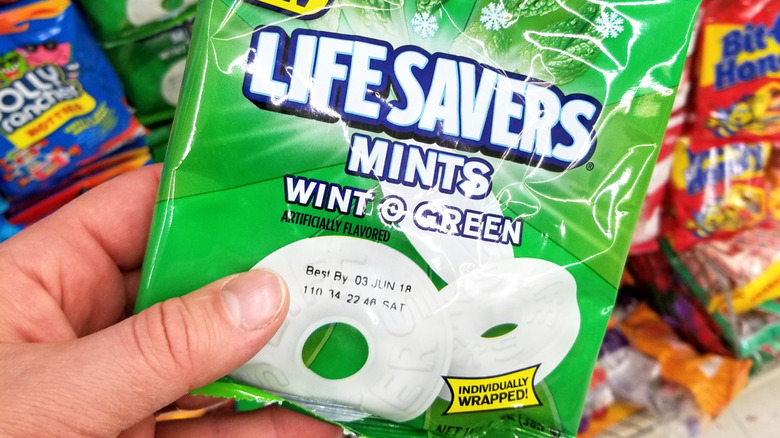
To see this flamboyant food phenomenon for yourself, all you need is a Wint-O-Green Life Saver, a dark room, and a mirror. After letting your eyes adjust to the dark, bite into the Life Saver. Chew the candy with your mouth open (we'll excuse this extremely annoying food habit just this once, for science). As you chew, you should see what appears to be tiny sparks in your mouth.
You can also crush the candy with pliers for the same effect, but quite frankly, the chewing method is much more fun. These sparks are essentially extremely tiny lightning, but don't worry, you won't get burned — if anything, you'll be left with a cool and refreshed feeling from the wintergreen flavoring.
This flashy food experiment might leave you wondering, what exactly is wintergreen? In modern American English, wintergreen typically refers to a shrub-like plant called gaultheria procumbens, which contains an organic compound called methyl salicylate. This sweet, minty chemical, also known as wintergreen oil, is often used in pain-relieving creams, mouthwash, and, of course, for flavoring Wint-O-Green Life Savers. It's worth noting that methyl salicylate can be toxic in large doses, but you'd have to consume a truly astonishing amount of Wint-O-Green Life Savers before experiencing any negative effects.