

If You Do This At A Diner, Expect Your Server To Give You The Side Eye
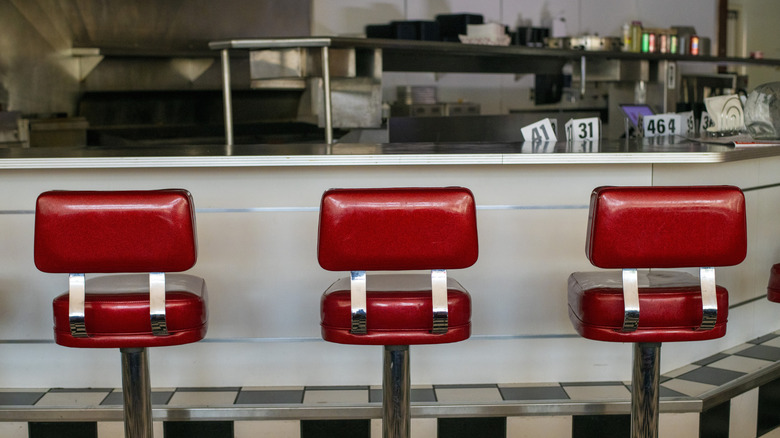
It's hard to go wrong with a hearty meal at a classic American diner — the kind with a multi-page menu, the best pancakes around, and impossibly perfect fried eggs. However, it's best to avoid one seemingly innocent diner etiquette blunder that will have you on your server's bad side in short order: attempting to use old-school diner lingo. This complex, cryptic, and totally delightful slang system was popular in American diners throughout the early 20th century, particularly from the 1920s to the 1970s. The lexicon includes linguistic gems like "burn the British" (a toasted English muffin) and "elephant dandruff" (perhaps the most imaginative way to refer to cornflakes). However, while learning diner lingo is a highly recommendable and thoroughly entertaining pastime, actually using it in a modern-day diner is not so practical.
The primary reason not to use old-school diner lingo is that it's, well, old-school. It's not the 1950s anymore, and it's unreasonable to expect a modern-day diner worker to understand arcane slang from decades past. Employees have enough on their plates without trying to interpret wonderfully creative phrases like "Eve with a moldy lid" (apple pie with cheese, the dessert combo that divides our nation). In other words, while it's understandably tempting to test out these fabulous phrases in real life, it's best to keep the diner lingo to yourself.
Other reasons not to order with diner lingo
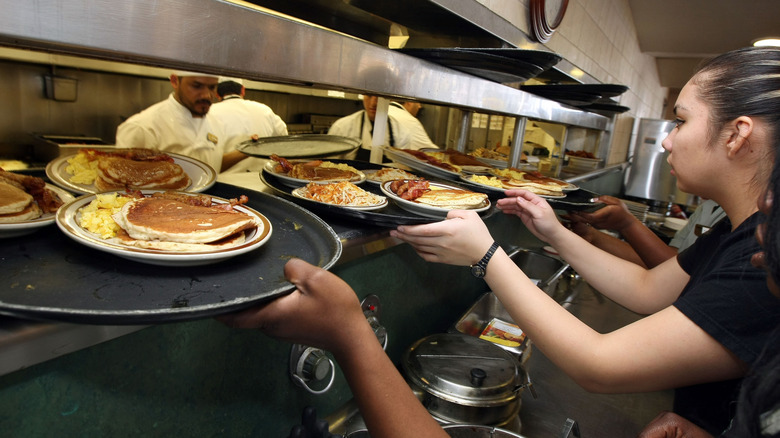
Even if you could travel back in time to the 1950s and visit a classic American eatery in the heyday of diner lingo, it still might not be advisable to try to order with the secretive slang. For one thing, even when diner lingo was in its prime, it was generally used more between staff than by customers. Additionally, diner lingo varies widely by region, and some terms are so localized that they might only have ever been understood by a handful of people. This is part of what makes the lingo so delightfully unique, but it also means it's rather impractical in most real-life ordering situations.
While diner lingo has largely fallen out of use (unfortunately, saying "dough well done with cow to cover" when you mean buttered toast is hardly efficient), some of the most practical and popular terms have stuck around. For example, eggs "over easy" and burgers "with the works" started out as diner lingo and are now almost universally understood in restaurants across the country. That said, attempting to order "Adam and Eve on a raft and wreck 'em" when you want toast with scrambled eggs probably isn't going to make you look cool, and likely will only get you a confused and annoyed look (especially if your server can dish out a Gen Z stare). If you're looking for more practical ways to upgrade your ordering game, check out these diner foods to order and avoid.