

Find The Best Wine On A Budget By Looking For These Label Signs

For years I assumed there were only two ways to identify a good wine without opening up the bottle. Either you could have an encyclopedic knowledge of regions, vintages, and varieties or you could rely on other people's opinions. I spent a lot of time clogging up the wine aisle at Kroger sifting through reviews on my phone. Turns out, there's a better way. There's a lot you can learn from a wine label even if you don't know the difference between Burgundy and Bordeaux. The Takeout talked to Kinga Mackowiak, director of food and beverage at Hyatt Centric Downtown Denver, to learn more.
According to Mackowiak, information is key. "When it comes to wine labels, the more specific, the better," she says. "A vintage listed on the label is usually the first good sign." Often, the vintage itself is less important than the fact that the wine has a vintage; specifics are a good sign. That specificity, Mackowiak explains, applies to the region, too. "A wine labeled simply as California is generally going to be lower quality than one labeled Alexander Valley, Sonoma."
Some countries label wines to guarantee quality and authenticity. Wine classifications can seem almost as confusing as memorizing vintages and regions, but once you start to understand the system they can make it easier to pick the perfect bottle. Mackowiak warns against relying too heavily on classifications, though. "When picking out wines on a budget, it's usually smarter not to chase those classifications," she says.
Label designations can help or hinder your wine hunt
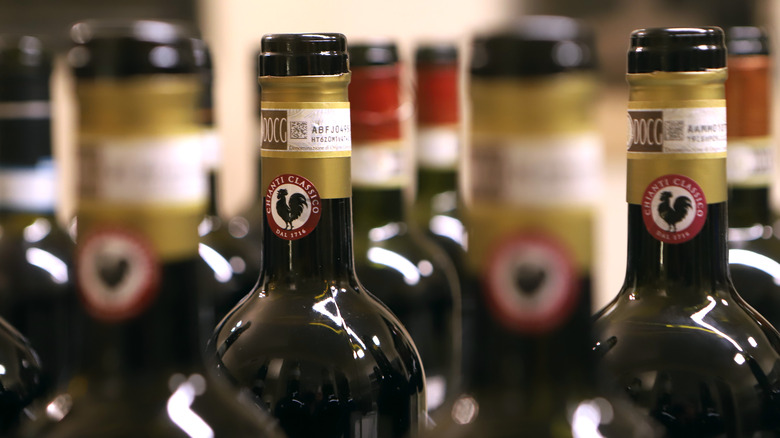
Different countries have different rules when it comes to wine classifications. French wines are regulated under the AOP (Appellation d'Origine Protégée) system. Italian wines use a similar system, inspired by the French. These designations appear on the label or as a slim paper collar around the neck of the wine bottle.
Indicazione Geografica Tipica, or IGT, marks standard Italian wines grown and produced with minimal regulations. Wines marked with Denominazione di Origine Controllata, or DOC, have stricter rules. The highest level, Denominazione di Origine Controllata e Garantita, or DOCG, represents DOC wines that have been selected for their exceptional quality. Yes, the Italian government employs wine taste testers.
"Label designations such as DOC, DOCG, or AOP are also useful indicators, often signaling a certain level of quality with European Union regulations," says Mackowiak. "With that said, they come with very strict rules." Those rules come at a price for producers, she explains; and, in turn, for customers. "A DOCG wine often carries a higher price point, not necessarily because it is better, but because achieving DOCG status requires specific grapes, techniques, and aging standards," she says. "Some of the best values come from producers who are capable of making DOCG wines but choose to bottle certain wines outside those regulations, often as side projects." Avoid obvious signs of low-quality wine, look for label specifics, and don't worry too much about designations. You should be good to go.