

Food In Federal Prisons Isn't Just Bad, Sometimes It's Dangerous — Here's Why
We may receive a commission on purchases made from links.
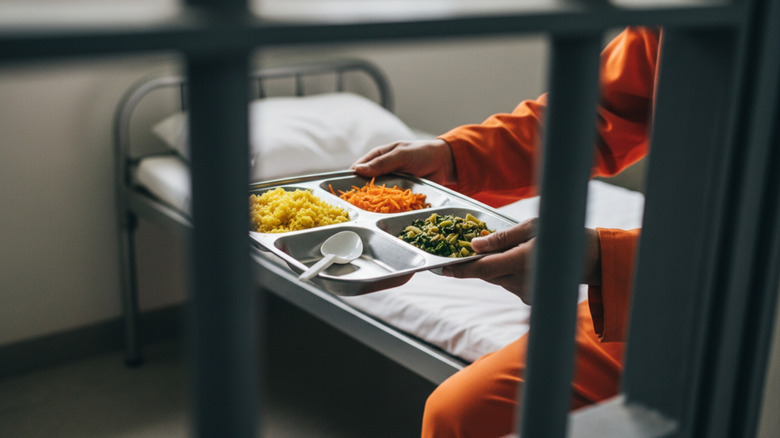
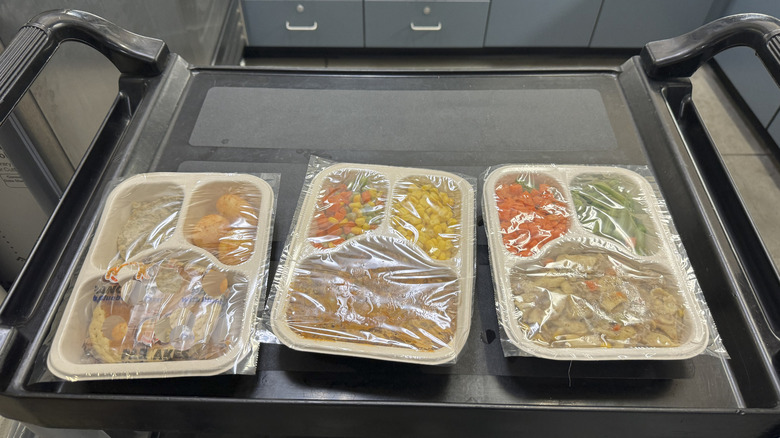
You'd be naive to think that food in federal or state prison is up to par with a gourmet meal by Bobby Flay. Honestly, you'd be naive to think the food is even slightly enjoyable. Food in prison is used to further punish inmates, lacking both nutrition and basic moral decency. Cell phone images smuggled out of American correctional facilities showcase the food being served in chow halls barely looks edible. This presents a slew of health risks for incarcerated individuals.
In 2020, Impact Justice conducted a study of food in American prisons. The study produced many unfortunate statistics, like 62% of inmates stating they rarely (if ever) were given fresh vegetables and 94% saying they did not receive enough food to feel full. The report additionally found that, on average, American prisons spend $3 per day on food per inmate. The food prisoners did receive was of the poorest quality. A 2021 federal lawsuit from Mississippi alleged food was "spoiled, rotten, molded, or uncooked" and contaminated with rat, bird, and insect feces. Shockingly, formerly incarcerated individuals reported seeing "not for human consumption" labels on food boxes. These boxes contained "chicken" as well as "deli meats" such as bologna, ham, and salami.
Exploring prisoners' health conditions, the U.S. Department of Justice has revealed 44% of incarcerated individuals experience chronic health issues (compared to 31% of the general public) and are 150% more likely to develop conditions like diabetes, asthma, and hypertension as well as hearing, visionary, cognitive, and ambulatory disabilities. Prison cookbooks give outsiders a microscopic glimpse into prison food, yet these cookbooks don't capture the emotional hardship that comes with this consumption.
Prison cookbooks highlight how survival of the fittest means those who have money for commissary
Prison cookbooks have burgeoned from intrigue about prison life. Popular prison cookbooks include Albert "Prodigy" Johnson's "Commissary Kitchen" and Wisconsin Books to Prisoners' "Canteen Cuisine." Although written by different people who shared different experiences behind bars, these books display creativity at its finest and how food persists as a source of light in the darkest of places.
Prisoners gather food from the life preserver that is the commissary (aka the canteen). The commissary offers food to prisoners we on the outside would purchase in grocery stores — think ramen, snack cakes, and chips. Because inmates make less than $1 per hour, unless you have support from the outside the commissary is often unattainable. Even if one is able to purchase a pack of ramen noodles, a typical bowl of ramen comes with over 1,500 grams of sodium, which only exacerbates the rampant health issues found in correctional facilities. Nevertheless, the Prison Policy Initiative found that inmates spend $947 per year at the commissary. Prison food suppliers, like Aramark, supply both chow hall food and commissary food across multiple prisons, thus incentivizing the suppliers to drive commissary sales by providing low-quality food elsewhere.
An excerpt from Johnson beautifully captures the intention of prison cookbooks: "This book won't make you a better cook, but it might make you a better person. Because in a world where prisoners are treated like animals, we made our experiences there feel more human by how we prepared our food." For the inmates, these books reflect what's needed for survival which comes in physical and emotional forms.