

How The Michelin Guide Rates Restaurants Around The World

Michelin stars are coveted, but the hows and whys of awarding them aren't widely understood — even Anthony Bourdain thought the Michelin star system was unclear. What we do know is that Michelin, the tire company that created the highest honor a restaurant can have, employs anonymous inspectors who could turn up at a restaurant at almost any time.
While no one but (maybe) Michelin's anonymous inspectors completely understands the intricacies of the Michelin rating system, the criteria the company's inspectors use to assess restaurants around the world are public. According to Michelin's website, there are five criteria: quality of products, mastery of flavor and cooking techniques, the personality of the chef represented in the dining experience, harmony of the flavors, and consistency between visits.
Some of these are easier to understand than others, and all invite some interpretation. That means the expertise of inspectors is important. All Michelin inspectors are experts in food and the hospitality industry and undergo nine to 18 months of training with more experienced colleagues before they can work alone. With that in mind, the rubric makes more sense. Its simplicity allows inspectors to evaluate food across a variety of cuisines, dining styles, and prices during the 250 to 300 anonymous restaurant visits they make annually.
When they're on the clock, inspectors give establishments false names, pay their own bills, and attempt to stay inconspicuous, seeking the same customer experience as everyone else. It's important to note that accolades aren't awarded on the back of a single inspector's opinion. Instead, those who have eaten at the establishment in the last year collaborate on their decisions in what they describe as a "collegial process" (via Forbes).
Understanding the Michelin Star criteria
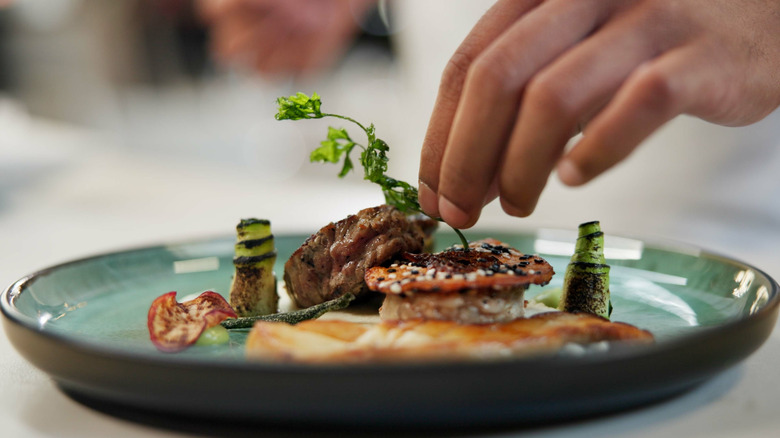
The most intriguing of the Michelin Guide's criteria for restaurants is probably "the personality and emotion that the chef conveys in the dishes." Often discussed in industry publications, this generally means the head chef's culinary point of view and their reputation will be taken into account by inspectors and that the style and vision of the restaurant are important. A Michelin contender perhaps has a chef that creates refined takes on a rustic cuisine they know well or uses heritage ingredients in innovative ways.
Other criteria that seem simple may not be. Mastery of flavor and ingredients relies on the inspectors' knowledge of how food and ingredients should look and taste, for example. This is why inspectors are trained both in their local market and across other cuisines. Additionally, experts in a cuisine are sometimes asked to travel, so an inspector based in Japan may visit an izakaya spot in London. Then there's the quality of products. This doesn't necessarily mean a menu full of truffle, gold leaf, and caviar is necessary — paying as much attention to sourcing high-quality spices and local, seasonal greens as sourcing wagyu beef might just impress the eagle eye of a Michelin inspector more.
Restaurants have to keep these exacting standards up, too, as Michelin scores on consistency. For establishments that have earned stars, this can be a stumbling block. Restauranteurs sometimes fear losing a Michelin star, which may be justified. Inspectors visit multiple times in a year for both new establishments and previous awardees — two- and three-star restaurants may get additional visits from inspectors, including those traveling experts.
Beyond the Michelin Star system
On top of stars, Michelin gives covers, which are represented in the guide by crossed knives and forks. Stars are awarded for food only, while covers are given for service, decor, and atmosphere on a scale of one to five. It's unclear exactly how these are decided upon and whether inspectors offer an opinion on other aspects of hospitality, but we do know that covers are considered separately. Plenty of taco spots and hole-in-the-wall noodle bars have a star, and, theoretically, a pricey restaurant with excellent food could be awarded a star despite uncomfortable chairs and strange decor choices.
Then, there's the Bib Gourmand. This Michelin honor was introduced in 1997 and named for Bibendum, the Michelin Man. When a restaurant gets a Bib Gourmand, it means that there is a balance between quality and value. These places serve great food at prices that Michelin deems affordable, with that price threshold varying by location.
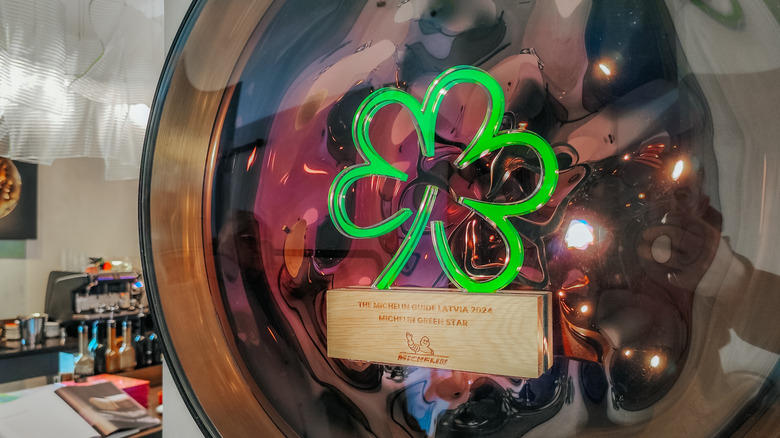
Michelin also hands out a Green Star. This is given to restaurants that are leaders in sustainability. This designation doesn't replace others, so a business with a Bib Gourmand or one or more stars can also hold a Green Star. For a brief time, Michelin awarded Plates to restaurants that "simply serve good food." It seems this has been replaced by calling all restaurants included in the Guide sans Star or Bib "Michelin Recommended."