

Chicken Breasts Have Never Been Juicier Thanks To The Simple 3-2-1 Rule
We may receive a commission on purchases made from links.
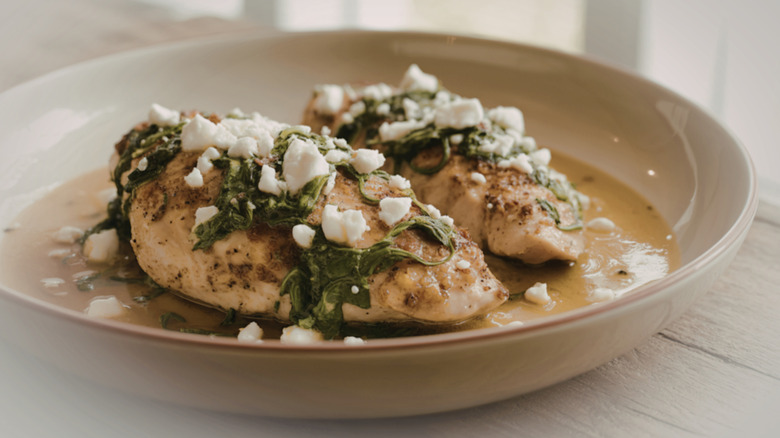
A lot of food writing these days seems to tout the idea that dark meat is the superior chicken, but the main advantage seems to lie in the fact that it's fattier and less prone to drying out. While dark meat tastes different, it doesn't necessarily mean it's better – white meat is lower in both fat and calories, and many actually prefer the flavor as long as it's still juicy. Recipe creator Emmy Clinton of Entirely Emmy has a trick to help ensure juicy chicken breasts.
It's called the 3-2-1 method, in which chicken breasts are seared at medium-high heat for three minutes to lock in the juices, steamed at medium-low heat for two minutes to cook through, and rested for one minute to allow the juices to redistribute. "Chicken breast can dry out very easily, so cooking it in three phases: searing, steaming, and resting, will help keep your chicken breast beautifully tender if done correctly," Clinton explained.
The precise timing of the technique will also help you to keep a close eye on the chicken, which cooks from the outside in, so that it won't overcook. "The key to achieving juicy chicken breasts comes down to two things: not overcooking the meat and allowing [it] to rest. The 3-2-1 method does both of these things and then some," said Clinton.
How to employ the 3-2-1 method
Emmy Clinton says she likes to start by marinating chicken for at least 30 minutes before cooking it. She'll use a marinade with lemon juice since the acid in it can help tenderize the meat and let the other seasonings permeate into the meat. Though she advised patting the chicken dry before cooking, as it's "very important to achieve a good sear."
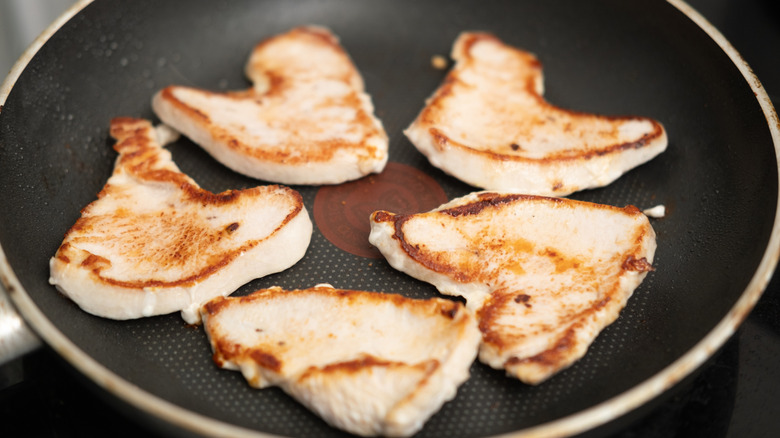
The next step is to heat a small amount of oil in a pan until the surface is shimmering. At that point, the seasoned chicken breasts can go into the pan, but with space between each. Without moving the chicken, let one side sear for three minutes until a nice golden crust forms. Then, do the same for the other side. After this comes the steaming — reduce the heat to medium-low, then add ¼ cup of water or broth to the pan. Put a lid on it and let the chicken steam for roughly two minutes, until it reaches an internal temperature of 165 F.
As a final step, remove the cooked chicken from the pan and let it rest for at least one minute. During this last step, Clinton said, "The resting period is so important because all of the juices migrate to the edges of the meat while cooking, and the rest allows them to ever redistribute throughout. It also keeps more moisture inside the chicken instead of on the cutting board when you go to cut the chicken breast."
How to utilize the 3-2-1 method if you're not pan-frying
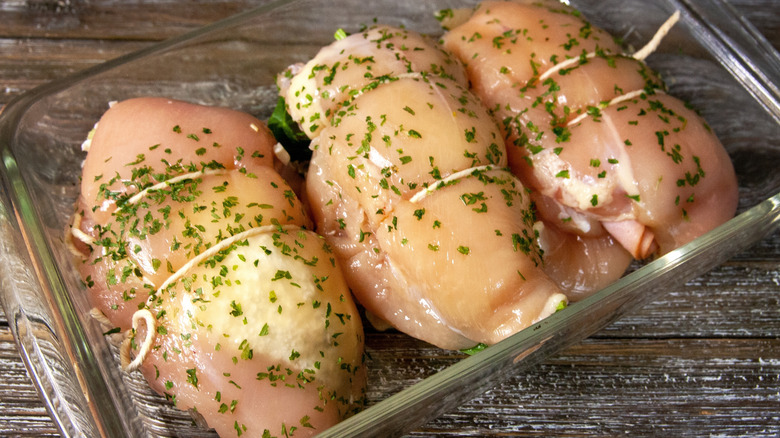
Can you still use the 3-2-1 method if you're deep-frying instead of pan-frying? What about baking chicken in an oven or air fryer? Emmy Clinton assured us, "You may need to play with the timing depending on the thickness of the chicken breast, but the 3-2-1 method will work across techniques." Even though the actual three-two-one minute aspect may be lost and steaming won't necessarily play a part, the general concept of starting at high heat, finishing at a lower heat, then resting still holds true.
Clinton advised deep-frying breaded chicken in hot oil on one side until crispy, then lowering the temperature so the chicken can cook more slowly on the other side. The chicken must then rest on a paper towel-lined plate so the paper can soak up excess grease as the juices recirculate.
If you're cooking chicken breasts in an air fryer, your method may look more like 8-4-1: Eight minutes of cooking at 400 F to crisp up the outside, four minutes at 350 F to cook the inside, and a minute of rest. Should you be baking in a standard oven, your chicken will need longer to cook, as it typically takes 30 minutes at 350 degrees Fahrenheit or 15 minutes at 450 degrees Fahrenheit to reach that USDA-approved safe internal temperature of 165 degrees Fahrenheit. Eight minutes at 450 F followed by 15 at 350 F might do the trick, but as with all chicken cooking methods, a good meat thermometer, like the ThermoPro digital instant-read meat thermometer, is your best friend.